

INSIDE:
Community
Calendar
50
Mazel
Toy!
51
Denial slows e ort at teaching
young people about ravages of
HIV and AIDS.
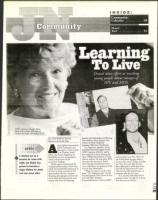
MJAC volunteer educator Sylvia
Block with a _photo of her late son
Nathan, also right who died of:AIDS.
JILL DAVIDSON SKLAR
Special to the Jewish News
Mg,“Ecila
V
.
4P
M
Ng .0 .0-1
t 4
a
r
e
EN
ela
It started out as a
service for Jews with
AIDS, but MJAC has
grown to become a
major lifeline for Jews
and non-Jews alike.
s the Eighth International
AIDS Conference was
drawing to a close on July
15 in Durban, South
Africa, Dr. Burton Fogelman of
Southfield was not as surprised as
others to hear some of the
researchers' findings.
Media reports underscored the
widespread destruction of the virus,
which has lowered life expectancy to
30 years in some countries in the
impoverished African continent.
Shocking photographs and live tele-
vision feeds documented the virus'
impact with shots of withering
patients and orphanages overflowing
with children whose parents were
victims of AIDS (Acquired
Immuno-Deficiency Syndrome).
Dr. Fogelman, president of the
Southfield-based Michigan Jewish
AIDS Coalition (MJAC), said he
isn't surprised at those denying the
virus' widespread existence in many
African nations. He and other AIDS
educators also encounter denial
when they go into Detroit's inner
city to talk about the presence of the
virus in that community.
"When we come in to do a pro-
gram," Dr. Fogelman said, "we ask
the participants if they know of any-
one with HIV (Human
Immunodeficiency Virus) or AIDS,
and everyone says, 'No.' Then we
ask if they know any gay men or
anyone who uses IV drugs, and they
say, 'No.' It is only after we have
been talking for a while that some-
one will say they know of a man
who has sex with another man, or
someone who has the virus.
"It is not that they didn't know
anyone at first," he said. "It is more
that they were in denial."
1
20 0
7/28
37