

and the Palestinians committed themselves to con-
tinue seeking a peace accord.
September Date
Pressure is likely to build, observers Anoted, with the
approach of the Sept. 13 deadline the two sides had
agreed on for reaching a final agreement.
Barak reiterated his long-standing warning that if
Arafat goes ahead with a unilateral declaration of
statehood if there is no agreement by Sept.13, Israel
would respond with unilateral steps of its own. This
has previously been taken to mean that Israel would
annex settlements in the West Bank.
The future that Barak was not willing to com-
ment on, however, was his political one.
Barak was elected last year on a platform of ending
the Arab-Israeli conflict. He found himself on the eve
of Camp David without a parliamentary majority.
Three political parties walked out of the government in
protest against the negotiations with the Palestinians
and concessions they presumed Barak would make.
At the news conference, Barak sought to deflect
questions on his next political steps.
"I would not take such a daring step as forming a
national unity government without consulting" the
media, Barak said, trying to brush off the question. "We
will consider on our return to Israel what is right to do."
But despite Barak's efforts to skirt the question in the
public arena, Israel's political sphere was already posi-
tioning itself for the anticipated new political reality.
Yisrael B'Aliyah leader Natan Sharansky, who pulled
out of Barak's coalition before the start of the Camp
David summit, said he would back a unity government.
But legislator Silvan Shalom of Likud said there
was no basis for such a government.
`'The thing for Prime Minister Barak to do now is
to go toward new elections," Shalom told Israel
Radio. "I must say to Barak's credit that he knew the
price of peace, and stopped."
Arab Reaction
Meanwhile, there is concern about how the sum-
mit's failure will play among Palestinians.
For weeks, observers have warned that its failure
could lead to an outbreak of violence in the West
Bank and Gaza Strip.
The Israel Defense Force's chief of staff, Lt. Gen.
Shaul Mofaz, said July 25 the army was prepared for
anything.
Israeli media reported after the summit collapsed
that Mofaz had assessed the situation and there did
not appear to be any immediate need to beef up
forces in the Palestinian territories.
Shortly after the suspension of the summit,
Hamas, the militant Islamic movement, called on
Arafat to return to armed struggle against Israel.
"The solution now is that Mr. Arafat and the
negotiators declare the failure and futility of the
entire peace process and return to the path of resis-
tance and jihad," or holy war, senior Hamas official
Abdel Aziz Rantissi told reporters.
"I renew my request to give Hamas a five-year
chance to work its jihad [Islamic holy war] and
resistance. Within five years, Hamas will be able
to achieve the gradual liberation.of all of
Palestine," he said. ❑
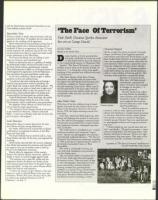
`The Face Of Terrorism'
Oak Park's Deanna Sperka showcases
her art. at Camp David.
SUSAN TAWIL
Pyramid Shaped
Special to the Jewish News
Sperka arranges the photos in groups of triangle
shapes, reminiscent of the Egyptian pyramids
eanna Sperka, a Jewish grandmother
some believe were built with Jewish blood, or, per-
and artist, exhibited her work last week
haps, broken Stars of David. In previous installa-
on the demonstration grounds adjacent
tions, she accompanied the photos with other cre-
to the Camp David summit in Thurrnont, Md.
ative element& Video monitors played the inter-
Sperka's The Face of Terrorism," is a visual
views she conducted with the victims' families.
attempt to give voice to the horror of Arab ter-
In the past, a minyan of 10 shtenders (yeshiva
rorist acts — to bring the viewer to an under-
study hall lecterns) was placed beside the photo
standing of the personal loss suffered with each
walls to evoke a feeling of holiness and loss. The
act of terrorism.
shtenders held scrapbooks compiled by family
Meir Inclor, director of the Terror Victims
members of terrorist victims.
Association, was familiar with the artist's work-
More than 100 black-stained
in-progress. He called Sperka from Jerusalem and
cinderblocks, engraved with
invited her to display her "artistic statement' ' in
names of victims, were arranged
the park bordering Camp David. While none of
in triangles on the floor — a
the principal players in the peace talks visited the
memorial graveyard.
demonstration grounds, Sperka's exhibit attracted
Because Sperka took a plane
considerable media attention, and that, she says,
to Camp David, the shtenders,
was her purpose.
video monitors and cinderblocks
remained at home. The photos
and
scrapbooks that accompa-
Idea Didn't Fade
nied
her filled two trunks weigh-
With three of her five children living in Israel,
Deanna Sperka
ing
70
pounds each.
Sperka conceived the idea while an artist in res-
Since
the exhibition area was
idence at the Jerusalem Center for the Visual
outdoors,
with
no
walls,
Sperka
laminated the
Arts in 1992; she began amassing material two
photos and laid them in triangle-shaped groupings
years later.
on the lawn; 244 of the terrorist victims' photos
Since then, Sperka has filled huge boxes with
were joined in strips on a section of dead grass.
photos and clippings that pertain to Arab terror-
Another group of victims' faces was superimposed
ism. She collected photographs, memorial books
on photographs of leaves and hung on surround-
and personal memorabilia from victims' families
ing trees.
and conducted extensive, videotaped interviews
"I know people are very moved when they see
with 22 families.
this,"
says Sperka. "My goal is awareness — inno-
The work's genre is "installation art," a multi-
cents are being killed, and still being killed. Their
media environment with emotional "experi-
families will never be the same. They're not right-
ences." Sperka uses photographs, documentary
wing fanatics, they want peace. They want to live
materials and sculptural elements. The Face of
normal lives just like everybody everywhere." ❑
Terrorise has had previous showings, including
in 1996 at the Janice Charach Epstein Gallery at
A portion of "The Face of Terrorism" installation in
the Jewish Community Center in West
the park bordering Camp David
Bloomfield.
Her work is continually evolving, she
says, with each installation constructed to
suit the display space.
The core of her exhibit is hundreds of 8-
by 10-inch, black-and-white photographs
of terrorist victims. There are scores of larg-
er color photographs, depicting harrowing
scenes connected to terrorist episodes: a
burning, bombed bus; grieving family
members at a funeral service; chevra kadisha
(burial society) workers collecting strewn
body parts; bloodied children; knife-wield-
ing Hamas terrorists attacking a civilian.
,
7/28
2000
25