

On The Bookshelf
CONEY ISLAND
Greek and American Cuisine
OPEN 7 DAYS A WEEK
In "Half-Jew," a Michigan native shares the emotional legacy left to children
when one parent's origins are treated as a shameful secret.
154 S. Woodward, Birmingham
(248) 540-8780
Halsted Village
(37580 W. 12 Mile Rd.)
Farmington Hills
(248) 553-2360
SUZANNE CHESSLER
Special to The Jewish News
S
6527 Telegraph Rd.
Corner of Maple (15 Mile)
Bloomfield Township
(248) 646-8568
4763 Haggerty Rd. at Pontiac Trail
West Wind Village Shopping Center
West Bloomfield
(248) 669-2295
841 East Big Beaver, Troy
(248) 680-0094
SOUTHFIELD SOUVLAKI
CONEY ISLAND
Nine Mile & Greenfield
15647 West Nine Mile, Southfield
(248) 569-5229
FARMINGTON SOUVLAKI
CONEY ISLAND
Between 13 & 14 on
Orchard Lake Road
30985 Orchard Lake Rd.
Farmington Hills
(248) 626-9732
UPTOWN PARTHENON
4301 Orchard Lake Rd.
West Bloomfield
(248) 538-6000
HERCULES.FAMILY RESTAURANT
33292 West 12 Mile
Farmington Hills
(248) 489-9777
Serving whitefish, lamb shank,
pastitsio and moussaka
111
I
I
I
I
7/21
000
80
mom
JININ
111Pm
mwm mom
WI
Receive
Reclaiming The Past
mom Imo
111
othfil
Entire Bill
not to go with any other offer
with coupon
Expires 12130/2000
mai wm mu um
I
Okemos, realized that the strict dictates
of that instruction were not for her
before she realized the facts of her reli-
gious heritage. Her father would tell her
later that he didn't want to put hurdles
in her path; he didn't want her to
believe she couldn't achieve her dreams
because she was Jewish.
After graduating from Michigan
State University in 1965 and working
part time for the Free Press, Jacoby
applied for a full-time position at the
Detroit newspaper. Told that women
would be assigned to the "society"
pages, Jacoby looked elsewhere and
became a national education writer for
the Washington Post.
After marrying Anthony Astrachan, a
Jewish journalist assigned to Moscow,
she took a leave from work, although
she still did some articles while getting
started on her first book, Moscow
usan Jacoby, growing up
in Okemos, Mich., outside
Lansing, sensed untold
secrets pulsating through-
out her home, and she set out to
reveal them. That quest and its
impact on her intellect, emotions
and relationships fill the pages of
Half-Jew (Scribner; $25).
The author's fifth book recounts
her years raised by practicing
Catholic parents and the time after
as she discovered that her father's
family was hiding its Jewish her-
itage. On a mission to learn her
genealogy, she also brought to light
the gambling compulsion that
compromised the successes of her
relatives.
Conversations.
While Jacoby's experiences cer-
When Jacoby returned to the
tainly are highly personal, they have
United States, she continued freelanc-
broader appeal than what is unrav-
ing for newspapers and magazines and
eled by most people tracing their
moved on to her other books. In the
roots. That's because the Jewish side
1970s, women's issues dominated her
of her family includes individuals
writing interests.
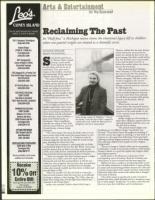
who achieved a level of celebrity — Susan Jacoby, author of "Half-Jew": "One of
Jacoby, caught up with touring to
great-uncle Harold Jacoby, an
the reasons I used the title is that I wanted to
speak
about Half-Jew, explains how her
astronomer whose constellation
reclaim that term, which has been used in a
upbringing
helped mold her into a sec-
map fills the ceiling of New York's
derogatory sense by so many people."
ular Jew and an atheist.
Grand Central Terminal, and uncle
"My attitude toward religion and
Oswald Jacoby, a famous bridge
Jewishness are two different things," says Jacoby, now
champion.
divorced. "If my family history has taught me anything, if
"One of the things I like about this book is that it re-cre-
the 20th century has taught us anything, it is that there is an
ates a period which really seems like ancient history to a lot
existence as a Jew apart from believing in God, apart from
of Jews under 40," says Jacoby, 55. A freelance writer for
adhering to Jewish religious practices. It is one of the things
national magazines, she also has worked for several newspa-
that make Jews different from people [of other religious
pers, including the Detroit Free Press.
backgrounds].
"My book was an attempt to understand why my father
"You are no longer a Catholic when you do not practice
and his family behaved the way they did. When I was young
Catholicism. I would never describe myself as a half-Catholic
and first learned that my father was a Jew, it was the late
because Catholic is a word that implies only religious belief
1960s, and I really did not understand the kinds of pressures
and religious practice."
that existed for previous generations of Jews in America.
Jacoby points to the Holocaust as illustrative of the
"I knew, for example, that there had been quotas in higher
encompassing
nature of Judaism. Both the Orthodox and
education, but it didn't come alive until I went to
those
known
to
have converted met the same tragic fate.
Dartmouth and read that correspondence. It told the atti-
Half-Jew has been a catalyst to introducing Jacoby to oth-
tudes Jews were up against, how pervasive they were and how
ers who define themselves as half-Jewish for a variety of fami-
socially accepted they were. If people had such thoughts
ly reasons and encountering problems because of it. She's also
today, they certainly wouldn't put them down in letters and
received correspondence from people who have made similar
save the letters in files.
discoveries about their ancestry and realized that it changed
"What I'm proudest of is that this book re-creates the
their sense of identity.
kind of social situation which led many Jews to do all kinds
"One of the reasons I used the title is that I wanted to
of things in relation to their heritage. The 1930s, when my
reclaim
that term, which has been used in a derogatory sense
father was a young man, was the high-water mark of anti-
by so many people," Jacoby says. "It is often a term that full
semitism in the United States."
Jews use to put down half-Jews, and it's exclusionary.
Jacoby, who attended Catholic school while living in
1**