

'
This Week
F
Conversation
With A Candidate
George W Bush shares
his views on the peace process,
religion and politics.
a
BILL NIGUT
Special to the Jewish News
•
BUSH: Well, I appreciate that. But I think it's
also a reflection of the will of the American people.
The Senate voted 99 to nothing to do just that a
while ago and I believe the idea of us beginning the
process of putting our embassy there should not
deter the peace process from going on. It's just a
statement of where the embassy ought to be.
JN: Do you favor the Palestinians having any portion
of Jerusalem if that's what it takes to find peace?
BUSH: What I favor is a president who's willing
to bring people together ... (but) those decisions
need to be worked out between the parties. We can-
not dictate the peace.
What concerns me is when I read articles — and
I'm not blaming the president for this — but I read
articles, the president attempting to have a feather in
his cap before he leaves office with a Middle East
eorge W. Bush never saunters and he
rarely strolls. He has too much nervous
energy for such leisurely gaits.
And so here he is at 8:30 on a hot
June morning in Austin, Texas, actually bounding
up the steps of his Miami Air charter jet, heading
off for another long day on the campaign trail. And,
of course, he's on time, because — in contrast to the
habitual lateness of countless presidential candi-
dates before him — Bush is always on time. It's
as if he's sure something good will happen at
$
each stop and he can't wait to get there.
On this day, he's off to Augusta, Ga., where
he'll give a speech honoring veterans. Dressed in
an off-white shirt, red tie and blue-gray suit,
Bush immediately strides to the coach section of –
the plane to chat with the handful of reporters
travelinc, with him.
The plane begins taxiing to the runway.
"Stretch out, put your feet up. It's a long flight,"
Bush tells the reporters before returning to his
first-class seat.
Bush enters the presidential contest at a clear
disadvantage among Jewish voters. Unlike Al
Gore, who's courted Jews for decades and is con-
sidered to be a strong and loyal friend, Bush has
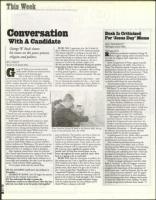
Texas Governor George W Bush at the Western Wall, during
said little about Jewish issues. What's more, his
a tour in the old city on Nov. 30, 1998.
outspoken declarations of his devotion to
Christianity have made some Jews more wary of his
peace settlement. The problem with that is there's an
ability to understand their concerns.
artificial time frame. We cannot be setting time
Still, in May, Bush was warmly received at an
frames for an Israeli and Palestinian peace negotiation
American Israel Public Affairs Committee (AIPAC)
based on our election cycles. There needs to be a dis-
policy conference in Washington. His speech won sus-
cipline and focus and patience with the peace process,
tained applause when he promised that, as president,
otherwise whatever will be negotiated will not last.
he'd move the U.S. embassy in Israel to Jerusalem.
JN: Can you win a significant portion of the
More applause rained down when he criticized
Jewish vote? Al Gore has courted Jews, as you
the Clinton administration for trying to force Israel's
know, throughout his entire political career. How
hand on accepting a peace pact. "In recent times,
hard is it going to be to crack that?
Washington has tried to make Israel conform to its
BUSH: Well, there are stereotypes in politics. It's
own plans and timetables, but that is not the path to
like asking me can I win a significant portion of the
peace," Bush told the AIPAC gathering.
XYZ minority vote when in fact they've been voting
On his plane, Bush told the Jewish News:
Democratic a lot. And the answer is yes, I can [win
Jewish votes]. But I know I've got a lot of work to
JN: You told AIPAC you'll move the embassy to
do. I mean, people hear "Republican" or he's a
Jerusalem ...
"committed Christian" and therefore he's not going
GEORGE W. BUSH: I said I'll begin the process
to like me; and I understand the stereotype and I'm
of moving the embassy to Jerusalem.
going to do my best to break through it. But I think
JN: You understand that that's a gesture the
there are a lot of Jewish people who aren't happy
Palestinians would see as inflammatory? How does that
with the Administration on a lot of fronts and I
play into your desire to see the parties work together?
think I'll have a chance to do well.
Bush is Criticized
For Vesus Day' Memo
ERIC FINGERHUT
Washington Jewish Week
Washington/JTA
epublican presidential candidate George W.
Bush is again coming under criticism for the
role that his religious faith might play in his
presidency.
Bush, the governor of Texas, signed a procla-
mation calling June 10, 2000, "Jesus Day" in
Texas. The American Jewish Congress said the
proclamation violates the "spirit and intention of
the First Amendment of the Constitution." Bush
has previously been criticized for remarks he
made stating that only Christians go to heaven
and his naming Jesus as the political philosopher
or thinker with whom he most identified.
The principal problem with the Jesus Day
proclamation, said AJCongress Executive Director
Phil Baum, "is not that it acknowledges the
important civic contributions of a particular
-
faith, but that it assumes the profound regard in .
which the teachings and person of Jesus Christ
are held by the Christian community are the
norm for all the residents of the state of Texas.
"Jews, Muslims, Buddhists, members of
other faith groups and non-believers, all of
whom are entitled to equal respect, would have
difficulty responding to the governor's call to
practice civic responsibility by 'following
Christ's message' on June 10," said Baum.
AJCongress notes that while such proclama-
tions have become "customary and routine" —
saying that Congress and many states have, for
instance, issued proclamations commemorating
the life and teachings of the late Lubavitch Rebbe
Menachem Schneerson — "all such statements
are offensive and erode the protection afforded
minority beliefs" by the First Amendment.
A spokesperson for Gov. Bush's office provided
a number of examples of other recent Bush
proclamations concerning religion.
They included proclamations honoring the
100th anniversary of the Baha'i faith in North
America and the 300th anniversary of the founding
of the Khalsa, "a community of Sikhs committed
to defending and upholding their faith." Bush also
has signed proclamations declaring Honor Israel
Day and a week of Holocaust remembrance, and
honoring the Austin, Texas, Chabad House.
A Bush campaign spokesman said that while
Bush is "sensitive" to the AJCongress' concerns,
"he does not fully share them." "The governor
recognizes the importance of the separation of
church and state," said Ari Fleischer. But he said
"it is a long American tradition" and "an appro-
priate function for governors to issue proclama-
tions honoring groups both religious and secular
in nature for important events, adding, "It does-
n't mean the governor endorses those causes."
R