
Obituaries
World Tribute To Polish Hero
L
arge chapel. Small chapel. Graveside. Cemetery chapel. We are without
limitations in our ability to provide services that meet the exact needs of each
family we serve. For nearly 60 years, we have shown flexibility through
unsurpassed responsiveness to Detroit's Jewish community.
THE IRA KAUFMAN CHAPEL
Bringing Together Family, Faith & Community
TH E KAUFMAN
COMMUNITY CORNER
Temple Beth El Hosts 3rd
Annual Senior Concert,
Sun, July 23, 2000
Beginning 3:00 pm
Temple Beth El welcomes
area seniors to the 3rd Annual
Senior Concert in the
congregation's Helen L. DeRoy
sanctuary, Sun. July 23, 2000
beginning at 3:00 pm.
The concert features music
from the Big Band era made
famous by Benny Goodman,
Duke Ellington, Glen Miller,
the Dorsey Brothers and
Les Brown.
The concert is made possible
by a grant from the Sally and
Harry Nosanchuk Family
Caring Community Fund.
The concert is open to
the public and there is no
admission for seniors. A
$5 donation is suxested
for others.
For more info,
call Barbara Grant
(248) 851-1.100, ext. 3149
18325 West Nine Mile Road, Southfield, MI 48075 • Telephone: 248-569-0020 • Toll Free: 800-325-7105
Please visit us at our web site: vvvvwdralcaufmart.com
Monuments & Markers • Monument Duplicating
HEBREW MEMOR_LA.LS
BY: HEBREW MEMORIAL CHAPEL
Slanb 31arob set
a pillar upon
tier irrsbe: that
is tbe pillar of
R.ocbel's 'trans
unto tbiS bap
dientsit
SERVING ALL CEMETERIES
(248) 543-3874 Fax #(248) 543-7421
26640 Greenfield Rd. Oak Park, MI 48237
Expert Consultation - Select Quality Granite
Complete
Carry-out and
Catering for Shiva
or entertaining
,
• g'eA
01,44
7/21
2000
134
7295 Orchard Lake Road,
West Bloomfield, Michigan 48322
248-932-8934
www.ladifference.com
z gi eck
z
z
z
llt our
Expanded
Classified
Section
of
DETROIT
JEWISU NEWS
Rome/JTA --- Jan Karski, a World
War II Polish resistance hero who
tried to convince Allied leaders of
the horrors of the Holocaust, died
July 13 in Washington at the age of
86.
Jews and non-Jews alike paid trib-
ute to a man whose wartime heroism
and lifelatig commitment to justice
made him a moral authority in the
fight against intolerance and anti-
semitism.
In Warsaw, Rabbi Michael
Schudrich led a prayer in his memo-
ry during Shabbat services.
"Karski was an absolutely right-
-eous man," said Stanislaw Krajewski,
a member of the board of the Union
of Polish Jewish Congregations. "His
unbelievable World War II record
made him a great moral authority in
Poland. He represented the best face
of Poland, and it was clear that his
views, such as his alertness to anti-
semitism, were against the main-
stream. There is no way to replace
him." .
Born Jan Kozielewski in 1914 in
the central Polish city of Lodz,
Karski, a Roman Catholic, was a
diplomat in pre-war Poland. After
the war broke out in 1939, he
joined the underground Home
Army.
Thanks to his courage, his photo-
graphic memory and his talent with
languages, he became a legendary
courier, sneaking through enemy
lines and occupied Europe to bring
news from the Resistance to Poland's
government in exile. He was cap-
tured and tortured by the Gestapo
in 1940, but managed to escape
with the help of an underground
commando team.
In 1942, he risked his life to
sneak two times into the Warsaw
Ghetto. Also, disguised as a Nazi
guard, he infiltrated the Izbica death
camp in eastern Poland, where he
saw Jews tortured, stabbed and
crammed into boxcars.
He managed to bring his graphic
eyewitness report of executions, mass
deportations and horrific conditions
to the West, and personally briefed
President Roosevelt and other west-
ern leaders.
His reports, however, resulted in
little concrete action from skeptical
Allied leaders.
Karski's 1944 book, Story of a
Secret State, which detailed the
Polish resistance fight, recounted his
exploits, and also described the reali-
ties of the Holocaust, became a best-
seller in the United States.
Karski refused to return to Poland
after the Communists took power
and settled in the United States,
becoming a naturalized citizen in
1954 and a professor at Georgetown
University.
The first time he spoke publicly
after the war about what he saw in
the Warsaw Ghetto and Izbica camp
was when he was interviewed in the
1980s for Claude Lanzmann's film
Shoah.
Karski returned to Poland only
after the fall of communism in
1989. Among many awards, he was
recognized as Righteous Among
Nations, and also was granted
Poland's highest civilian and military
honors.
Karski's late wife was the daughter
of an Orthodox Polish Jew and lost
all her family in the Holocaust.
Photos Welcome
The Jewish News will be happy to
publish photographs of the
deceased in obituaries. There is
no charge.
'Photos should be clear and as
recent as possible. If only a
dated photo is available, we ask
that you provide a date and that
information will accompany the
photograph in the paper. Only a
photo of the individual will be
published and we reserve the
right to reject any photograph.
We cannot use scanned or elec-
tronic submissions.
Please attach a label to the
back of the photograph that
includes the deceased's name as
well as a return name and
address. Do not write on the
photograph itself.
All photos must be received at
The Jewish News by noon
Tuesday to be considered for
that Friday's paper. To be
returned, all photographs must
be accompanied by a stamped,
self-addressed envelope.
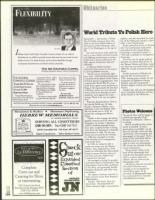
Scanned image of the page. Keyboard directions: use + to zoom in, - to zoom out, arrow keys to pan inside the viewer.
July 21, 2000 - Image 134
- Resource type:
- Text
- Publication:
- The Detroit Jewish News, 2000-07-21
Disclaimer: Computer generated plain text may have errors. Read more about this.