

Community
Spirituality
C om i n g
Gay rabbi grapples with
Torah's g̀ ray areas.
JOSHUA BRANDT
Jewish Bulletin of Northern California
San Francisco
W
hen Orthodox Rabbi
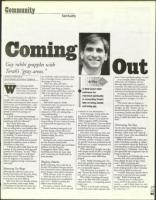
Steve Greenberg came out
of the closet, he opened
more doors than just his
own.
"I've received quite a few calls from
people who want to belong to the
Orthodox community but don't want to
do so at the cost of self-rejection," said
Rabbi Greenberg, a senior fellow at the
New York-based CLAL, the National
Jewish Center for Learning and
Leadership.
"I think it's becoming increasingly
possible to find a place where one can be
quietly gay and from [devout]."
But it hasn't been easy.
Although Rabbi Greenberg said he
was not subjected to overt hostility after
coming out, for many painful years he
has struggled against what he calls "bina-
ry thinking." It started during his
teenage years growing up in a
Conservative household and continued
through his academic career at Yeshiva
University in New York
"I think pluralism really feeds the dis-
cussion of why someone who's gay can't
possibly be Orthodox," he said. "Why
shape the conversation in such black-
and-white terms? The issue isn't flat —
just the religious vs. the secular. It's
about a tradition having a conversation
with itself."
Removing The Wraps
Although the rabbi has come out to
family and friends over the years, doing
so in his New York-based Orthodox
community was more difficult.
After more than two decades of keep-
ing his sexuality under wraps, Rabbi
Greenberg was spurred into action dur-
ing Shavuot two years ago, when a fel-
low Orthodox rabbi showed him a ketu-
ba, or marriage contract, adorned with
the images of two men. .
When the rabbi told Rabbi
Greenberg some jokes about what the
"reformers" were doing to Judaism,
Rabbi Greenberg replied that it was pos-
sible to be openly gay and Orthodox.
And he offered himself up as one —
and, as far as he knows, the only —
example.
His friend's response, Rabbi
Greenberg recalls, was along the lines of
"have you gotten help?"
But the 42-year-old rabbi, who was
ordained in 1983, isn't seeking help —
only understanding.
"There's no battle here," said Rabbi
Greenberg. "There's no question of win-
ning or losing. It's just a matter of trying
to understand the experience of the
other."
Rabbi Greenberg attempted to do
just that during a recent talk in San
Francisco. The title: "What does Jewish
Tradition Really Say About
Homosexuality?"
During his talk, jointly sponsored by
the San Francisco-based Jewish
Community Federation's gay and lesbian
taskforce and San Francisco
Congregation Sha'ar Zahav, Rabbi
Greenberg said there are many "gray
areas" concerning the Torah's take on
homosexuality.
Weighing HaLacha
Rabbi Greenberg, who is also the co-
founder of Jerusalem's first gay and les-
bian community center, reiterated those
points during a recent phone interview.
While reluctant to lay out specifics
— which he said will be covered in a
forthcoming book to be completed by
year's end — Rabbi Greenberg did
address some broad issues.
For starters, Leviticus 18:23, states:
"Do not lie with a man as one lies with
anSION
in
st
r
▪ gt
s*
•
0
a
A West Coast rabbi
embraces his
innermost spirituality
in reconciling Torah's
take on being Jewish
and being gay.
a woman; it is an abomination."
Seven years ago, writing under the
pen name of Rabbi Yaakov Levado
(Hebrew for "alone") in an article for
Tikkun magazine, Rabbi Greenberg
wrote, "for the present, I have no plausi-
ble hakchic [by Jewish law] method of
interpreting this text in a manner that
permits homosexual sex."
Since then, he's come up with a pos-
sible solution to the biblical dilemma.
Rabbi Greenberg, whose partner is also
Orthodox, posited a scenario in which
the specific sexual acts prohibited by the
Torah were not a major component of a
gay male relationship.
When asked if he thought many gay
male couples would see that as too great
a sacrifice, Rabbi Greenberg responded
that his premise wasn't fully being
grasped.
"Look," Rabbi Greenberg said, "the
Torah also prohibits a man sleeping with
his wife while she's menstruating — and
yet it occasionally happens. •
"This dichotomy is so painful," he
said, "because the Jewish- tradition is so
rich, and no one wants to injure it."
What Rabbi Greenberg ultimately
wants to do falls well within standard
rabbinical duties — interpreting ancient
Jewish texts.
"There is a much more interesting
picture that exists, which requires more
Out
than a mere superficial reading," he said.
As an example, Rabbi Greenberg
offered the tale of Sodom, the city
famously destroyed for its supposed
amorality. The rabbi said the narrative's
original meaning has been distorted by
centuries of non-Jewish interpretation.
According to Rabbi Greenberg,
Sodom was destroyed because the city
was inimical to strangers, or to the
"other."
"The Jewish take on Sodomy is
much more vague and unclear than we
thought," he said. "Sodom was not
destroyed because it was a place of sexu-
al perversity. Jewish texts depict Sodom
as a place of social amorality — as a
place of wealth that didn't know how to
share."
Overcoming The Pain
On the other hand, Rabbi Greenberg
talks about such biblical figures as
Abraham, whose tents were "open all
four sides;" hence, who was unafraid of
strangers in his midst.
Biblical references such as these give
Rabbi Greenberg a template to initiate
new conversations about the Torah and
homosexuality, as well as about having a
spiritual base in Orthodoxy, "one of the
most grounded and imaginative ways of
being on this earth.
"Living life as an Orthodox Jew is too
precious and sweet and wonderful to
leave, despite the pain [of gay intoler-
ance]," Rabbi Greenberg said.
And that belief has inspired him to
lend a helping hand to other Orthodox
Jews who are afraid to come out.
"I couldn't keep quiet, because there's
too much to say and too many people
to help," Rabbi Greenberg said.
"Coming out is a redemptive
move, both of the person and of
society — and I think there is a reli-
gious imperative to find the strength
to come out." ❑
troN
7/14
2000
83