

I
n the Akron exhibit, works from 1947-50 indude
eight examples of Krasner's well-known "Little
Image" series. While Pollock's influence (he, of
course, was one of the leading pioneers of Abstract
Expressionism and the leading exponent of action
painting) is evident in such web-like renderings as The
Mouse Trap (1949), Krasner's orderly mosaics and
hieroglyphs bear distinct styles of their own.
Although Krasner "rejected Cubism" and "absorbed
Pollock" as a painter, she never thought of herself as
anything but Lee Krasner. "I painted before Pollock,
during Pollock, after Pollock," she said.
In his extremely well written and scholarly cata-
logue accompanying the exhibit, Robert Hobbs con-
vincingly argues that Krasner's beautifully rendered
"Little Image" hieroglyphic paintings with their
strong suggestion of ancient language are Krasner's
tribute to the memory of the Six Million who per-
ished in the Holocaust.
By using painted symbols suggesting ancient
Scriptures, Krasner recalls her own Jewish roots and
the exquisite calligraphy of prayer books that were
very much in evidence in her home.
When she was a child, Krasner learned to write
(but not read) Hebrew.
"These [Hebrew] markings I didn't understand,"
Krasner told art historian Barbara Novak. "I learned
how to write, but I couldn't read it. So there's a mys-
tery from the beginning. Visually, I loved it ... I
couldn't write a sentence in Hebrew today that you
could read, so I only had the gesture, and the visual
thing that stays with me."
Despite the tendency of critics and art historians to
point out Krasner's rejection of her Jewish background,
there also is the assertion in the way she worked her can-
vases — right to left, like Hebrew — that she was more
involved in her religious past than previously thought.
While she was reluctant to be hidebound by the
rigidly religious orthodoxies of her upbringing, she
did not mind having her work associated with the
Hebrew script.
"The whole body of work comes out of her experi-
ence," notes Barbara Tannenbaum, the Akron muse-
urn's chief curator. "She was a Jewish woman who
was raised by strongly Orthodox immigrant parents.
As much as she changed her identity, she was making
new identities out of the experiences of her past life
and those were firmly rooted in Orthodox Judaism."
in shambles, is one such example. At the time,
Pollock was drinking heavily, had taken a mistress
and was no longer painting, while Krasner's work was
progressing rapidly.
Prophecy was left on an easel when Krasner
escaped to Europe in July 1956. One month later,
on August 11, Pollock was killed in a car crash, and
Krasner was riddled with guilt for not having been
with him when he died.
With its disembodied body parts — including
three legs, two torsos and several heads — Prophecy
is as complex as it is troubling.
The incised eye at the upper-right-hand corner is
equally ominous. The placement of a disembodied
eye, or eyes, which evolved subconsciously in this
and other Krasner paintings, had its origins, accord-
ing to curator Hobbs' interpretation, in the artist's
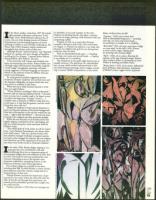
Below, clockwise from top left•
"Prophecy" 1956, oil on cotton duck.
With its disembodied body parts — including
three legs, two torsos and several heads —
the painting is as complex as it is troubling.
"Bird Talk," 1955, oil, paper and canvas collage
on cotton duck. In the early 1950s, Krasner,
a master colorist, began ripping apart
her paintings and creating collages.
"Birth," 1956, oil on canvas. Rejecting the
in uence of her late husband's images, Krasner
c ose instead to follow in the footsteps of artists
Willem de Kooning and Pablo Picasso.
"Rising Green, 1972, oil on canvas. Silhouetted
forms of flowers, buds and leaves, reminiscent
ofMatisse's cutouts, suggest notions of growth.
I
n the early 1950s, Krasner began ripping or cut-
ting apart her own and Pollock's work and
recombining them into an important group of
monumental collages that were exhibited in New York
in 1955. This body of work was acclaimed by critic
Clement Greenberg as one of the decade's most
important exhibitions, catapulting Krasner to the
forefront of abstract artists of her generation.
Five of these collages are included in. the show,
including Bird Talk, in which Krasner, a master colorist,
gives dissonant colors like crimson, orange and tan a
startling beauty of their own.
Though Krasner rejected the importance of giv-
ing titles to her work, which she often did with the
help of friends and through free association, her
named pieces nonetheless provide keen insight into
her work and life.
Prophecy, painted in 1956 when her marriage was
7/7
2000
73