
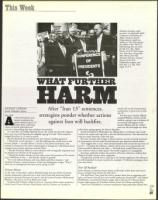

Malcolm Hoenlein, right,
executive vice chairman of the
Conference of Presidents of
Major American Jewish
Organizations, speaks out
Sunday in New York against
the verdict in the "Iran 13"
hied Joining him are, front
far left, U.S. Rep. Major
Owens, D-NY; back center,
New York State Comptroller
Alan Hevesi; front left,
Abraham Foxman, national
director of the Anti-
Defamation League; and,
back left, U.S. Rep. Eliot
Engel, D-NY
WHAT FURTHER
EAU?'
MICHAEL J. JORDAN
Jewish Telegraphic Agency
New York
A
After "Iran 13" sentences,
strategists ponder whether actions
against Iran will backfire.
s the international corn-
munity condemns the
prison sentences given 10
Iranian Jews, a growing
chorus of Jewish politicians and
activists is demanding that Iran somehow be punished.
In a case that was widely followed all over the world, the devoutly religious
Jews were convicted Saturday for allegedly spying for Israel. Their sentences
ranged from four to 13 years in prison.
But the demands for punishing Iran raise several troubling questions:
• Would the use of sanctions — and the suffering they would cause to the
Iranian people — actually deliver a victory to the Iranian hard-liners, who
seemed to orchestrate the entire trial precisely to damage the mild detente devel-
oping between Iranian reformers and the West?
• Should American efforts to warm relations with strategically important Iran
be derailed over the fate of 10 Iranian Jews?
• Would the further isolation of Iran only worsen the situation of the remain-
ing 25,000 Jews in Iran — plus Iranian society in general?
"It's a very delicate balance, and not a black-and-white situation," said
Abraham Foxman, national director of the Anti-Defamation League. "But if
there are no consequences for Iran, you're saying it's OK."
Protests Mount
In the wake of Saturday's verdicts, British Foreign Secretary Robin Cook has
already postponed a planned trip to Iran. Now, Israel and American Jewish
groups are pressing Germany to cancel a visit by Iranian President Mohammad
Khatami, who was to arrive in Berlin next week.
President Bill Clinton called on Iran to "overturn these unjust sentences,"
while Israeli Prime Minister Ehud Barak told his Cabinet on Sunday he
would call on the international
community to press Iran to free
the 10.
For their part, Iranian officials
attacked Western criticism of the
verdicts, saying it was a violation of
its national sovereignty. Some
Iranian officials said the verdicts
were too soft and might not deter
others from spying against the Islamic Republic.
Jewish lawmakers in Washington are talking about a resolution that would
criticize the verdict and urge Iran to free the Jewish prisoners. Also discussed are
steps to curtail American trade with Iran.
But Iran-watchers and emigres in North America say the potential unintend-
ed consequences of such steps should dominate any sanctions-related debate.
They suggest that in Iran, where fundamentalists still control the key levers of
power — including the judiciary, military, police and, most importantly, the
state-controlled television and radio — the hard-liners would frame any sanc-
tion, however small, in their typical "the-world-is-against-us" propaganda.
Sanctions could also weaken the position of Iranian reformers, making their
Western-friendly rhetoric more unpopular.
Though they recently won a majority in the Iranian legislature, the reformers
are still embattled. In recent months, for example, 19 reformist newspapers have
been shut down.
Fear Of Backlash
More relevant to American Jewry, blame could easily trickle down and exacer-
bate an already-tense climate for Iran's Jews.
The hard-liners "have used this trial to present these Jews as aggressors and
spies, and [assert] that all Jews have hostile tendencies toward Iran," said Pedram
Moallemian, a non-Jewish Iranian emigre who is director of a Toronto-based
human rights group, the Canadian Iranian Center for Liberty and Equality.
"Some sort of backlash or sanction would prove their point that Iranian Jews
7/7
2000
27