
Finance
Jonathan
Lowe:
Planned
giving has
double
benefits.
LISA BARSON
Special to the Jewish News
t is a problem facing every not-for-profit
organization: how to attract new, younger
contributors to what has become an older
donor base.
Some organizations have gone to great measures,
such as special programming not linked directly to
donations, to attract younger audiences. Today, many
non-profits are also using "planned giving." It's prov-
ing to be an effective method of maintaining charita-
ble funding sources while offering valuable tax benefits
to donors.
Six years ago, the Jewish Federation of Metropolitan
Detroit hired Jonathan Lowe to deal solely with the
issue of planned giving. Federation Chief Operating
Officer Mark Davidoff explains that Lowe serves as a
"philanthropic counselor" to the community. Among
the many plans offered by the Federation, including
endowment funds, capital campaigns and philanthrop-
ic funds, "planned giving is the thread that runs
through it all."
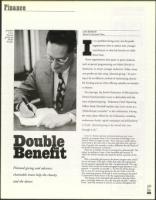
Double
Benefit
Planned giving and advance
charitable trusts help the charity
and the donor.
Lowe is a former attorney and estate planner and, more
recently, an assistant dean at the University of Michigan Law
School. When he began his job, "there was just a small endow-
ment fund at the time, but it was clear that there was a genera-
tion of people who wanted to make a difference for the future of
the Jewish community in Detroit."
There are a number of ways to arrange for a planned gift. The
easiest, according to Lowe, is the charitable gift annuity, in
which the charity actually pays back the donor a portion of the
gift.
With a charitable gift annuity, the donor can give cash, securi-
ties or real estate. If the gift is other than cash, the organization
has the property appraised and sells it to generate cash. The orga-
nization then invests the funds and agrees to pay the donor a set
amount — quarterly or annually — for the rest of the donor's
life, or even to a surviving spouse for the rest of his or her life.
Any remaining portion of the gift is used according to the specif-
ic instructions of the donor or by the organization's discretion.
"The beauty of the charitable gift annuity is that the donor
gets a charitable deduction the year they give the gift," explains
Lowe, "and will continue to receive an income throughout the
a 7/7
2000
101
Scanned image of the page. Keyboard directions: use + to zoom in, - to zoom out, arrow keys to pan inside the viewer.
July 07, 2000 - Image 121
- Resource type:
- Text
- Publication:
- The Detroit Jewish News, 2000-07-07
Disclaimer: Computer generated plain text may have errors. Read more about this.