

Always The Teacher
RABBINIC IMPACT
from page 7
have to go other congregations to say
Kaddish when there was a death."
In 1955, he began a daily minyan at
Temple Israel, eventually training other
men to lead the evening service. Today,
the daily minyan is held each morning.
"Rabbi Syme also started what we
call our Minyanaires," says David
Tisdale, former president and current
executive director of the 3,400-family
congregation. "It is a coterie of 35 vol-
unteers who go into people's homes
when there's a death and conduct the
daily services."
As a youth in Canada, Rabbi Syme's
father was active in the Chevra Tehillim,
which oversaw Jewish burials, ensured a
minyan at shiva houses and recited
tehillim (psalms) in memory of the dead
and on behalf of the sick.
"Rabbi Syme's greatest strength is in
trying new things, establishing new
programs," says Rabbi Harold Loss, a
colleague for 29 years. "At first I used
to raise my hand in staff meetings say-
ing, 'I'd really like to do this or that,'
and Rabbi Syme always said,
`Absolutely.' After two years, I was
overwhelmed and I realized he wasn't
going to say no.
"He always showed great love of tra-
dition. We view ourselves as a tradi-
tional Reform congregation, rather
than classical Reform, and that in no
small part is his doing."
Educating The Youth
When he came to Detroit, Temple
Israel had no religious studies program
for the synagogue's youth other than a
Sunday morning class.
Around 1955, Rabbi Syme founded
the Temple Israel Hebrew School as its
sole teacher. There were 12 students in
that first class, including his son Dan
Syme, who became the assistant
Hebrew teacher at age 9.
"He started it and gave it rabbinical
support and insisted on it," says Dan.
"But the big thing that he did was that
he taught every day. It's easy to say we
need a school, like rabbis often do, and
then turn it over to the lay leaders to
see that it gets done, but what this
man did was, he was part of it — he
was the teacher and he still is."
Rabbi Syme says, "I met with the
parents and I said, 'If there is any
mother here who is interested in
becoming a Hebrew teacher, I will
teach you, but you'll have to come
every day, and you'll be paid for it.'"
With Hebrew school also came the
return of the b'nai mitzvah. "The
Reform movement, at its inception,
eliminated bar mitzvah in the name of
7/7
2000
10
Milestones
• July 4, 1920: Born Monte
Syme in Winnipeg,
Manitoba, Canada.
• 1934: Became "boy cantor"
of Ashkenazi Congregation in
Winnipeg.
• 1941: Graduated from
Wesley College at the
University of Manitoba in
Winnipeg.
• 1941: Met Rabbi Stephen
S. Wise, founder of Jewish
Institute of Religion (JIR) in
New York City, who influ-
enced him to become a rabbi.
• 1941: Enrolled in rabbinical
school at JIR.
• 1942: Married Sonia
Hendin in Orthodox ceremo-
ny in Winnipeg.
• 1946: Accepted first pulpit
in Plainfield, N.J.
• 1948: Began as spiritual
leader of Orthodox/Reform
congregation in Sharon, Pa.
• 1950: Received master's
degree in education from
University of Pittsburgh.
• Nov. 16, 1953: Hired as
assistant rabbi to Rabbi Leon
Fram of Temple Israel on
Manderson Road in Detroit's
Palmer Park area.
• 1955: Began daily minyan.
• 1955: Founded Temple
Israel Hebrew School.
• 1955: B'nai mitzvah intro-
duced under Rabbi Syme's
tutelage.
• 1970: Awarded honorary
Doctor of Divinity degree
from Hebrew Union College.
• 1979: Participated in cor-
nerstone dedication of the
new Temple Israel building
on Walnut Lake Road in
West Bloomfield.
• 1987: Eliminated rabbinical
titles, such as assistant and
associate.
• 1987-91: President of the
Metro Detroit District, ZOA.
• 1991: Received Justice
Louis D. Brandeis Award
from the ZOA.
• 2000: Retirement and 80th
birthday celebration.
egalitarianism," says Dan Syme. "But
the power of bar mitzvah was such that
as Reform congregations grew, there
were more and more people who want-
ed bar mitzvah."
From that small beginning,
Temple Israel now has 180 b'nai
mitzvah annually.
The congregation was immensely
pleased with the changes Rabbi Syme
made : In the March-April 1954 Temple
Israel Messenger, Rabbi Fram wrote:
"Especially has the influence of Rabbi
Syme's training and personality been
felt in our educational program. Our
high school youth has enthusiastically
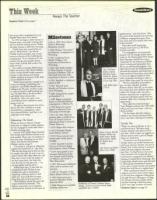
Top: The Syme
accepted his guidance and leadership. A
family: David,
large number of them have volunteered
Michael, Sonia,
Rabbi M Robert to arrive at religious school an hour
and Daniel Syme early on Sunday morning in order to
have a Bible class under his instruction.
(circa early '60s)
"He has undertaken personally to
Left: Rabbi Syme give our boys and girls weekday
Hebrew classes. Next fall, as our mem-
(1974)
bers realize that their children can have,
within the Temple walls, not only a
Hebrew education but a regular, per-
sonal and individual contact with our
assistant rabbi, they will grasp the rare
opportunity."
Now called the David and Jean
Tyner Religious School, the 1999-2000
school year had more than 1,400 stu-
dents enrolled.
"It's the largest [Jewish] religious
school in the country because of this
man," says Dan, referring to his father.
Family Ties
Above: Cantor Harold
Orbach, Rabbi Loss,
Rabbi Fram, Rabbi
Daniel Syme, Rabbi
M Robert Syme
(1984)
Left: Sonia and Rabbi
Syme (circa 1989)
Archbishop of Detroit Cardinal Adam
Maida, ecumenical activist Frank Stella
and Rabbi Syl?'!P (1 994)
"When we came to Detroit, I was 7,
and David was 4. We had a third
brother Michael, who died in 1975,"
says Dan. "And we grew up together in
Detroit and we were a part of Temple
Israel our whole lives.
"As much as my dad pioneered at
Temple Israel, my mother became one
of the pre-eminent teachers, not just in
Detroit, but in the country in terms of
adult and inter-religious education,"
says Dan. "As Dad became more and
more involved with temple life, she
continued to correspond with [Rabbi]
Solomon Freehoff from Pittsburgh. She
taught high school seniors and also had
a whole group of sisterhood women
who went on camp retreats and studied
Jewish law with her on a regular basis."
With a profound interest in inter-
religious activities, Sonia Syme began
an annual Inter-religious Colloquium
through Detroit's Marygrove College.
For the past 30 years, public school
teachers working in districts where
there were large numbers of Jewish
RABBINIC IMPACT on page 12