

s Wee
Water Woes Worsen
•
• •••,,',
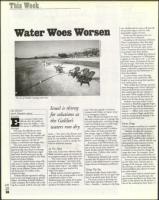
The Sea of Galilee's receding water line.
GIL SEDAN
Jewish Telegraphic Agency
Jerusalem
is
very summer, Israeli water
officials alert the public to
the same dry reality — that
the nation is suffering water
shortages.
This year, the officials are more
worried than ever. If current usage
continues, they warn, the country will
run out of water. The level of Israel's
main water reservoir, the Sea of
Galilee, is well below the danger line.
The water issue has important
political implications. _Those who
oppose giving away land in exchange
for peace with the Palestinians argue
. that Israel should never give up the
vital water sources located in the West
Bank and Golan Heights.
Last week, Israel's senior water offi-.
cials went to Turkey, which is blessed
with a seemingly unlimited supply of
water, to see whether Turkey would
sell Israel some 50 million cubic
-
meters of water.
Turkish officials expressed a willing-
ness to sell, and bargaining has already
begun. According to Israel's Mekorot
water company, the Turkish side is ask-
ing for as much as 86.3 cents per cubic
6/30
2000
Israel is thirsty
for solutions as
the Galilee's
waters run dry.
meter — four times what farmers now
pay and more than double the current
price for city dwellers. Some experts
maintain that it would be cheaper for
Israel to desalinate seawater.
At The Abyss
This week, Israeli Prime Minister Ehud
Bafak convened a group of ministers for
an emergency session on the water crisis.
"The water system suffers from cat-
astrophic shortages," said Dalia Itzik,
the environment minister. "And if the
premier deals with it," she added, "this
is a sign that we have reached the
verge of an abyss."
Barak and his ministers agreed to
seek bids in the coming weeks to build
a desalination plant on the
Mediterranean Sea within 20 months
at a cost of $130 million. It would
produce 50 million cubic meters a
year. They also agreed to continue
contacts with Turkey to import water
as an emergency measure.
Water officials say imports are actu-
ally only a minor part of a strategy that
includes desalination, recycling sewage.
water and finding ways to make large-
scale savings of current supplies.
Natural resources yield 1.6 billion
cubic meters of water annually, but
the average usage is 2 billion cubic
meters — and the shortfall increases
every year. Last year, the region suf-
fered its worst drought in 120 years.
According to the World Bank, the
deficit between the current water sup-
ply and the actual water needs of
Israel, Jordan and the Palestinians will
be more than 1 billion cubic meters
annually by 2015.
Environment Minister Itzik warned
recently that 40 percent of the water in
Israel is undrinkable because it contains
large amounts of dangerous pollutants.
Using The Sea
Palestinian leader Yasser Arafat often
threatens Israelis who do not agree with
,
him "to go drink water from the sea.'
The truth is that in the long run,
both Arabs and Jews will have to do
this — literally — because in the long
run, desalinated sea water will provide
the parched region with the only
dependable supply of water.
Critics say this option is far too
costly, but this is disputed.
According to the estimates of former
Water Commissioner Meir Ben-Meir,
the cost of desalinating water should
not exceed 70 cents per cubic meter.
This is 20 percent lower than the price
to purchase water from Turkey.
The Center for Middle East Peace &
Economic Cooperation in Washington
suggests an even lower cost — 55 cents
per cubic meter, 10 percent of the cost
of 20 years ago. This week, the center
published full-page ads in Israeli news-
papers, calling for cooperation among
Israel, Jordan and the Palestinians to
solve the problem.
As part of their water-shortage
alert, Israel's water authorities told
Israelis to stop watering their gardens
and washing their cars.
They recalled how during a previous
water shortage crisis, former Agriculture
Minister Rafael Eitan recommended
that couples take showers together to
save water. While couples are left to
work that one out for themselves, the
search is on for less drastic measures.
Professor Arye Iss2r of Ben-Gurion
University in Beersheba suKested forget-
ting about Turkey and the desalination of
seawater. He claims he has discovered a
treasure — 1 billion cubic meters of salt
water in a southern Negev aquifer that
could be desalinated and shipped to the
north at a much lower cost.
Farm Usage
Others propose curtailing the wasteful
use of water for agricultural-purposes.
Neheniia Strassler,,fhe economic
editor: of the. Israeli daily Ha'artiti:,.
argued this week that rather than
importing 50 milli& cuhic meters:_of
water from Turkey, officials should stop
allocating the same omount-ofwater
for fishponds in the coastal plain.
One possible way to save water
would be to have farmers change the
crops they raise. For example, Israel
produces water-thirsty plants like cot-
ton, which is later exported to Europe.
Some point to the subsidies farmers
get for their water. Farmers pay an
average of 20 cents per cubic meter.
By Contrast, an urban customer or an
pays almost 35 cents
industrial
per cubic meter.
Cheap water leads to wasted water,
say critics. Several months ago, the
government decided to cut water sub-
sidies to the farmers by 20 percent —
but so far, nothing has been done. El
-