

•
This Week
+.4sti•Acioe
CoverStory
A Model For Learning Jewishly
were added recently.
school, to schools in Jerusalem and to the
"I believe we have to find a way of com-
entire country, Rotem said.
municating
with our neighbors," Levin
Levin and the Frankel school's original
said,
explaining
the need for the Arab-
steering committee opened the way for alter-
Jewish
programs.
native schools in Israel. Frankel is now part
The pluralistic outlook of the school is
of a chain of about 80 schools known by the
aptly reflected in the students. Religious
Hebrew acronym TALI (Intensifying Judaica
children wearing kippot (head coverings)
Studies). Spurred by the success of the
mix easily with their secular counterparts.
Frankel school, other parents took the initia-
The students are Ashkenazi, Sephardic and
tive of forging alternative educational sys-
from the different socioeconomic levels
tems throughout the country that address
that
make up the Jerusalem community.
different educational needs, Rotem said.
During
morning prayers, instead of just
The Ministry of Education has declared
reciting
the
Ashkenazi version of a prayer,
Frankel "a model school." Israeli and foreign
the students also learn the Sephardic ver-
educators come there to observe and learn
sio,n; boys and girls pray together and girls
from the educational techniques.
can be called up to be the chazanit (prayer
"It is a community school par excellence,"
leader). On Shavuot, boys and girls in the
Rotem said. "Barbara believes that everyone
first grade are awarded their first prayer
can learn and advance, and she has an •
books and Bibles in a special ceremony.
extremely democratic outlook that is reflect-
"The Frankel school is pluralism in all
ed throughout the school. She doesn't sit
its
glory" Rotem said. "With her amazing
back and rest on her laurels; she is always
Jean and
belief in certain ideals, Barbara [Levin]
looking for new ways and new methods of
Samuel Frankel
opens paths, pushes doors and she really
doing things."
influences the way things are done."
Way ahead of the pack in addressing the ,
educational requirements of special-needs children in
Israel, the Frankel school began working to main-
Hands-On Experiences
stream autistic children about seven years ago.
There is no such thing as only book learning at the
Though they have their own special classroom,
Frankel school. Studying zoology involves the cre-
the autistic children also have a student mentor, par-
ation of a simulated jungle in the school's bomb shel
ticipate in certain classroom activities with the other
ter, and every week a zoology professor from Hebrew
students and are an integral part of the school.
University stops by with a batch of assorted animals
Suddenly, children who were withdrawn into their
for the children to see and touch. Once, a turtle's
own worlds and didn't even speak were talking and
eggs hatched while they watched.
relating to outside stimuli.
Another time, during a session with snakes, a sec-
As Levin showed the classroom to a visitor during
ond-grade class studying the Genesis story discussed
the interview, one girl who was on her way out of the
the snake and his punishment in the Bible. Botany is
room came over to Levin and spoke to her excitedly
not just looking through the lens of a microscope but
about a recent class trip.
includes hands-on gardening, both in an organic gar-
In typical fashion, Levin did not stop with helping
den outdoors and in a hothouse. Students learn
autistic children function in her school. Thinking of
about photosynthesis from the plants themselves, not
their future, she negotiated with a middle school
just from a textbook.
attended by many Frankel graduates and convinced
"There is nothing.
the administrators to accept the autistic children as
like it — the richness
well. Now the work begun at the Frankel school can
of experiences the
continue.
school gives the chil-
Popularity Grows
At the outset, the majority of students at Frankel
were the children of Anglo-Saxon immigrants; today
the 440 students represent a cross-section of
Jerusalem society As a public neighborhood school,
Frankel must accept all applicants from the neighbor-
hood, and the average classroom has about 40 stu-
dents. While this attests to the popularity of the
school, some parents would like to see smaller classes
— a virtual impossibility given the financial restraints
on the school.
The list of ongoing extra-curricular activities
seems endless: computers, music, an award-winning
gymnastics program (opened to both Arab and
Jewish children throughout the city), baseball, bas-
ketball, arts and crafts, nature studies, a very popular
drama program. An animal care program at the
Biblical Zoo and a folklore program with children
from the adjacent Drab neighborhood of Beit Hanina
3)1
6/30
2000
10
dren," said parent
Lauren Wolfsfeld,
whose younger daugh-
ter attends Frankel
while the other is a
Frankel graduate. "It's a
very remarkable place.
My daughters will
never forget the experi-
ences and memories
they have had at this-
school. The school is
truly a community, and
that is not so in other
schools."
Unashamedly
biased, Wolfsfeld con-
fesses that her family
moved to the neighbor-
hood specifically for
the school. Her husband showed up at the school
doors at 2 a.m. on the day it came to enroll their first
daughter so he could save a spot in the line of par-
ents eager to have their children accepted.
"I've never seen anyone who rejuvenates herself
every summer like Barbara and comes back for ,more
every year with the same enthusiasm," Wolfsfeld said.
"She knows all the kids, all the siblings. She has her
finger on the pulse of the school but at the same time
gives the people around her the freedom to grow as
well."
New Challenges
Despite the Frankel school achievements, Levin's
continuing challenges include the growth in class size
and an increase in student violence.
"We are a microcosm of our society and there has
been a 120 percent increase in violence country-
wide," Levin said. "We have to deal with the integra-
tion of a population that comes from different
socioeconomic background's. That requires the inte-
gration not only of the kids but of parents, too.
"There are different attitudes about how to solve
conflicts: whether to fight, talk, negotiate. We are
doing a lot of work at the Family Education Center
but it doesn't come overnight," she added.
Cultural differences have surfaced in serving the
diverse population. Sephardic families, for example,
have no strong tradition of theater; for many of the
parents, it was hard to understand the concept of
late-afternoon rehearsals that conflict with their tradi-
tion of a substantial mid-day meal for their children.
Instead of one tradition overshadowing the other, the
school found ways to provide transportation back to
the school so the children could return for rehearsals
after lunch.
Levin called the recent award a wonderful way to
convey a sense of appreciation to the staff and boost
morale. The Frankels' involvement enables the hard-
•
working staff to find innovative educational tech-
niques and methods of balance and integration of
different traditions, she
said.
In the final analysis,
Levin said, all involved
with Frankel school hope
their efforts will help bring
about a more tolerant soci-
ety where people are more
willing to listen to one
another and appreciate dif-
ferent viewpoints.
"We want the children
to value what they are and
the traditions they have,"
Levin said. "But we also
want them to respect other
people and appreciate the
different talents that enrich
our lives." ❑
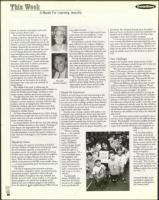
Principal Barbara Levin
and students display the
education awardgiven to
the Frankel school