

This Week
(
The Occupation Revisited
Reflections Of South Lebanon
Why Israel went in, why Israel got out, and the cost.
month ago, Israel ended its 18-year-long occupation of a nine-mile-
wide swath of southern Lebanon. With its local ally, the South
Lebanon Army, fleeing an expected onslaught by Hezbollah gueril-
las, the IDF forces hastily beat a retreat across the border.
For all that the move had long been coming — getting out of Lebanon
was one of Prime Minister Ehud Barak's strongest commitments — the end
came so swiftly that it left many Israelis, as well as Jews in North America,
wondering anew about the strategic importance of buffering Israel's north-
ern border. And that led in turn to questions about why Israel had gone into
Lebanon in the first place and whether the occupation and the deaths of
more than 900 Israeli soldiers in the effort had truly been worth it.
In these articles, ordinary Israelis look back on the experience with a mix-
ture of sorrow and pride.
— Jonathan Friendly, national editor
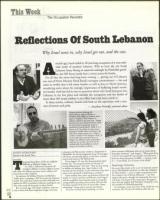
top lefi. •
Counter-clockwisefrom
J -
Gerias Khowy, mayor of Fasuta, a
Christian Arab village in northern Israel
says he is hopeful to meet relatives in
Lebanon whom he has never seen; Yehuda
Kamari grew up in Kiryat Shemona where
he used to play his guitar for people in
bombshelters during attacks. Today he is a
doctor in Tel Aviv where he enjoys music
playing the middle eastern instrument. the
oud; Orna Angoni points out a village in
southern Lebanon to her daughter Arely, 12,
at the border fence near their house iv
Misgav Am; Elisheva Lahav ofierustilem
welcomes her son Kir, 20, home for the
weekend after Israel withdrew its final
troops out of southern Lebanon.
JUDITH SUDILOVSKY
Special to the Jewish News
T
Jerusalem
371
6/23
2000
6
he geopolitical facts of life are suddenly
different at Kibbutz Misgav Am.
In 1980, a Palestinian terrorist cell
invaded a kibbutz nursery, killed a 3-year-
old child, the kibbutz secretary and a soldier, and
injured four other children.
In response, the Defense Ministry established a
"buffer zone" extending 1,500 feet across the Lebanese
border. Two years later, Israel mounted a full-scale war
against the PLO in southern Lebanon, pushing its way
nine miles north all along the northern border.
But a month ago, the troops withdrew, and now
only a chain-link fence separates Misgav Am from
Lebanese and Palestianian residents. Supporters of
Hezbollah, the Syrian-supported Army of God guer-
rilla force, occasionally gather at the fence to throw
taunts and stones at the kibbutzniks.
Orna Angoni, 47, says the demonstrations don't
bother her. "It's just provocation on the part of
young [delinquents]," she said. "They are just trying
to bother the soldiers, but I don't think it will
become like the Intifada. In the meantime, they don't
seem to be interested in bothering us civilians."
Israeli soldiers have taken up positions behind the
border at various northern settlements, and Angoni
and her neighbors have become used to seeing the
young soldiers patrolling their streets. She says she
has been assured of all sorts of up-to-date "smart
technology" being used to protect the border.
"If we are worried about anything it is more
.
X>X )y
,YY
v . ,
Yyk X
\/\N'
about terrorist infiltration and not so much about
Katyushas (rockets)," said Angoni. "What good does
it do if I am scared? If I am scared I can't function. I
have too many functions to fulfill — mother, work-
er — to be afraid. It is a luxury to be afraid."
Surprising Consensus
For once there seems to be a sort of national consen-
sus on Ehud Barak's decision to order the withdraw-
al. Most Israelis — even in right-wing bastions like
the northern city of Kiryat Shemona — say they
support the move, though not necessarily the way it
was done. The haste of the retreat gave the appear-
ance that the mighty IDF had been routed by a rela-
tive handful of Hezbollah
In retrospect, many say, even if the initial war was
necessary, the 18 years in Lebanon after the war