

This Week
MARCH from page 7
All along it was the soldiers who'd
given her and the other protesters
their greatest encouragement. "We'd
be demonstrating at a highway inter-
section in the north, and there'd be a
jeep of soldiers on their way in from
Lebanon for a weekend furlough, and
they'd honk their horns and shout,
`Get us out of there!'" she said.
In the past, she, too, had gone
along with the national consensus that
Israel had to remain in the south
Lebanese security zone to protect the
northern border settlements. "There
was this mentality that whatever the
army says is right," she noted, recall-
ing the way she was.
Israel's Direction
Yet just before the helicopter crash,
Ben-Dor was going through a time of
transition in her thinking about Israel
and her place here.
A few months earlier, Or had
enlisted as a commando in an elite
combat unit, the kind that fought in
Lebanon, and Ben-Dor, naturally, was
worried about him.
With the freeze in the peace process
View From The North
and the lingering depression over the
Rabin assassination, she was worried
about where the country was headed.
She had friends in the U.S., and
she'd wonder, "Why don't Israelis get
to live in peace like they do?"
Watching the roiling skies that
night, Ben-Dor wondered whether Or
was in the crash. She wouldn't find
out until the following day that he
was alright. That night, though, she
sat up in bed, writing.
She wrote about how her parents
had survived the Holocaust — her
mother escaping the Warsaw Ghetto,
her father, a Polish soldier, spending
two years in a Soviet prison. Even in
Israel, though, her family wasn't safe.
Her husband, Ram, had spent
many a tour of reserve duty as a com-
bat medic in Lebanon, and, like every-
one who'd been to the front, had had
many brushes with death. Now Or
would no doubt be going up there, if
he wasn't there already.
There were only two sane choices
— to leave the country or change it. If
this was the way things remained, peo-
ple like herself would have no place in
Israel, she wrote.
It was approximately 3 a.m. The
FRONT LINE from page 7
Living In Peace
nel have been received in Israel and
are being processed. Some wish to
continue on to addresses abroad, oth-
ers wish to stay. Some wish to return
to Lebanon once this becomes possi-
ble. In the meantime, Israel is provid-
ing them with shelter and money."
Baker, who was born in England
and made aliya in 1969, said that
wherever he speaks, he is criticized
from the right for giving up too
much, and from the left for being too
hesitant.
While in Detroit, he talked to local
chapters of the Labor Zionist Alliance,
the American Jewish Committee and
the Zionist Organization of America.
"Listening to Ambassador Alan
Baker was one of the most depressing
experiences of my life," said Jerome S.
Kaufman, ZOA-Metro Detroit
District president.
Citing Baker's glib references to
peaceful co-existence between Jews
and Arabs in Hebron, a non-existent
peace with Egypt, and the need for
compensation to Arab refugees, he
said, "It is hard to believe that this
man is and has been one of Israel's
primary negotiators with the Arabs."
"We're negotiating with an element
who, up to now, has been our enemy,"
Baker answers the critics. "They have
demands and we have demands. The
aim is to come out of it with some
type of compromise that gives both of
us the basic elements that we both
need without necessarily prejudicing
the other side, and enables us all to
live quietly and live in peace."
Living quietly and in peace is his
mantra.
"People are getting wounded, peo-
ple are getting killed," he said of
Lebanon. "We're not claiming
Lebanese territory, so if there's a way
of leaving and establishing some basis
of safety and peace, then we'll do it.
Obviously, if its not the case, then
we'll have to defend ourselves.
"Similarly, two sides are claiming
territory," he said of the Palestinians.
"We have to find a way of getting
these two elements absorbed into each
other so we can all live quietly and
peacefully. It's a question of political
will to live quietly."
Baker said that sometimes sitting
across from someone you know who
killed several people or more is difficult.
"You come home in the evening
penny finally dropped and she wrote
the following sentence:
"I have to do something." She was
reborn as an antiwar organizer.
Momentum Gathered
The next day she called friends who
were having similar thoughts, and they
started holding protest demonstrations
at highway intersections and going
after politician after politician, implor-
ing them to raise their voices against
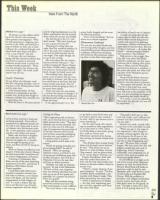
Rachel Ben Dor
-
or go back to your hotel room and
you have a pain in your stomach,"
he said, "and it's not because you've
eaten something.."
On tile other hand, after spend-
ing six months in daily negotiations
in an Eilat hotel in 1995, which
involved taking a steam bath, going
for a walk or a swim with
Palestinian representatives during
the evening, he became friends with
some.
"You develop these strange friend-
ships with formerly sworn enemies,"
he said. "They phone me up on
Passover or other holidays, and say
l'hag sameach. And we phone them
up on certain Islamic festivals, too."
Despite friendliness, both sides
take their orders from above, he
said, and the only relationships that
matter are between leaders, based on
mutual trust.
"There's a certain element of per-
sonal chemistry," he said. "The late
[Yitzhak] Rabin established a rela-
tionship with [Yasser] Arafat. They
didn't particularly love each other,
— there's a long history of dislike
— but they were negotiating part-
ners and they respected each other.
The same with Peres.
the futility of Israel's war in Lebanon.
A couple of months after the heli-
copter crash, by which time Ben-Dor
and her fellow activists had grown in
number and seemed to be gathering
momentum, a kibbutz movement news-
paper asked to interview them. She invit-
ed three to her home — all mothers like
herself— and the newspaper dubbed
their movement, "Four Mothers."
High points in the struggle, Ben-
Dor said, were when Yossi Beilin
called for withdraWal, the first time a
politician did so, leading other politi-
cians to follow, and the Netanyahu
government's decision to withdraw. A
low point, she noted, was when noth-
ing came of the Netanyahu govern-
ment's decision.
Along with the shouts of encour-
agement the demonstrators heard,
however, were also shouts of derision.
"I'm at peace with myself," she said.
"The fact is that Israel's way wasn't
working, and we had to try something
new And as far as the possibility of war
goes, war isn't something that happens,
it's something that leaders decide on.
"If it comes, I won't be responsible.
The people who blunder into war will
be responsible." ❑
"Netanyahu didn't get on that
well with Arafat, and it affected the
mutual trust that existed between
the two sides."
Mutual trust aside, outside influ-
ences have to be controlled, he said.
"When you get to this stage of
the negotiation, when things are
perhaps coming together, the out-
side pressures,. by all sorts of ele-
ments who are opposed, increase,
and this is what's happening now,"
he said. "We knew that it would
happen. We were aware that this will
happen towards the end, and it's
happening. And if it becomes
unbearable, and completely out of
control, then we're in trouble and
the process breaks down."
It's still difficult to see light at the
end of the tunnel of the Palestinian
question, he said, but Israeli Prime
Minister Ehud Barak still thinks an
agreement might be had by mid-
September and a solid forum is need-
ed with Arafat and President Bill
Clinton. With the problems in
Jerusalem, with refugees and borders,
security matters and water, all the
other heavy issues on the agenda, he
said, "The light is there, but I don't
know if we're getting closer to it." ❑
6/2
2000
9