

to us looking for someone, but
then on the other end of it, the
other person becomes a client
also. We have to respect both
wishes. We weigh whether or
not we should tell him or keep
it from him."
O'Neill said it has happened
before.
According to the Red Cross,
more than 900 people have
been located by the Holocaust
and War Victims Tracing and
Information Center in
Baltimore since it began in
1990. About 20 percent, which
include very distant relatives,
have refused contact from the
other side.
"It was determined that peo-
ple looking had a right to know
at least what we found, even
though it's painful," O'Neill
said. "You asked us to look, we
looked and we found some-
thing. It's not what I want
either."
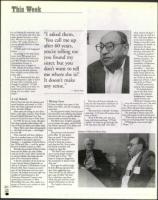
"I asked them,
`You call me up
after 60 years,
you're telling me
you found my
sister, but you
don't want to tell
me where she is?'
It doesn't make
any sense."
A Life Rebuilt
Harry Praw last saw his parents and
seven brothers and sisters in 1939,
after the Nazis captured his home-
town of Lodz, Poland.
After years of toiling in one slave
labor camp after another, Praw finally
found himself liberated. In a few
years he found his way to New York.
In 1949, he met an uncle, who gave
him three portraits taken before the
war of Praw, his father and oldest sister.
Harry Praw took these photographs
— this link to his past — and began
his new life.
Praw, married with four children,
lives in a modest home in Oak Park.
He worked in the plastic slipcover
business — a mainstay of Jewish life in
the 1950s and '60s — until he retired
because of health reasons in 1984.
Beneath the portraits of Harry's older
sister and his father, his wife, Esther,
curls up on the couch. She's warmed by
an electric blanket that helps ease the
pain of her rheumatoid arthritis.
A former president of the local sur-
vivors' group Shaarit Haplaytah, as
well as a member of Workmen's Circle
Branch 460, Praw remains an active
part of the Holocaust survivor com-
munity. He helped mourners light the
candles of remembrance at the
Holocaust Memorial Center's corn-
memoration ceremony in West
Bloomfield this year, then spoke to a
group of Russian war veterans at their
celebration a week later.
5/26
2000
a
— Harry Praw
They have all become friends, in a
way, but the frustration still shows on
Praw's face and in the sound of his
voice.
"She must have a family," he keeps
repeating. "A 90-year-olrl woman must
have a family."
"Even if she does, she may not
have told them anything," O'Neill
replied. "In order to get through life,
she may have just said, 'You know
Waiting Game
It's been another hour spent in the
Red Cross office, and the wrangling
continues.
For the past two weeks, Praw has used
the same drive and craftiness that helped
him survive the war to get the informa-
tion he needs to contact his sister.
The Red Cross wouldn't normally
try to contact her again, said O'Neill,
but Harry's pictures of his father and
sister represent new informa-
tion.
Barbara O'Neill and Harry Praw
The pictures were forward-
sAfwie4A,
ed on May 19, but there's
• ‘'sk, , t1.: `4-
been no word. If she declines,
the Red Cross would be
forced to drop the contact
and close her file. Praw's other
lost family members will
remain an open file.
"The Red Cross' mission is
not to cause people anxiety,"
O'Neill said to Praw. "We
hope to bring you happiness,
but sometimes it doesn't work
that way."
Praw gets the staff to laugh
by first offering expensive din-
ners, then suggesting they
"leave the file on the table and
get a cup of coffee" like they
do on television cop shows
when they give someone confi-
dential information on the sly.
The laughter doesn't get
results.
.
what, they're all dead. I
have to get on with my
life.' Our brain allows us
to do some wondrous
things to stay alive, and
sometimes it's denial, to
shut down the past.
Maybe that's what's kept
her alive until she's 90.
It's a delicate situation."
"To me, this is not a
delicate situation," he
insisted. "If you find
somebody, a Holocaust
survivor, especially,
nowadays — we're get-
ting up in age.. If some-
body would tell me we
found a brother or a sis-
ter, I'd be on the first
plane out of here. I don't
care if it's in China."
O'Neill answers his
remark with sympathy.
"Everybody knows
you in the Red Cross
now, at the national
headquarters' interna-
tional services, the
Holocaust tracing center
— we're all rooting for you," she said.
"We all envision a scene at the air-
port. We've all seen those reunions
and there's nothing more moving."
The meeting is almost over and
Praw still comes up short of his goal.
"What did we come with today and
what are we leaving with?" he asked.
O'Neill gives a one-word reply:
"Hope." ❑
&\\K' n5,