

;4.
I),
tit
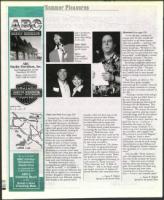
Right: Rabbi
Bergman warms
up the crowd
Below:
Chaircouple
Judi and Brad
Schram.
ABC
Harley-Davidson, Inc.
4405 Highland Rd. (M-59)
Waterford, MI 48328
Phone: (248) 674-3175
FAX: (248) 674-1630
r r
Scale in miles
2
1
0
3
THEN AND
I-75
Walton Blvd.
VVill
Lk. Rd.
.
%1 •
Great Lakes
Crossing
5
04. anon Biltd.
Pontiac .ake Rd. II
/-
1
Abu :
=Ton
Huron
Be sure to visit
ABC Harley-
Davidson's
dealership
on Highland Rd.
in Waterford and
ABC's
Clothing Store
7 14
5/26
2000
at the
Great Lakes
Crossing Mall.
Now from page S28
Situated just 100 miles northwest
of New York City, in the foothills of
the Catskill Mountains, the Borscht
Belt — a Jewish cultural phenomenon
replete with grand meals, fancy dress-
ing, weekend husbands, coming-of-
age dramas and kitschy humor —
took root in the early 1880s when
Charles Fleischmann, an Ohio senator
famous for yeast and distilleries,
bought 60 acres in Ulster County.
The more southerly heart of the
Catskills, Sullivan County, began
developing as a summer resort more
than a decade later when Jews who had
come to farm found the land inhos-
pitable and began taking in boarders to
make ends meet, Richman says.
Boarding houses gave way to
rooming houses called kuchaleyn —
"cook for yourself" — in Yiddish —
where guests would rent bedrooms but
cook and eat together in a community
kitchen. Rungalow colonies and the
famous hotels soon followed, reaching
their heyday in the postwar boom
from page S28
In the old days, mothers of
teenage girls, he says, would call
each season to ask resort owners
what was available — and they did-
n't necessarily mean rooms. "The
owner would say, 'We have six doc-
tors, four lawyers and 14 dentists,'
even if a kid was just in his first term
of pre-med," recalls Brook, a retired
upholstery salesman. '"The male
waiters all had to go to college."
Recalling loudspeaker announce-
ments reminding staff to remain on
the grounds, he adds: "The girls
would save up all year to come to
the Catskills and to have enough
clothes to change several times each
day."
Alan Stamm, an editor at The
Detroit News, grows nostalgic
remembering the Catskills, where he
spent a dozen summers as a young-
ster and later as a camp counselor in
the '60s.
"You'd go a certain week and get
to know people you didn't know in
the city. Many of them were
European immigrants who had left
Germany, left the Holocaust. This
was their refuge, their escape from
Manhattan . The women sat around
smoking cigarettes, playing canasta
and mah jongg, and the men played
shuffleboard and smoked cigars.
" These were simple pleasures, the
Americans. I
good life, for
remember the owner (at Stern
Summer Camp, Pinebush, N.Y.)
woke us up every morning playing
the accordion, and singing 'God
Bless America' around the flagpole."
Citing the "more is more,
wretched excess" of continuous meals
and kitschy comedy by such emerg-
ing performers as Joey Bishop and
Henny Youngman, Stamm compares
the experience to "a cruise without
water."
And, he adds: "Don't underesti-
mate the importance of young love.
You were in the country, the moun-
tains — there were stars overhead
and the moon was shining on the
pool. You could hear the birds sing.
.Every summer you were either
renewing love or discovering new
love — it was a very romantic place."
MEMORIES
Left: Comedienne
Kathy Buckley
leaves them rolling
in the aisles.
UMW
-
decades, when city Jews came to the
mountain resorts- to relax. Earlier,
they'd sought fresh air as an antidote
to tuberculosis and to escape over-
crowding on the Lower East Side.
"All those hotels prided themselves
on having the very latest in enter-
tainment," Richman says. And
mothers liked that they could be free
of their kids, who were supervised at
both hotels and bungalow colonies
by day-camp counselors.
Starting around the '70s, howev-
er, jet travel, an aging clientele and
various other social and economic
factors led to the region's demise as a
prime Jewish vacation retreat. Today,
the golden era of the Catskills lives
on, in varying degrees of accuracy, in
such movies as "Sweet Lorraine,"
"Dirty Dancing" and "A Walk on
the Moon" - and in the fond, nostal-
gia-tinged memories of legions of
Jewish families who vacationed there.
— Susan R. Pollack
Special to the Jewish News
— Susan R. Pollack
Special to the Jewish News