

This Week
FACES
5/26
2000
10
The Culture of Adoption
from page 6
These families want their children,. who may look want to return to the gene pool of their pasts.
Others have political reasons to go abroad, prefer-
different or come from different religious upbring-
ring to raise a child already born, but with no par-
ings but are being brought up Jewish, to be accepted
ents. Still others fear the unclear legal rights of birth
by the community.
mothers in this country.
"Multiracial adoption forces everyone to think
After the governmental red tape, the language
about what it means to be a Jew," says Boston-area
barriers and the international flights that most for-
Reform Rabbi Susan Silverman. Last year, she and
eign adoptions encompass, Jewish
her husband adopted an infant
adoptive families face additional
from Ethiopia.
Anca Vlasopolos and Anthony
daily challenges. These range from
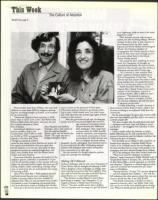
International adoptions in gen- Ambrogio, above, hold a photo of
their just-adopted daughter
concerns about the child's possible
eral are steadily rising in the
United States, from 7,093 in 1990 Beatriz, right, and her brother Jose need for conversion and acceptance
in the Jewish community, to issues
to 16,396 in 1999, as reported this Hecker. The couple also have a
biological
daughter,
Olivia.
surrounding the child's identity and
March in The New York Times.
how to integrate the birth culture
Though no statistical evidence
alongside a Jewish upbringing. Some families need to
exists for how many of these families are Jewish, all
be concerned with the effect of blending adopted
the experts interviewed for this story agree that
children with biological ones and/or having their
Jewish adoption is on the rise. And more of these
sons circumcised at an older age.
prospective parents are seeking foreign-born chil-
But the rewards of a foreign adoption, parents
dren, most notably from Asia, the former Soviet
insist, far outweigh the challenges.
Union and Latin America.
Sometimes infertility becomes the catalyst for the
adoption process. Infertility is estimated at 15 per-
Making Of A Mitzvah
cent for all married couples in this country and even
Anthony Ambrogio and his wife, Anca Vlasopolos of
higher for educated Jewish couples who have put off
Grosse Pointe, had no thoughts of adopting a child.
having children. Most undertaking a foreign adop-
With a daughter, Olivia Ambrogio, in college, they
tion, at some level, also are motivated.by the notion
were enjoying having more free time together. Then
of rescuing a child.
they read an article last year that motivated them to
Since 1973, when Roe v. Wade legalized abortion
adopt Beatriz, an 11-year-old Guatemalan.
and birth control became more widespread, fewer
"The decision to adopt Beatriz is one of those
healthy Caucasian infants have been available for
hard things to explain," says Vlasopolos, 51, an
adoption here. This, too, has prompted more prospec-
English professor at Wayne State University in
tive parents to start investigating international adop-
Detroit. "You hear terrible stories about children
tion as an alternative means to building their families.
who are homeless and the image of a girl left behind
Some go to the former Soviet Union because they
in an orphanage made us want to do some-
thing if we could."
Their mitzvah was not only saving an
orphan, but also reuniting siblings. Beatriz's
younger brothers, Jose, 9, and Gustavo, 3,
were adopted earlier by Alice Audie-
Figueroa and David Hecker of Huntington
Woods. The Heckers, members of
Congregation Shir Tikvah, hoped to find a
home for their sons' sister through an arti-
cle written about them in the former
Detroit Sunday Journal.
The match has been satisfying on many
levels. For Vlasopolos, it's brought an
extended Jewish family. She has no Jewish
relatives in this country since her mother, a
Holocaust survivor, died 10 years ago.
"It's a mitzvah to raise someone else's
child," explains Orthodox Rabbi Steven
Weil of Young Israel of Oak Park. "The
Talmud says that anyone who raises a child
along halachic lines of a perfected. Jewish
life, it's as if they gave birth to that child."
Rabbi Elimelech Silberberg at Sara
Tugman Bais Chabad Torah Center, and a
member of the Presidium, Council of
Orthodox Rabbis, offers a different inter-
pretation. "The mitzvah is raising an
orphan, and there is no higher accolade.
But that has nothing to do with the types
of adoption we do today."
To Rabbi Silberberg, a couple choosing to
adopt because of their desire to have a child is not
the same as taking in an orphaned child from the
community.
But he acknowledges the great pain women suffer
who can't have children and the void it can create in
a Jewish couple's life.
The three couples who founded the Jewish faith
— Abraham and Sarah, Isaac and Rebecca, Jacob
and Rachel — all struggled with infertility in their
marriages.
Once a couple makes the decision to adopt,
Rabbi Silberberg says he will counsel them in the
process of conversion and the halachic tradition that
embraces the laws of Judaism.
Not all rabbis are as willing to take a position on
foreign-born adoption. Orthodox Rabbi Eliezer
Cohen of Or Chadash says he has no thoughts on
the issue and has had no contact with people in his
synagogue who have adopted foreign-born children.
Part of the ambiguity stems from unclear Jewish law.
"There is no word for adoption in classical
Hebrew," states Conservative Rabbi Michael Gold of
Temple Beth Torah in Tamarac, Fla., and the author
of And Hanna Wept, a Jewish approach to infertility
and adoption. "Adoption is a formal legal procedure
unknown in Jewish law because Jews put impor-
tance on bloodlines.
"Having said that," he says, "I'm very pro-adoption
— and have adopted three children — but with the
full realization that when parents adopt they raise real
issues in Jewish law, like, is my child Jewish?
"The Jewish community is divided on what is
required to become a Jew," says Rabbi Gold. And
that can be one of the most painful aspects of adop-
tion. Whatever Jewish parents decide for their chil-