

JNEditorials
Editorials and Letters to the Editor are posted and archived on JN Online:
www.detroitjewishnews.com
The Jewish Connection
e're proud of the Jewish support
behind the Detroit Symphony
Orchestra's $125 million fund-
IVIIT raising campaign.
Organizers say the campaign, expected to
end in 2002, will bring major building
improvements and a stronger orchestra endow-
ment. That Jews would fall in behind a cultural
jewel like the DSO is no surprise. They've long
supported the symphony, going back to music
director Ossip Gabrilowitsch, a Russian-born
Jew, in the 1920s.
The DSO unveiled its campaign to make
the 81-year-old Orchestra Hall more resplen-
dent in response to Max Fisher's prodding in •
1994. Fisher's prodding spurred son-in-law
Peter Cummings (then board vice chair) and
other DSO brass to dream beyond brickwork,
landscaping and lighting.
The DSO's Campaign for the Future donor
list now includes several $500,000-plus donors.
Among them are Jean and Sam Frankel, Mari-
lyn and Bernard Pincus, Marjorie and Max
Fisher, David and the late Marion Handleman
and Handleman Co., Shirley Schlafer, Julie and
Peter Cummings, Lois and Judge Avern Cohn,
Judy and Stanley Frankel, Aviva and Jack
Robinson, Marianne and Alan Schwartz and
Jean Shapero.
They and other Jewish friends of the DSO
are responsible for $21 million of the $91
million raised so far: 23 percent. That degree
Related story: page 6
IN FOCUS
of support says much about the Jewish com-
mitment to the cultural arts and Detroit's
rebirth, especially because Jews make up only
a tiny percentage of the region's population.
In tribute to Max Fisher's dream of some-
thing special six years ago, the final phase of
the new Orchestra Place, a Woodward Avenue
arts, educational and commercial complex with
boundless potential for investment and vitality,
will be named, aptly, the Max M. Fisher Cen-
ter for the Performing Arts. Slated to open in
2003, the 130,000-square-foot addition will
boast a four-story atrium lobby, a 550-seat con-
cert hall and the Jacob Bernard Pincus Music
Education Center.
At an age when rest and relaxation are the
norm, Fisher, two months shy of 92, is still
eager to do his part in revitalizing Detroit. It's
the city where he honed his business acumen in
oil and real estate, the city he is still loyal to,
even though the Jewish community now lives
mostly north and west.
Though slower in step, Max Fisher remains
a pillar of metro Detroit and the patriarch of
Jewish Detroit.
.If the generosity that flows from the Cam-
paign for the Future rejuvenates the once-
neglected neighborhood around Orchestra
Place — while expanding programs, endowing
operations and attracting new patrons for the
DSO — Max Fisher's calculated nudging will
not have been for naught.
Rather, another significant stride in the pur-
suit of a new Detroit will have been taken. ❑
Catching Up
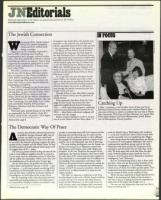
A May 1 reception at the Franklin home of Jane and Larry
Sherman honored former Israeli prime minister Shimon Peres,
who was in Detroit to deliver an address the next day at Wayne
State University. With Peres and Jane Sherman are, seated, Max
Fisher (Jane's father) and Penny Blumenstein, Jewish Federa-
tion of Metropolitan Detroit president.
The Democratic Way Of Peace
merican Jews should understand governmen-
tal gridlock, having witnessed eight years of
inaction on health care, gun control and
campaign financing, to name just a few top-
ics on which the national consensus outpaces the parti-
sanship of the Congress and the White House. So they'
should be patient as Israel's political leaders grope with
the biggest issue of all — peace.
The tortuous process toward ending the state of war
with its most bellicose neighbors seemed to unravel a
bit this week amid the Palestinian protest of what they
call the nakba, the catastrophe, which is how they view
the establishment of the Jewish state 52 years ago.
On the West Bank, the gunfire left three Pales-
tinians dead and hundreds injured; in Israel — and
in America — it left many people wondering if the
hopefulness of Ehud Barak's accession to office one
year ago has been crushed by the harsh realities of
intransigence on both sides of the Jordan River.
But the surprising truth is that the process toward a
responsible and lasting settlement with Palestinians is
no worse off for Monday's violence and indeed it may
A
Related story: page 26
actually be somewhat better off. And, however sad the
shooting and rock-throwing was, by week's end the
incidents and the political reaction to them affirmed
the strength of a democratic process in Israel and the
need for one in the Palestinian state that is aborning.
The most striking development was the Knesset rat-
ification of turning over to Palestinian control Abu
Dis, Eizariya, and Suwahra, three small villages near
Jerusalem. In the vote, Barak lost the support of one
small group, the National Religious Party, but he held
the main parts of his coalition government together in
what amounted to a meaningful vote of confidence in
his handling of the negotiations with Yasser Arafat.
Barak and his partners deserve applause for staying the
course — despite the unnecessary and inflammatory
rhetoric of the PLO executive committee, which went
out of its way to offend Israelis in its praise for the
nakba protesters.
The effort to negotiate a settlement with Syria
has foundered on the rock of Hafez Assad's inability
to deal with the 21st century. But talks between
Israel and the Palestinians on the tough issues of
land, security, water and refugees have continued
quietly in Stockholm. They have laid the ground-
work for Barak's trip to Washington this weekend
— a trip that would have been a fool's errand with-
out the successful vote on transferring the villages.
Some things about the Israeli democracy are flawed.
It continues to overrecognize Ashkenazic men and to
underrepresent significant groups such as the Arab-
Palestinians who now account for 20 percent of the
population and the haredi who are more than 10 per-
cent. We don't agree with much that Shas, the rigor-
ously Orthodox political party stands for, but it is •
wrong to view the party and its demands as somehow
endangering "true" democracy.
But the overwhelming truth is that it does work
and that, when you get beyond the bombast of the
Palestinian demagogues, it is a Mideast model to
which most of those two million people aspire. They
understand that their interests will never be served
by the Assads of Syria or the mullahs of Iran.
When the peace agreement is finally signed between
Barak or his successor and Arafat or his successor, it
will have a chance of lasting because the majorities on
both sides of the Jordan have bought into it.
No one ever said democracy was easy, just that it
beats everything else. ❑
6s,
5/19
2000