
Arts it entertainment
Dealing In Modernism
Humanities professor will discuss the role of ewish art dealers
in the development of new trends in the visual arts.
Dellheim will explore the image of Jews in business.
"The role of Jews in the modern art world is
immense," says Dellheim, director of the humanities
program at Arizona State University. Under the spon-
ene Gimpel's signature may not appear on
sorship of the Cohn-Haddow Center for Judaic Studies
any masterly painting, but he certainly
at Wayne State University, the Anti-
had a strong hand in popular-
Defamation League and the Detroit
izing art. As a dealer whose
Institute of Arts, the professor is about to
business expanded in Paris, Gimpel's
make his first visit to Detroit.
influence reached to the Motor City
"Even though it's not true the Second
through his client Edgar Whitcombe, a
Commandment prohibits making all visu-
benefactor of the Detroit Institute of Arts.
al icons -- what it actually prohibits is
Gimpel, who joined the French
making idols or graven images of God —
Resistance and died in a concentration
Jews
were still traditionally a people of the
camp, will be among the Jewish art deal-
book more than a people of vision. But in
ers discussed by humanities professor
the late 19th and 20th centuries, as they
Charles Dellheim as he covers "Next Year
begin to assimilate culturally into Europe,
Charles D ellheim:
in Paris: Jewish Art Dealers and Modern
art
plays into this scenario."
"The story takes place
Culture" May 17 at the DIA.
Dellheim will explore how and why
largely in Paris."
The talk, a presentation of the annual
Jews
became important as art dealers
Kalman Lassner Memorial Lecture, this
as
well
as
the
effects
on their identity: turning
year given in conjunction with the van Gogh exhibit,
from
an
"artless
people"
to an "artful people." He
will follow by one day another Dellheim discussion,
also will show how they suffered during the
"ShyloCk's Shadow: Myths and Practices," at the
Holocaust for their identification with art, espe-
Janice Charach Epstein Museum/Gallery in West
cially modern art, and how the Nazis condemned
Bloomfield. Presenting a more general theme,
SUZANNE CHESSLER
Special to the Jewish News
II
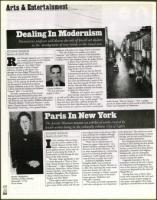
Andre Kertesz: "Rue de Chateau," 1932. Leading
Jewish art dealers based in Paris served as both cultural
brokers and champions of Modernism. -
Paris In New York
The Jewish Museum mounts an exhibit of works created by
Jewish artists living in the culturally vibrant City of Lights.
SUZANNE CHESSLER
Special to the Jewish News
I
Amedeo Modigliani:
"Portrait of Anna (Hanka)
Zborowska," 1916,
oil on canvas.
VgA
5/12
2000
U2
n the catalogue that accompa-
nies the current exhibit at the
Jewish Museum in New York,
there's a reference to the role of
Jewish gallery owners, critics and col-
lectors in promoting the work of
Jewish artists in Paris during the first
third of the 20th century.
The essay relates specifically to the
12 artists featured in "Paris in New
York: French Jewish Artists in Private
Collections" — Marc Chagall, Sonia
Delaunay, Mane-Katz, Moise Kisling,
Jacques Lipchitz, Louis Marcoussis,
Amadeo Modigliani, Elie Nadelman,
Chana Orloff, Jules Pascin, Chaim
Soutine and Max Weber.
Thirty-eight works by these artists
will be on display through June 25 to
give a sense of the artistry and the pres-
ence of great works in the private collec-
tions of Jewish New Yorkers, although
the display has been supplemented by
pieces owned by the museum.
"There was an infrastructure in
France to support these artists," says
Susan Chevlowe, associate curator of
fine arts at the Jewish Museum. "For
us, their representation is a continuing
part of our showing Jewish artists
working in world capitals, and we
want to focus on rarely seen work."
Exhibition highlights include
Chagall's Rabbi, once owned by
George Gershwin; Pascin's Hermine in
a Blue Hat, depicting the artist's muse
who later became his wife; and
Soutine's Landscape at Oiseme, painted
near the country house of the artist's
major patrons, Madeleine and
Marcellin Castaing.
"The works are mostly expressionist
with color and gesture very important,"
Chevlowe says. "The artists have used
formal elements of paintings to express
feelings, and no one except Delaunay
reaches complete abstraction."
East European Jewish artists began
settling in Paris during the first decade
of the 20th century, when the city
became a mecca for Jews from diverse
geographic, economic and religious
backgrounds, and the metropolis
seemed to remain so until the Nazis
started coming into power.
Originally attracted to the cos-
mopolitan culture of the city, a haven
for bohemians and foreigners at the
turn of the century, most of this com-
munity was dispersed by the onset of
World War II.
During their time in Paris, these
artists were nurtured by the city's envi-
ronment and the creative energy of
their peers, and together they made
significant contributions to the stylistic
Scanned image of the page. Keyboard directions: use + to zoom in, - to zoom out, arrow keys to pan inside the viewer.
May 12, 2000 - Image 116
- Resource type:
- Text
- Publication:
- The Detroit Jewish News, 2000-05-12
Disclaimer: Computer generated plain text may have errors. Read more about this.