

This Week
Remembering The Shoah
Another View
Historian's book sparks controversy, exploring
why the Holocaust has loomed so large in our culture.
HARRY KIRSBAUM
StafrWriter
!, eter Novick knew his book would be con-
troversial, but he didn't expect his intentions
to be so misunderstood.
When it was announced that Novick
would be speaking on Friday, April 28, at the
Birmingham Temple, some people were enraged that a
Holocaust denier would be given this forum.. Since he
began his book tour last summer, Novick has dealt
with angry Holocaust survivors fueled by newspaper
articles from journalists who haven't read his book.
Novick, 65, says he doesn't deny the Holocaust.
Instead, through exteAsive academic research, his book
The Holocaust in American Lift (Houghton Mifflin,
1999) pursues the reasons why "the Holocaust has
loomed so large in our culture."
The author, a University of Chicago professor of
history, said his idea came after noticing a contrast in
the amount of attention paid to the Holocaust — a
great deal since the 1980s but nearly nothing in the
1950s. After 10 years - of research in archives across the
country, Novick, a founder of the Jewish studies pro-
gram at University of Chicago, has written a book that
raises controversial questions and makes some
provocative points.
Among them:
• American Jews were hesitant to speak out about
European Jewry for fear of a rise in American anti-
semitism. Besides, bombing rail lines would have had
a very temporary impact, and shelling the camps
themselves would only have forced the Jews to rebuild
them. The quickest way to rescue the Jews was to end
the war.
• Polish-born statesman David Ben-Gurion felt that
working for the creation of a Zionist state took prece-
dence over working to save Europe's Jews. After the
war, Ben-Gurion said the survivors included "people
who would not have survived if they had not been
what they were — hard, evil and selfish people, and
what they underwent there served to destroy what
good qualities they had left."
• When World War II ended, the war against
Nazism became a continuation of a war against totali-
tarianism. The Cold War saw Americans ally them-
selves with West Germany, which forced a "marginal-
ization of the Holocaust."
• American Jews kept a positive spin on the
Holocaust in the 1950s by commemorating only the
Warsaw Ghetto uprising, leaving survivors themselves
to commemorate the horrors of the Holocaust.
• The Holocaust was firmly planted in the
American Jewish consciousness after the Six-Day War
in 1967, and especially after the Yom Kippur War in
j.
4/28
2000
16
1973, when an isolated and vulnerable Israel was
seen as similar to European Jewry.
• No real "lessons" can be learned from the
Holocaust.
"There are people who like the book a lot
and people who hate it, which is not saying
much," Novick said.
His aim in writing the book was to foster dis-
cussion and hope that, "particularly among
American Jews, some reconsideration of priori-
ties might take place," he said. "I have this
teacher's impulse not to sell a bill of goods to
anybody, but re get people to think harder about
things they haven't thought much about before."
"In one sense, my argument that for
American Jews [the Holocaust] has become the
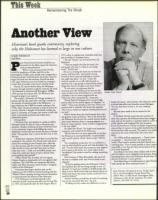
center of their sense of Jewishness in a way that's Author Peter Novick
unhealthy is by no means original with me.
Others have been saying this for a long time.
"Saving Eastern European Jews was not a high
besides the point," said Gorman, who shares her story
priority item for the Jewish Agency in Palestine," he
in school assemblies and churches across Michigan.
added. "These were attitudes at the time. This is not
"For me, they have to hear it. It's not a healing
controversial to anybody who knows the material.
process."
This is by no means an original, startling discovery on
She said there needs to be an answer for the
my part."
deniers.
Novick doesn't deny that the European Jews were
In his book, Novick writes that the numbers of
the greatest victims in history. "But to the extent that
those
who question the Holocaust have been exagger-
the Holocaust has become the central memory leads a
ated,
and
can be traced to a question asked in a poll. A
great many American Jews, in varying degrees, to a
public opinion poll conducted for the American
kind of 'victim identity,' which I think is inappropriate
Jewish Committee in 1993 by the Roper Organization
in the year 2000."
daimed that 22 percent of the public doubted that the
He called Elie Wiesel, "the single most important
Holocaust
had really occurred. The statistic was widely
interpreter and symbol of the Holocaust.
reported
in
the press. Meanwhile, Jews were aston-
"He has been the one most responsible to say that
ished.
the Holocaust is incomprehensible, unrepresentable
The Gallup polling organization — Roper's main
and a sacred mystery, which I don't-accept," Novick
competitor
— "deconstructed" the original poll
said.
results.
They
found a question had been framed in a
'As a completely secular Jew, I'm not entitled to a
confusing way "Does it seem possible or does it seem
vote on what should be sacred and what shouldn't," he -
impossible to you that the Nazi extermination of the
said. "On the other hand, the numerous, very religious
Jews never happened."
Jews I quote in the book, very much object to the
According to the book, when Gallup took its own
`sacralization [the author's word for making something .
poll
and asked a more straightforward question, those
sacred]."
expressing
doubt about the Holocaust shrank from 22
Erna Gorman of West Bloomfield, who survived
percent
to
between
1 and 2 percent.
the war as a hidden child, says Novick's book is not
Such
debunking
of misinformation is what Novick
objective.
hopes people get from reading his book. ❑
"If you're speaking about the Holocaust, I blame
the American Jews for not doing enough to save us,"
she said. "It wasn't just 10,000 or 20,000 people who
Peter Novick will speak at 8 p.m. Friday, April
died, it was a whole society that was almost wiped out.
28, at the Birmingham Temple Book Fair,
Didn't they know that some of them could have been
28611 West 12 Mile Road, Farmington Hills.
saved by bribery?"
Admission
is $8; $5 for members. For infor-
Novick "touches on little bits of truth of everything
mation,
call
(248) 477-1410.
but it's not necessarily like that," she said.
"If telling my story makes any difference or not is