

Entertainment
eZerAr..3,Viza
•
Z ceatIVW kNi's1
On The Bookshelf
Devil
The Details
The second volume of Victor Klemperer's diary of life in
Nazi Germany bears witness to unbearable times.
ARTHUR SALM
Copley News Service
I shall go on writing. That is my heroism. I
shall bear witness, precise witness!"
The style is straightforward, the tone
restrained — almost matter of fact. In I Will
Bear Witness: A Diary of the Nazi Years, 1942-1945
(translated by Martin Chalmers; Random House;
$29.95), Victor Klemperer wasted no time on
imagery, made no attempt to evoke sympathy, didn't
deign to rail against his oppressors.
The devil, he knew, is in the details, and despite
hardship and terror and chaos, through crushing
depression and incalculable sorrow, he chronicled
Nazi evil with unswerving doggedness and cold preci-
sion.
The result is one of the most remarkable docu-
ments to come out of the Second World War. Long
thought lost — perhaps suppressed and destroyed by
the Communist East German government — the
diary was discovered just a few years ago in the
Dresden Landesarchiv, where Klemperer's wife had
deposited the manuscripts after his death in 1960. Its
publication was a national event in the new
Germany.
At the time of Hitler's rise to power, Klemperer
was a distinguished professor of Romance languages
in Dresden. Although his father had been a rabbi,
Klemperer as a young man converted to
Protestantism and married a non-Jew, though the
conversion seems to have been for the sake of conve-
nience: Several times in his diaries, Klemperer makes
it clear that he is a strict nonbeliever.
Jewish spouses of "Aryans" were not systematical-
ly rounded up and sent to concentration camps —
not at first, anyway. Bizarre as it seems, as late as
early 1945, a few ragged souls with a yellow, six-
pointed star stitched on the sleeves of their thread-
bare coats could still be seen walking the streets of
Nazi Germany. One of them was Victor Klemperer,
and though its discovery would have meant death,
he was keeping a diary.
Already, by the beginning of this second volume
(the first, published in English translation last year,
covers the years 1933-1941), Klemperer has been
dismissed from his position at the university and
stripped of most of his possessions, including his
home.
He and his wife, Eva, are living in a "Jews'
House," one of a handful of crowded tenements for
Dresden's shrinking Jewish population. Forbidden to
get a job, use a library, attend the cinema, ride pub-
lic transportation except during certain
hours, Klemperer spends his time trying
merely to get enough food to eat — and
chronicling the day-to-day intricacies of
Jewish life in Nazi Germany.
There was the constant fear of house
searches, during which the Gestapo might
exercise the option of arresting someone —
there was always a reason — and sending
him to a "labor camp," or certain death.
More often, though, the Nazis simply
stole food, wrecked the rooms and roughed
up the inhabitants, concentrating on older
women. "Why are you still alive?" they
would demand, frequently giving hints on
methods for suicide.
Since Dresden was not an overly large
city, and since there were fewer and fewer
Jews, Klemperer and the others came to
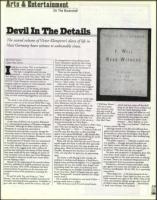
"I Will Bear Witness"• which had been taken off the shelf,
recognize individual Gestapo members. He
"The best written,
lying on the desk. If one of them had
refers to two by their nicknames — Boxer,
most evocative, most
been the Greek dictionary, if the
who liked to box ears, and Spitter, whose
observant record of
manuscript
pages had fallen out and
pastime was spitting in Jews' faces.
daily life in the Third
had
thus
aroused
suspicion, it would
With the hindsight of a half-century, and Reich," wrote author
undoubtedly
have
meant my death.
from the perspective of the other side, it is
Amos Elon in the
One
is
murdered
for
lesser misde-
difficult to imagine the state of the war as it
New York Times.
meanors. ... But I shall go on writ-
was perceived inside the Third Reich.
ing. That is my heroism. I shall bear
"On every birthday since October 9, 1934, I have
witness, precise witness!"
said: 'Next year we shall be free!' I was always
Although already in his 60s and suffering from
wrong. This time" — 1943 — "it looks as if the end
angina
and malnutrition, Klemperer was dragooned
must be near. But they have so often prevailed
for
months
at a time into forced labor, first shovel-
against every natural likelihood ... why should they
ing
snow
through
a hard winter, then working long,
not go on conducting war and murdering for anoth-
deadening
hours
in
a factory.
er two years? I am without optimism now."
This public exposure — which he avoided when-
Worse still was the belief that the end of the war
ever possible — brought him and his yellow star
would inspire the Nazis to redouble their genocidal
into direct contact with the German public. Boys
efforts. And everyone knew that mass murder was
taunt him; men sometimes take the time to spit, or
taking place. Word of Auschwitz had filtered back to
to call out, "Why don't you die, you rogue!"
Dresden; Klemperer first mentions it in March
Yet there were exceptions: A shopkeeper gives him
1942, not long after the gates into its maw swung
more than a food coupon is worth. Two elderly
open.
women stop him on the street and insist on shaking
The diarist is self-effacing in the extreme. He
his hand. There is an occasional whispered word of
confesses to stealing small amounts of food from a
encouragement from an anonymous passerby.
slightly better provisioned neighbor ("It is a dreadful
Klemperer, a devoted German nationalist, strug-
humiliation for me, that I pilfer these things") and
gles against the notion that the Nazis are a uniquely
to buckling under the strain of unrelenting terror
German manifestation. Yet by 1942, he is expressing
("The mornings are so dreadful. Everything closes in
reservations.
on me all at once. Shall I be beaten and spat upon
"What shakes me ... is the precariousness of my
today? 'Summoned'? Arrested? Arrested now means
position as a German. Equal rights for Jews not until
certain death").
1848, restricted once again in the 1850s. Then in the
He is capable of striking but one kind of blow —
1870s anti-Semitism already stronger and, in fact, all
putting words down on paper:
of Hider's theory already developed. ... Nevertheless:
"After the house search I found several books,
I think I am German, I am German. ..."
4/28
2000
1 01