

its Entertainment On The Bookshelf
In Search Of Justice
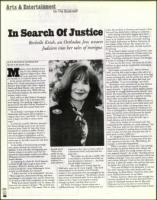
Rochelle Krich, an Orthodox Jew, weaves
Judaism into her tales of intrigue.
ALICE BURDICK SCHWEIGER
Special to the Jewish News
111
41N
4/21
2000
98
ystery writer Rochelle Krich
says it's easy making her pro-
tagonists religious Jews. After
all, as an observant Orthodox
Jew herself, it's a world she knows well.
In her newest nail-biter, Dead Air (Avon
Books; $23), Krich reintroduces homicide
detective Jessie Drake (Fair Game, Angel of
Death and Blood Money), who recently has
learned of her Jewish roots. While delving
into Orthodox Judaism, the detective solves
another violent crime.
Krich will be at Adat Shalom Synagogue
on Thursday, May 4, for a discussion and
book signing. Her speaking engagement is
sponsored by the Adat Shalom Sisterhood in
conjunction with their annual fund-raiser
donor day.
. "In my books, I am happy to be able to
disseminate information about Judaism, a
religion that I love," says Krich. "At the same
time, I hope I am able to correct stereo-
types."
, In Dead Air, popular talk-show therapist
Dr. Renee Altman turns to her old friend
detective Jessie Drake for help after being
harassed by an unknown stalker. Shortly
after Jessie agrees to investigate, Renee's 6-
year-old daughter is kidnapped, and her
nanny is murdered: While thousands of lis-
teners tune in, the killer taunts the talk-show
host on the air.
In the midst of the harrowing investiga-
tion, Jessie continues her journey into
mysteries is that I get to restore order to
Rochelle Krich:
Judaism. It was only after investigating anti-
a disordered world, and Jessie feels the
`Many
of
my
Semitic crimes in an earlier novel that she
same way.
learned her Episcopalian mother was really a readers are not
Jewish, and I like
"But unlike me, she has a mother who
Holocaust survivor who had hidden her
explaining Jewish is very abusive, and that's one of the rea-
Jewish identity.
traditions to a
sons she became a detective — she finds
In preparing for Dead Air, Krich listened
wide audience."
her job highly therapeutic."
to hours of talk radio to get a sense of the
The impetus for writing Dead Air,
dynamics. While Dr. Renee's style may
Krich
says,
came
out of a local tragedy. "This book
sound a lot like Dr. Laura Schlessinger's, Krich
was prompted by the murder of an Orthodox
wanted to individualize her character.
woman in my community who was strangled by her
"I didn't want her to be stereotypical," she says.
violent husband," she reports. "We all had a tremen-
"[But] tough love, shoot-from-the-hip, talk-show
dous source of communal guilt. So in a way this is a
psychology is very popular now, and Dr. Renee has
tribute to her. I hope I can empower women
to do that in order to be competitive in the ratings."
through my fiction and help them survive."
While Krich doesn't identify with Dr. Renee, she
For Krich, becoming.a mystery writer was a
does with the character of Jessie. "We are both pur-
childhood
fantasy. The daughter of Holocaust sur-
suing justice," she notes. "The reason I like to write
vivors, she was born in Germany and moved to New
York and New Jersey before settling in California.
After earning a bachelor's degree from Stern
College and a master's from UCLA, she began a
career as an English teacher, eventually chairing
the English department at Yeshiva University of
Los Angeles High Schools. But despite her suc-
cessful educational career path, she had a passion
for writing.
"In my head I always wanted to be a writer," says
Krich, who has been married for 29 years and is the
mother of six grown children and four grandchil-
dren. "I had been teaching for 18 years and thought
I would try writing at the same time.
"I sent out my first novel, Till Death Do Us Part,
without an agent and got wonderfully encouraging
rejection letters."
Krich began a second novel, Where's Mommy
Now?, and was able to get an agent, who sold it to
Avon Books. The editor there asked Krich if she had
written anything else, and the author sent along Till
Death Do us Part, which the editor also liked, and
got published. "It was very exciting," . says Krich.
Choosing to write mysteries was an easy decision
for the author, who's always enjoyed the puzzle
aspect of stories. "I grew up reading Agatha Christie
and loved the struggle between good and evil," says
Krich. The author now has nine published books to
her credit, and eventually had to quit her teaching
job to allow more time for her writing career.
Not only does Krich pursue the ideal of justice in
her novels, she also is able to weave social issues and
Jewish story lines within a riveting crime story. In
Blood Money, a suspicious death of a Holocaust sur-
vivor is investigated; in Angel of Death, Jessie investi-
gates anti-Semitic crimes and discovers her Jewish
roots. Till Death Do Us Part tells the story of a
Jewish man who refuses to give his wife a get, a
Jewish divorce, and is murdered.
"Many of my readers are not Jewish and I like
explaining Jewish traditions to a wide audience," she
says. "Non-Jews [tell] me they didn't know if they
would be interested in reading about a Jewish char-
acter or issue, but that they were glad they did. It
feels good to make a difference."
As a daughter of Polish Holocaust survivors, it's
impossible for Krich not to bring some of her par-
ents' experiences into her work. Blood Money, for
example, is somewhat biographical.
"When I was about 12 years old, I was rummag-
ing through my parents dining room cabinet and
came across a photo of a young woman who was
very elegantly dressed," she recalls. "Standing next to
her was a young bearded man with peyot, and he was
holding a little girl. There was a pram next to them
with another little girl. I had no clue who these peo-
ple were. I asked my mother, who told me they were
my father's first wife and their two daughters.
"They were all killed in the Holocaust. It was the
first time I learned of his other family and it was
devastating. In Blood Money, I based my main char-
acter, Nathan Pomerantz,' on my father.
"Nathan, however, whom you meet on page one,
has been murdered. But we learn about him from a
series of videotaped narratives that he, like other
Holocaust survivors, has done to record history.
Nathan's account of what happened to him is based