

Have
your party
at
In The Hands Of Heroes
•
,
Detroit Public Television airs a
documentary on the only all-Jewish
fighting unit ofWorld War II.
The
Perfect Place
for
}Bridal Showers
}.Baby Showers
a-Retirement
}Office Parties
la-All Special Occasions
Customized Menus
Southfield;
248-351-2925
29244 Northwestern Hwy.
St. Clair Shores:
810-498-3000
23722 Jefferson at Nine Mile
Detroit
313-965-4600
400 Monroe in Greektown
11111111111111111111111411111111
4/21
2000
100
372 Oullette Avenue • Windsor, Canada
SUZANNE CHESSLER
Special to the Jewish News
lc
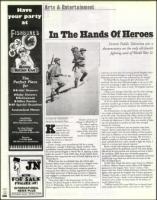
Members of the Jewish
Brigade in World War IL
The soldiers' uniforms
bore a yellow Star of
David. Flanked by
stripes of blue and white,
the symbol of shame
became a badge of hope.
hamutal Eitam
turns 21 this
month, but col-
lege, career and
dates are not her priorities.
Already a veteran of the Israeli
army, she serves as a volunteer
medic in Kosovo.
Eitam, living a very nontraditional life for a young
sophisticate, actually is following a family tradition. Her
grandfather, retired journalist Hanoch Bartov, was a mem-
ber of the Jewish Brigade in World War II, fighting in Italy
before he turned 17 with 5,000 other Jewish soldiers from
Palestine who comprised the only all-Jewish fighting unit in
World War II.
While Eitam has not decided what she will do after
Kosovo, Bartov knew what he would do as a brigade mem-
ber after the war — serve as a medic helping survivors.
Others from Palestine formed secret vengeance squads to
assassinate Nazi officers in hiding, engineered the rescue
and illegal movement of Holocaust survivors to Palestine
and engaged in widespread arms thefts for Israel's future
War of Independence.
Their story, told in the documentary In Our Own
Hands: The Jewish Brigade in World War II, will be shown at
10 p.m. Wednesday, April 26, on Detroit Public Television.
Bartov appears in the 90-minute film, which gathers the
testimony of more than 40 surviving Jewish Brigade volun-
teers and historical footage, as well as interviews with
Holocaust survivors who were influenced by the brigade.
"In World War II, because the Jews of Europe were
unarmed, the Jews from Palestine fought to say we are still
here and we're going to fight the Germans as much as we
can," says Bartov, who wrote a novel, The Brigade, based on
his experiences.
"That is one message of the film, and the other message
is that the State of Israel came to be, to a great extent,
thanks to those survivors who lost hope and then found
new hope of being their own masters in their own country
"If not for those hundreds of thousands of people who
said they wanted to go to Israel, the United Nations would
not have adopted the historic resolution that established the
Jewish state."
The Palestine Jews, living under British rule during the
war, sought permission to take an all-Jewish force into bat-
tle for five years. The British War Office, fearful of offend-
ing the Arabs, had refused them, but Winston Churchill
overrode the objections in 1944. After two months of fight-
ing and taking heavy casualties in Italy, they emerged
among the victorious.
"I was born in Palestine, but my parents came from
Poland," Bartov recalls about his motivation. "Both my
father and mother were the only children of their parents
who went to Palestine, so we were closely connected emo-
tionally to what was going an in Europe. We were not a
different people; we were the same people. I wanted to
reach anybody left alive, and I wanted to fight the Nazis. I
think it's a young man's natural response."
Bartov, whose only hesitation about going into battle
was leaving behind his girlfriend, says he was most deeply
affected by burying friends and meeting survivors in horri-
ble condition. After three years of intense operations
among the 5,000-member brigade, he started his university
studies only to go back into service for two years in the
War of Independence.
In Our Own Hands tells about many heroes in addition
to Bartov: Shlomo Shamir, senior officer of all Haganah
personnel in the brigade; Meir "Zarro" Zorea, a Nazi
hunter who later found Adolph Eichmann; Johanan Peltz, a
fighter who captured the brigade's first German prisoners;
Chanan Greenwald, a leader of search parties tracking sur-
vivors; Israel Carmy, a leader in the vengeance squad; and
Netanel Lorch, author of many books on the history of
Israel's defense forces.
"Soldiers usually kill or get killed, but we found [near]
dead people and helped them come back to life," Bartov