

Spirituality
•
100 Tea
Stis On
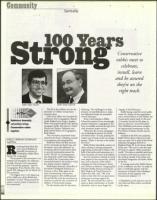
Rabbi Elliot Pachter
•
•
•
•
x* a Is
n in a MEV
al
VA, IN a at al 11
AS a a a IN IN 28
Rabbinical Assembly
convention brings
Conservative rabbis
together.
SHELL' LIEBMAN DORFMAN
StaffWriter
R
eturning home from this
year's annual Rabbinical
Assembly convention in
Philadelphia, Rabbi Elliot
Pachter felt invigorated.
"The purpose of the convention is to
energize and strengthen the rabbinate,
through education and camaraderie,
and it served that purpose," said the
Congregation B'nai Moshe rabbi, who
joined 450 colleagues for the March 26-
30 convention.
"The biggest story is the beginning
of the 100th year of the Rabbinical
Assembly," he said. "Being around for
nearly a century makes a statement to
the community."
4/14
2000
82
•
Conservative
rabbis meet to
celebrate,
install, learn
and be assured
they're on the
right track.
Rabbi Ismar Schorsch
The RA is the rabbinic arm for the
estimated 1.5 million Conservative
American Jews.
Other local rabbis who attended the
conference were Congregation Shaarey
Zedek Rabbis Irwin Groner, Stephen
Weiss and Joseph Krakoff, Adat Shalom
Synagogue Rabbis Efry Spectre, Daniel
Nevins and Herbert Yoskowitz; and
Rabbi David Nelson of Congregation
Beth Shalom.
The convention pinpointed many
issues for the future, including outreach
to young Jews and young families.
Rabbi Joel Roth, the Ms secretary
of the Committee on Jewish Law and
Standards, said it also addressed "an
increasing call for Conservative rabbis
to serve in communities around the
world." He saw "an increasing sense
that the Jewish world wants rabbis in
the mold of the Conservative rabbi,
someone focused on the modern world,
but clearly rooted in tradition."
Rabbi Ismar Schorsch, chancellor of
the Jewish Theological Seminary of
America in New York, spoke to the
issue of maintaining Conservative
Judaism's grasp on the middle ground.
He said the key is for the movement to
continue to push for the conversion of
children of intermarried couples.
He also issued a plea for education,
declaring, "Our challenge is to keep
pressure on local federations to make
sure federation funds are earmarked
toward education."
Some voiced surprise at Rabbi
Schorsch's mention of two increasingly
popular Manhattan congregations that
have successfully attracted younger Jews
with innovative prayer services.
"Most Jews do not join synagogues
out of ideological reasons, but social
and ethical ones," he said, praising the
creative use of music at the two congre-
gations. "Music is the key to the sacred
and God."
Rabbi Pachter described a session on
ethics relating to cloning and genetic
engineering, conducted by those in the
field of bio-ethics and humanities, as a
frank discussion of science and Judaism.
Several resolutions relating to Israel
were passed at the convention, includ-
ing a call to launch a $50 million
campaign for the movement's Israel
arm, known as Masorti. Outgoing RA
President Rabbi Seymour Essrog of
Beth Shalom of Carrol County in
Taylorville, Md., said, "We must
make certain that the next generation
continues its strong support for
Israel." He also stressed the need to
assure a deep commitment to Jewish
education, and to never forget the
tragedy of the Holocaust.
Rabbi Essrog noted the recent publi-
cation of a history of the organization
and a revised edition of Sim Shalom, the
Conservative prayer book. In the next
12 months, he said the RA plans to
share its ideas for a more formalized
Yom HaShoah ritual and to complete
its long-awaited commentary. on the
Five Books of Moses (Torah) and the
haftorot.
Installed as the RNs new president,
Rabbi Vernon Kurtz will serve for the
next two years. He is rabbi of the North
Suburban Synagogue Beth-El in
Highland Park, Ill. In the future, Rabbi
Kurtz said, "We need to raise the need-
ed funds to support rabbis around the
world." He plans to establish task forces
to examine such issues as needs of rab-
bis working outside of the pulpit and
the further integration of women rabbis
in the RA.
A message received by Rabbi Pachter
at the installation was that "we really do
have a worldwide agenda, with the
movement in Buenos Aires, Budapest
and Israel, all tied together with
Conservative Judaism."
❑
A Philadelphia Jewish Exponent story by
Ami Eden and Brian Mono contributed
to this report.