
Getting Eno
' 4
. * .g kick:Nsezz A V '
migposts.a.v.:tan
In a fast-paced world,
sleeping problems are more common, but can be overcome.
RUTHAN BRODSKY
Special to the Jewish News
I
love to sleep," says Caryn
Zilber of West Bloomfield. A
single mother of two teens.
Karen is up at 5:45 a.m., takes
the kids to the bus at 6:45, and drives
to Roeper School in Bloomfield Hills
where she works. "I seldom get the
seven to eight hours of sleep I need. I
try to watch the evening news from
10 to 11, but often fall asleep watch-
ing TV."
The National Sleep Foundation's
1999 survey reported that most of us
are tired all the time. Two-thirds of
adults reported a sleeping problem
and nearly one-quarter of adults
acknowledged having fallen asleep
while driving.
Even for those who had no prob-
lems sleeping, setting aside the time
to get the rest they need was difficult.
"Working with active, bright 4-
year-olds will tire anyone," says Zilber
of her duties at Roeper. "Sometimes I
get to rest when they're taking their
nap. I'm one of those who finds it
easy to fall asleep just about any-
where and on any bed. I seldom get
up in the middle of the night, but I
seem to have my own personal,
built-in clock because I always get
up in the morning just before the
alarm rings."
We spend one-third of our lives
asleep, yet medical research hasn't
been able to define exactly why we
need sleep. At one time, it was spec-
ulated that we sleep because the
brain needed to rest. Today, the the-
ories for why we sleep range from
cell regeneration to immune system
replenishment.
What is known is that while the
body may be resting, the brain is
actually very active during sleep.
Dreaming is one small facet.
Although sleep deprivation is a
ITN
4/7
2000
124
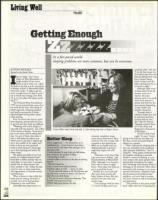
Caryn Zilber helps Emily Ashcraft, 5, relax during nap time at Roeper School.
estions — by themselves or in
ns -- may improve your sleep:
at the same time and get up at
a4
4
It may help you fall asleep,
the quality of sleep.
meals.
ee or tea late in the day or during
,§ 01.
ly.
Akoim
bath
before bedtime.
,s.
a glass of milk — warm or cold.
can't fall asleep in 20-30 minutes, get
mod, or listen to music. Go back to
wh en you feel sleepy.
Try not to worry about not sleeping. That
itself can keep you awake.
lit take naps during the day.
common complaint, many
issues about sleep haven't been
resolved. The one concept well
accepted is that sleep has an
effect on our health and any
sleeping disorder is going to
negatively impact our well
being.
"I function at my best when
I get nine hours of sleep," says
Pamela Markus of Bloomfield
Hills, "although I can function
fairly well on seven or eight
hours. These days, I'm lucky to
get in a good five hours."
Mother of a 2-year-old tod-
dler and a three-month-old
baby, Markus is busy. She also
practices law part-time and
teaches yoga.
•
"I am grumpy with less than
7 1 /2 hours of sleep and I start
catching colds," she says.
"I do my best to get in a
30-minute nap when the
kids are taking their naps
but it doesn't always
work. At least now the
baby is giving me five to
six hours a night."
Although eight hours
of sleep seems to be the
amount most of us
require, the exact
amount each of us needs
varies from person to
person and even for the
same person depending
on age, health and
amount of activity.
"Enough sleep is
whatever makes you feel
fit and alert and func-
tioning well the next
day," says Dr. Harvey
Organek, medical direc-
tor of the Sleep and
Respiratory Association
of Michigan.
"If you've had a bad
night," he says, "you're
going to be tired the next day and
that has a social and psychological
impact on a person.
"More importantly, sleeping disor-
ders can exacerbate and complicate
other physical disabilities," says Dr.
Organek. "Sleep apnea, characterized
by irregular breathing or periodic
breaks in normal breathing, is a pri-
mary reason why many people wake
periodically throughout the night;
their breathing stops because there's a
blockage in the airwaves. Most often
associated with snoring, it can cause
extreme drowsiness, complicate high
blood pressure and cardiovascular
problems, and even lead to strokes
and heart attacks as well as headaches
and depression.
"The problem is that most people
don't realize they have 'a -sleeping dis-
Scanned image of the page. Keyboard directions: use + to zoom in, - to zoom out, arrow keys to pan inside the viewer.
April 07, 2000 - Image 124
- Resource type:
- Text
- Publication:
- The Detroit Jewish News, 2000-04-07
Disclaimer: Computer generated plain text may have errors. Read more about this.