

SPECIAL COMMENTARY
What The Pope Said
AP Photo/Isaac I-Iarari/GPO/ho
Following is the text of Pope John Paul
Its speeches at the Bethlehem heliport in
the Palestinian Autonomous Territory on
March 22 and at the Yad Vashem Holo-
caust Memorial in Jerusalem on March
23, as distributed by the Vatican press
office.
"Your Torment is Before the
Eyes of the World"
Bethlehem Heliport
Dear Chairman Arafat, Your Excellen-
cies, Dear Palestinian Friends,
1. "Here Christ was born of the
Virgin Mary": these words, inscribed
over the place where, according to tra-
dition, Jesus was born, are the reason
for the Great Jubilee of the Year 2000.
They are the reason for my coming to
Bethlehem today. They are the source
of the joy, the hope, the goodwill,
which, for two millennia, have filled
countless human hearts at the very
sound of the name "Bethlehem."
People everywhere turn to this
unique corner of the earth with a hope
that transcends all conflicts and difficul-
ties. Bethlehem — where the choir of
angels sang: "Glory to God in the high-
est, and on earth peace among men"
[Luke 2:14] — stands out, in every place
and in every age, as the promise of
God's gift of peace. The message of
Bethlehem is the Good News of recon-
ciliation among men, of peace at every
level of relations between individuals
and nations. Bethlehem is a universal
crossroads where all peoples can meet to
build together a world worthy of our
human dignity and destiny. The recently
inaugurated Museum of the Nativity
shows how the celebration of Christ's
birth has become a part of the culture
and art of peoples in all parts of the
world.
2. Mr. Arafat, as I thank you for the
warm welcome you have given me in
the name of the Palestinian Authority
and people, I express all my happiness at
being here today. How can I fail to pray
that the divine gift of peace will become
more and more a reality for all who live
in this land, uniquely marked by God's
interventions? Peace for the Palestinian
people! Peace for all the peoples of the
region! No one can ignore how much
the Palestinian people have had to suffer
in recent decades. Your torment is before
the eyes of the world. And it has gone
on too long.
The Holy See has always recognized
that the Palestinian people have the nat-
ural right to a homeland, and the right
to be able to live in peace and tranquilli-
ty with the other peoples of this area [cf.
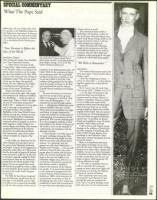
Pope John Paul II greets World War II
death camp survivor, and boyhood friend,
Jerzy Kluger, during a visit to the Yad
Vashem Holocaust Memorial.
Apostolic Letter Redemptionis Anno, 20
April 1984]. In the international forum,
my predecessors and I have repeatedly
proclaimed that there would be no end
to the sad conflict in the Holy Land
without stable guarantees for the rights
of all the peoples involved, on the basis
of international law and the relevant
United Nations resolutions and declara-
tions.
We must all continue to work and
pray for the success of every genuine
effort to bring peace to this land. Only
with a just and lasting peace — not
imposed but secured through negotia.-
don — will legitimate Palestinian aspira-
tions be fulfilled. Only then will the
Holy Land see the possibility of a bright
new future, no longer dissipated by
rivalry and conflict, but firmly based on
understanding and cooperation for the
good of all. The outcome depends great-
ly on the courageous readiness of those
responsible for the destiny of this part of
the world to move to new attitudes of
compromise and compliance with the
demands of justice.
3. Dear friends, I am fully aware of
the great challenges facing the Pales-
tinian Authority and people in every
field of economic and cultural devel-
opment. In a particular way my
prayers are with those Palestinians —
Muslim and Christian — who are still
without a home of their own, their
proper place in society and the possi-
bility of a normal working life. My
hope is that my visit today to the
Dheisheh refugee camp will sen e to
remind the international community
that decisive action is needed to
improve the situation of the Palestin-
ian people. I was particularly pleased
at the unanimous acceptance by the
United Nations of the Resolution on
Bethlehem 2000, which commits the
international community to help in
developing this area and in improving
conditions of peace and reconciliation
in one of the most cherished and sig-
s
nificant places on earth.
The promise of peace made at
Bethlehem will become a reality for
the world only when the dignity and
rights of all human beings made in the
image of God [cf. Genesis 1:26] are
acknowledged and respected.
Today and always the Palestithan
people are in my prayers to the One
who holds the destiny of the world in
his hands. May the Most High God
enlighten, sustain and guide in the path
of peace the whole Palestinian people!
"We Wish to Remember"
Yad Vashem
The words of the ancient psalm rise
from our hearts: "I have-become like a
broken vessel.
I hear the whispering of many —
terror on every side! — as they scheme
together against me, as they plot to
take my life.
But I trust in you, 0 Lord; I say,
`You are my God' " [Psalms 31:13-15].
1. In this place of memories, the
mind and heart and soul feel an
extreme need for silence. Silence in
which to remember. Silence in which
to try to make some sense of the
memories which come flooding back.
Silence because there are no words
strong enough to deplore the terrible
tragedy of the Shoah. My own person-
al memories are of all that happened
when the Nazis occupied Poland dur-
ing the war. I remember my Jewish
friends and neighbors, some of whom
perished, while others survived.
I have come to Yad Vashem to pay
homage to the millions of Jewish peo-
ple who, stripped of everything, espe-
cially of their human dignity, were
murdered in the Holocaust. More
than half a century has passed, but the
memories remain.
Here, as at Auschwitz and many
other places in Europe, we are over-
come by the echo of the heart-rending
laments of so many. Men, women and
children cry out to us from the depths
of the horror that they knew. How can
we fail to heed their cry? No one can
forget or ignore what happened. No
one can diminish its scale.
2. We wish to remember. But we
wish to remember for a purpose,
namely to ensure that never again will
evil prevail, as it did for the millions
of innocent victims of Nazism.
How could man have such utter
contempt for man? Because he had
reached the point of contempt for
God. Only a Godless ideology could
plan and carry out the extermination
WEST MAPLE
WN BIRMINGHAM
48.258.0212
t*:4,
3/31
2000
45