

Following The Leader
ADL's Abe Foxman looks back at 13 years as agency chief.
J.J. GOLDBERG
Special to the Jewish News
New York
N
of long after he took over as national
director of the Anti-Defamation League,
Abraham Foxman was asked to fly to
Geneva to head off an international cri-
sis. It set the tone for what's come since.
It was June 1990. Nelson Mandela, newly
released after 27 years in a South African prison,
was headed to New York for an expected hero's
welcome. A group of Jewish militants planned a
rally, protesting Mandela's links to Muammar
Qaddafi of Libya and Palestinian leader Yasser
Arafat. Fearing a black-Jewish flare-up, civil rights
leaders convinced a Jewish delegation to meet
Mandela en route and hear him out. Some Jews
warned, though, that the mission wouldn't help, as
it consisted entirely of stock liberals.
Just before takeoff, Abe Foxman agreed to join
the mission. A veteran ADL staffer, he had a repu-
tation as a staunch opponent of racial pandering
and as an Israeli security hard-liner. If he found
Mandela "kosher," the opposition would dissolve.
Indeed, Mandela went on to a triumphal
American reception that helped cement South
Africa's peaceful transformation.
A decade later, it's hard to imagine the episode
repeating itself in the same way. Not that Foxman
no longer would shake hands with former foes.
No, he's accepted apologies from political leaders
Pat Robertson and Jesse Jackson, singer Michael
Jackson (for an antisemitic song lyric) and Texas
Governor George W. Bush (for saying Jews can't
enter heaven). Along the way, Foxman all but lost
his hard-liner reputation.
Lately he is displaying his conciliatory side more
and more. Foxman is still a hard-liner by tempera-
ment, particularly around Israel. But he seems
increasingly concerned with, not just how others
treat Jews, but how Jews appear to treat others.
"If you want people to change their minds and
hearts," he says, "you have to be ready to accept it
when they do change."
Last month, he raised hackles by opposing the
isolation of Austria, after Joerg Haider's far-right
Freedom Party entered the government. "Three-
quarters of the Austrian people didn't vote for him,"
Foxman says. [By isolating Austria] "what are we
telling them?"
Last year Foxman caused shock waves by speaking
out against what he saw as an overemphasis on
Holocaust restitution. If things continued, he said,
"the last Holocaust sound bite of the 20th century
could be about money."
J.J. Goldberg is the author of "Jewish Power:" He can
be reached via e-mail at jjg@compuserve.com
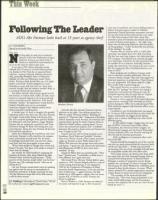
Abraham Foxman
Attitudes like that infuriate Foxman's onetime
admirers on the right. One militant group has a
Web site called "Foxman's Follies," detailing the
treasons of "Dishonest Abe." Supporters of Jonathan
Pollard repeatedly attack Foxman, the American Jew
imprisoned for spying for Israel. Foxrnan refuses to
lobby for Pollard's release, insisting there's "no evi-
dence that antisemitism played a role" in Pollard's
draconian life sentence. Some critics say Foxman has
been "bought by the CIA."
Foxman says he's used to being attacked. Louis
Farrakhan, David Duke and "pontifex" Matthew
Hale of the World Church of the Creator routinely
single out Foxman as their Public Enemy No. 1.
Militia Web sites and chat groups brim with curses
and threats. "I guess you can measure the seriousness
and effectiveness of ADL by how much we're
attacked," he says.
Attacks by fellow Jews are something else. "They
hurt," Foxman says. "I would like to think we're a
little different, but I guess we're not."
After Israeli Prime Minister Yitzhak Rabin's assas-
sination in 1995, Foxman helped push for a code of
civility among Jewish groups. It was adopted in
1996 by the Conference of Presidents of Major
American Jewish Organizations. So far the code has
been invoked once — against Foxman. He had
lashed out in 1998 against a rightist who was accus-
ing the ADL of softness on Israel. Foxman was
forced to apologize.
Born in Warsaw in 1940, Foxman was taken by
his nanny and baptized at age 1, after his parents
were sent to Auschwitz, the German killing center in
Poland. Foxman's parents, leaders in Vladimir
Jabotinsky's Zionist Revisionist movement, survived
the war and retrieved him afterward by court order.
In 1950, they moved to New York, where Abe
attended a series of Orthodox day schools and joined
a series of Zionist youth groups — the right-wing
Betar, then the left-wing Habonim, then the apoliti-
cal Young Judaea. "I wasn't bothered by the severities
of the ideology," he recalls.
Foxman went to work for ADL in 1965, after
receiving a law degree from New York University.
His first case was suing Aramco, the Arab-American
Oil Company. The plaintiff was a Jewish job appli-
cant who'd been warned by the job interviewer that
he wouldn't fit in at Aramco. Ironically, Foxman
recalls, the interviewer "was trying to be nice to him.
But the young man felt it was discriminatory and
came to ADL."
Blunt-speaking and unreflective, Foxrnan rarely
tries to articulate a seamless philosophy. There are
common threads, though. They start with support for
Israel and opposition to antisemitism. They're framed
by a rare pragmatism. He's always ready for a fight.
He's usually ready to patch things up.
This month Foxman was quick to reject Pope
John Paul II's "apology" for church sins, saying it
should have mentioned the Holocaust. Later he
reminded reporters that the pope had an "unparal-
leled" record on Catholic-Jewish relations.
Foxman is a firm supporter of the Israeli-Palestinian
peace process, reversing ADL's staunchly pro-Likud
policies during the 1980s. Yet he defends Israel's West
Bank settlements against Arab-American efforts at eco-
nomic boycott.
Consistent or not, his formulas have vast appeal.
In 13 years as ADL's national director, he's turned the
league, traditionally the biggest Jewish defense_
agency, into a colossus dwarfing every other Jewish
advocacy group.
Its $50 million budget is bigger than the bud-
gets of AIPAC (American Israel Public Affairs
Committee), the American Jewish Congress, the
World Jewish Congress and the Simon Wiesenthal
Center combined. ADL runs diversity training for
the CIA and the German government.
ADL's intelligence on extremists often rivals
that of the FBI.
Foxman himself has emerged as one of the only fig-
ures who can speak authoritatively for American Jewry
and be sure that others — Jewish and non-Jewish —
are listening. He's one of just a handful of Jewish lead-
ers recognizable outside their own office suites.
That unique stature was thrown into sharp relief
last week when the ADL honored Foxman with an
unusual fund-raising dinner. It featured Henry
Kissinger as master of ceremonies and an all-star
speakers list, including CIA director George Tenet
and sex guru Dr. Ruth Westheimer. Celebrities aren't
unusual at fancy Jewish dinners, of course. What's
almost unheard of is a Jewish organization throwing
a fancy dinner to honor one of its own employees.
"I'm a product of the worst and the best,"
Foxman says. "The worst being antisemitism at its
nadir, which killed people, and the best being a
woman who risked her life to save me. How do you
blend the two?"
❑
3/31
2000
20