

Arts Entertainment
Tchaikovsky
C.
V.•
ff
Zs1/4 ' , •
BILL CARROLL
Special to the Jewish News
A
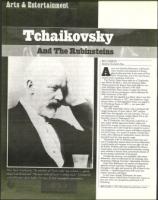
Peter Ilych Tchaikovsky: The premiere of "Swan Lake" was a fiasco — poorly
played and ill-directed "My own lake of Szvan.i.' is simply trash," Tchaikovsky
said of his now-classic ballet. For once, he had misjudged a masterpiece.
nton and Nicholas Rubinstein, well-known
music teachers and composers in Russia,
played influential roles in the career of Peter
Ilyich Tchaikovsky, one of the most famous
classical music composers of all time.
The Detroit Opera House takes on a Tchaikovsky
aura March 30-April 2, when the American Ballet
Theatre presents his famous Swan Lake ballet to con-
clude Michigan Opera Theatre's 1999-2000
DaimlerChrysler Dance Series. It marks the Detroit
debut of an all-new production, which celebrates the
60th anniversary of the ABT.
Swan Lake was regarded as a failure when it was first
performed in Moscow in 1877, then hailed as a huge
success when a re-choreographed version was staged in
St. Petersburg, Russia, in 1895 — two years after
Tchaikovsky's death.
The ABT made ballet history with a landmark full-
length production of Swan Lake in 1967, and has
added new choreography, sets and costumes. The cur-
rent production premieres tonight (March 24) at the
Kennedy Center in Washington, D.C.
But if Tchaikovsky, who reluctantly studied law at
first, hadn't rebelled against his family's wishes and
showed the courage to study music at the St. Petersburg
Conservatory, the world would have missed the numer-
ous symphonies, concertos, operas and ballets composed
over his 53 years. As a master of melody, Tchaikovsky's
works, often reflecting his melancholy nature, also have
provided tunes for many popular songs.
The founder of the St. Petersburg Conservatory and
one of Tchaikovsky's teachers there was Anton Rubinstein,
a superb pianist and composer in his own right. He and
his brother, Nicholas, who later established the Moscow
Conservatory, were of German-Jewish extraction, causing
many students to boycott those conservatories because of
the ever present antisemitism of the period.
Tchaikovsky, however, was enthralled with Anton
Rubinstein, and was influenced by his teachings, later
developing a lifelong "love-hate" relationship with him.
Once when Rubinstein, his teacher of composition,
asked for several variations, Tchaikovsky stayed up
throughout the night and turned in 200 of them in the
morning — transforming Russian folk tunes into
waltzes, mazurkas and fugues.
In later years, though, Rubinstein, for some
unknown reason, helped block Tchaikovsky's request to
have one of his new symphonies performed in St.
Petersburg.
Bill Carroll is a West Bloomfield-based freelance writer.