

This Week
Civil rights activist o ers znsight to
bringing diverse groups into the
21st century together.
SHELLI LIEBMAN DORFMAN
StaffWriter
A
s blacks and whites,
Christians and Jews entered
the Temple Beth El sanctuary
on Tuesday night, they were,
in essence, building the bridge support-
ed by the speaker they came to hear.
While Coretta Scott King, civil
rights and peace activist and:widow of
Dr. Martin Luther King Jr., spoke of
"Building Bridges in the 21st Century,"
members of churches and synagogues
sat side by side to hear her insight on
racial, religious and cultural issues.
Much of Mrs. King's talk included
memories and quotes from her late hus-
band, but her words were interspersed
with strong modern-day variations.
She stressed the importance of see-
ing "Jews and African Americans
working together in the community,
[with] integration not a mixing of col-
ors but a sharing of responsibility."
Flanked by Temple Beth El Rabbi
Daniel Syme and the Rev. Kenneth J.
Flowers of Greater New Mt. Moriah
Missionary Baptist Church in Detroit,
Mrs. King was escorted into the sanc-
tuary, linking the two men of religion.
The program was presented by the
two congregations as well as Metro
Parent Magazine and African American
Parent Magazine and was moderated by
Alyssa Martina, publisher of Metro
Parent Publishing Group.
The evening was a tribute to Beth
El member Isadore "Izzy" Malin, who
died last May. He was a supporter of
bridging religious, racial and cultural
differences. Rabbi Syme described him
as "a giant of social justice," whose
dream was to bring the community
together with Mrs. King.
Event chairs included N. Charles
Anderson; Daniel Krichbaum, execu-
tive director of the National
Conference for Community and Justice
Shelli Liebman Dorfman can be reached
at (248) 354-6060, ext. 246, or by e-mail
at sdolfman@thejewishnews.com
3/24
2000
22
Michigan Region; and Mr.
Malin's wife and children,
Frances Malin and Elaine and
Mark Schonberger.
In speaking of "the power of
the ballot box," Mrs. King
referred to people "who suf-
fered, bled and died so that
you could vote." She added,
"If you don't use your power
for positive change you are
indeed part of the problem."
For Ruthie Maples of
Detroit, this statement hit
home. She is angered when
"people ignore the power to
vote." Coming from
Mississippi, she lived through _
the civil rights era and is dis-
appointed to find "there is
still an issue of not voting" in
her hometown and elsewhere.
Mrs. King showed humor.
In explaining that her hus-
band did not run for presi-
dent "because he was a spiri-
tual and moral leader," she
had intended to continue her
thought with an explanation
that a spiritual leader has a
different agenda than a politi-
cian. But the audience mis-
took her pause for an ending,
and broke out in laughter —
to which, she did the same.
Speaking to a diverse group,
she offered overall sentiment in
wanting to "promote goodwill
of people of all religious cul-
tures in our communities."
But she also spoke to indi-
vidual groups stressing her posi
tive stand on affirmative action.
And staring into the audience
Top to bottom:
of 1,500, she uttered, "As long
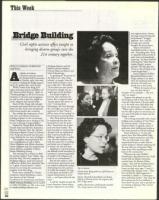
Coretta Scott King,speaks to a full house at
as God gives me breath I will
Temple Beth El.
oppose antisemitism at every
turn — and hope others do the Sharon Mitchell of Southfield and Ruthie
Maples of Detroit discuss the program after
A call for "health security for Mrs. King's speech.
every American, better educa- • Debbie Fleischmann of Plymouth attended
tional, employment and child
Mrs. King's speech with her family.
same."
care opportunities, decent
housing and protecting the
environment" brought
applause. But a call for
stronger gun control
brought the house down.
Sharon Mitchell of
Southfield found it a brave
call. Describing Mrs. King
as "graceful and powerful at
same time and exceedingly
inspiring," she found herself
motivated by "what Martin
Luther King Jr. accom-
plished." But she also sees
"there is a lot of work to do.
I need to get busy"
Stuart Opperer of West
Bloomfield believes Mrs.
King's mission is to share
what her husband said and
she lived. He easily saw
Jewish ties in her words.
"When she spoke of jus-
tice, the first thing I
thought of was tzedaka
she was
right on target."
Opperer was pleased to see the
diverse group and to hear Mrs. King
stress the importance of living togeth-
er. In his work with child abuse and
foster care placement, Opperer said,
"When I get a call from a worker who
has five kids to place in two hours, no
one cares if the kids are black and the
family is white."
The evening concluded with a hand-
holding, joint rendition of "Let There
Be Peace on Earth," led by Cantor
Stephen Dubov. It ignited a show of
politeness, door holding and smiles as
the crowd poured out of the building.
Karen Schwartz, a 17-year-old
senior from West Bloomfield High
School, looked around her and said,
"You can tell people were really
inspired and want to make Martin
Luther King Jr.'s dreams come - true by
the way they are acting now They
came away with something to take
back to the community."
Wiping away tears, Debbie
Fleischmann described how she "held
hands with an African American -
woman from the Detroit Urban
League." She and her husband drove
the distance from their Plymouth
home, so their sons, ages 13 and 11,
could hear Mrs. King's words. "They
have no feel for what happened. I
remember it clearly — I - heard gun-
shots and had a curfew." Her hope for
the evening was for her children to
learn about the past and to partake in
an evening of sharing. They weren't
disappointed.
—
❑