
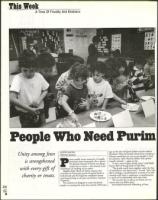

A Time Of Frivolity And Kindness
People Who Need Purim
Unity among Jews
is strengthened
with every gift of
charity or treats.
DAVID SACHS
Editorial Assistant
urim usually rouses memories of megilla,
merriment and masquerade. But a power-
ful spiritual element of Purim not always
comes first to mind — the mitzvah (com-
mandment) of reaching out to others.
Megillat Esther (Book of Esther) requires that
every Jew at Purim give parcels of special foods to
both friends and the forgotten (mishloach manot)
and financial help to the poor and forlorn (matanot
revyonim).
The mitzvot are designed to unite the Jewish
people, re-creating the unity that existed 2,500 years
3/17
2000
6
.
ago in the time of Queen Esther and her relative
Mordecai. Then the horrific threat from murderous
Haman caused Jews to turn as one people to God
for salvation. After Haman's defeat, they sponta-
neously rejoiced — again as one.
"It was a time of great Jewish unity," said Rabbi
Steven Weil of Young Israel of Oak Park.
"The Jewish world came together under the face
of annihilation and destruction," he said. "Not only
did it undergo a transformation in terms of its rela-
tionship with God, it underwent a transformation
in terms of its relationship with each other.
"So not only do we rejoice on Purim, but we
rejoice with our fellow Jews."
Said Rabbi Elimelech Silberberg of Sara