
ANTIQUE JEWELRY
SILVER COINS
POCKET WATCHES
GOLD COINS
COIN COLLECTIONS
TIFFANY
ROLEX WATCHES
FRANKLIN MINT
STICK PINS
STERLING SILVER
SILVER DOLLARS
BROACHES
mammas
ANTIQUE SILVER
SILVER BARS
FLATWARE Sus
DIAMONDS
CANDLESTICKS
GEMSTONES
PAPER MONEY
SCRAP GOLD
PATEK PHILLipE
OBJECTS D'ART
VACHERON
BOWLS fi TRAYS
TEA SERVICES
COIN WATCHES
CARTER
RINGS
VAN cLEEF
POSTCARDS
PIAGET
10-24 KARAT GOLD
PENDANTS
CHAINS
ROYAL DOULTON
EARRINGS
We are kite:Intel in sewing you or your dent
in the appraisal or liquidation of your coins,
jewelry, collectables or an entire estate.
PLEASE CALL OR STOP INI
*4111%
LLD
3/10
2000
112
at, A
The BiG Story
The Torah presumes that the
events of the exodus became
known to the surrounding nations.
Parshat Yitro (Exodus 18:1) records
that Yitro, father-in-law of Moses,
came to join the Jews because he
had heard of the miraculous libera-
tion. The Jews were now regarded
with awe and admiration, and
God's majesty was acknowledged.
In contrast, the Amalekites, also
aware of what had transpired,
demonstrated their loathing of both
God and Israel by launching a
treacherous assault.
Nonetheless, in the Midrash the
rabbis point out that the attack of
Amalek was successful only
because the Jews demonstrated a
lack of faith in God. In the episode
of the demand for water, prior to
the battle with Amalek, the Jews
scold Moses for bringing them out
of Egypt to a place of no water.
The Torah records their words: "Is
God among us or not?" (Exodus
17:7). The Jews' weakness in faith,
the rabbis explain, led to a slacken-
ing in military might. Thus, the for-
tunes of the Jews are tied directly to
the soundness of their faith.
Based on the statement of the
wicked seer, Bilam, in Parshat
Balak (Numbers 24:20), Amalek is
the most evil of nations, while Israel
is the embodiment of good. Thus,
the battle of Amalek and Israel is
the epitome of the eternal struggle
between good and evil.
The Tanach (Jewish Bible) records
many other wars between Israel
and Amalek: in the period of the
Judges, the reigns of King Saul,
King David and King Hezekiah.
In the traditional view, the
Amalekites never were annihilated,
and their descendants continue to
cause trouble for the Jewish people.
The Roman Empire was seen by
many rabbis as Esau's progeny,
and the dispersion of the Jewish
people after the destruction by
Rome of the Second Temple is
referred to in rabbinic literature as
the Exile of Edom (Edom being
another name for Esau).
The rabbis designated this Shab-
I bat, immediately before Purim, as
Shabbat Zachor because Megillat
Esther records that the evil Haman
commandment to remember the evil
of Amalek, every synagogue rabbi •
I demands utter silence from the con-
! gregation as the verses are read. This
mitzvah is so important that some syn-
agogues hold a reading of Parshat
Encyclopedia Judaica
'N'egelpiSp.:§:*.rPia, U.ViN k :,::::. •
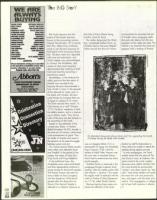
An illustrated manuscript shows Aaron and Hur supporting the hands
of Moses during the bottle with Amalek.
Zachor by itself for latecomers or
was an Agagite (Esther 3:1), a
those otherwise unable to attend the
descendant of Agag, the Amalekite
reading during regular services.
king (I Samuel 15:8). Until the
In most synagogues, the Torah
I advent of Adolf Hitler, Haman was
:reader recites the last verse of Par-
:the only ruler in recorded history
shot Zachor twice. k Hebrew, the
I that'd tried to exterminate the entire
verse contains the word, zecher.
Jewish people.
Because some rabbis maintain that
Shabbat Zachor is observed in the
the word should be pronounced
I synagogue through a special Torah
reading. After the weekly portion (Par- "zecher" and others read it as "zey-
cher," most Torah readers will recite
! shot Vayikra — Leviticus 1-5) is read,
the regular maftir is replaced with the
the verse first with one pronuncia-
tion, and again with the other artic-
maftir of Parshat Ki Tetze (Deuterono-
my 17-19), called Parshat Zachor.
ulation. The congregation is obligat-
ed to hear both versions in silence.
Because hearing these verses con-
stitutes the fulfillment of the Torah
I Ei
Scanned image of the page. Keyboard directions: use + to zoom in, - to zoom out, arrow keys to pan inside the viewer.
March 10, 2000 - Image 112
- Resource type:
- Text
- Publication:
- The Detroit Jewish News, 2000-03-10
Disclaimer: Computer generated plain text may have errors. Read more about this.