

Arts Entertainment
The Last La
ALICE BURDICK SCHWEIGER
Special to the Jewish News
t the U.S. Comedy Arts
Festival in Aspen last
month, comedian Jerry
Lewis was the subject of a
tribute following the pre-
sentation of awards to
female comedians. Asked his opinion of
them, he said, "I don't like any female
comedians. A woman doing comedy doesn't offend
me, but sets me back a bit. ... I think of her as a pro-
ducing machine that brings babies to the world."
Wake up, Jerry. Since the turn of the 20th cen-
tury, American women have kept audiences laugh-
ing out loud. Who are these comediennes who
have struck a humorous chord? Find out in a new
book titled Funny Ladies (Harry N. Abrams;
$29.95), in which author Stephen M. Silverman
profiles more than 75 funny females who have
made their mark.
• "The ending of the 20th century made me think
about all the funny women who have shaped audi-
ences," says Silverman, the editor of People Magazine
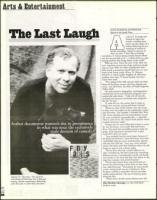
Author documents women's rise to prominence
in what was once the exclusively
male domain of comedy.
e m..
•
T.S
k
AMHARA
STAR VAYA ,
ODD
,RAArrifigt*.?001031k A(RRAVADD.
.§,.: , ,A$11`
•• '
•:
AR DAR
SONAR
URA,Dit“..
1*
, AMAA$36441,
-.AMMA6RAARA'
,ORMADRARt.
...,
DRAM #
DMA**
DDRREV,
,,STIERSAMIR
At A ARA , ;441,N
•.:
Stephen M Silverman: "For all of the
assimilation of American Jews of this past
century, [Jewish comediennes] didn't hide
who they were or where they came from."
3/3
2000
80
Mt.t1A3f.ittifi X
CARR
ARMARY
-,,,,,,
AgARDWIANKRA
144aSSMOKAWSAILSUIR "ftnrirniT
t.q*.nt`t-AION:
Altv Ets,
ULLMAN
RAFERR
:TAA-LIN If
•£1 11*-EXAS
. .
.
. .
A,RAI:DERVARAICA.
.
.
Online Daily.
He read numerous biographies, autobiographies,
watched old movies and television programs, and
studied old radio shows. "I did a lot of research,
surveyed entertainment journalists and comprised
the list," he says.
To make the cut, the women had to make us
laugh,- have uncanny timing and funny material.
"However, some of the women were very funny -
in their time, but might not be considered-so today,"
says Silverman. "For example, I included Mae West,
who wrote comedies and was tremendously success-
ful, even considered a groundbreaker — especially
when it came to sex. But I don't think anyone would
consider her funny today."
Perhaps the two most influential women in come-
dy, says Silverman, were Lucille Ball and Fannie
Brice. They both had incredible .presence, body lan-
guage, facial expressions and knew how to play
material for all it was worth.
"Lucy probably had the most impact because of
the power of television," notes Silverman, who inter-
viewed Ball when he was an entertainment reporter
with the New York Post. "Lucy was a strict discipli-
narian. Her black-and-white half-hour shows are still
being run and are just as funny today.
"Fannie Brice also had a terrific influence on
other comediennes. She had a knack for mimicking
different accents. Coincidentally, Lucille and Fannie
were similar in the sense that they were funny on the
stage but in person were strictly business."
The fact that Fannie Brice was Jewish did not
prevent her from being a major force in show busi-
ness, adds Silverman. "Fortunately for many Jewish
comics, being Jewish was not a hindrance. Show
business, comedy in particular, was one area that
readily embraced Jews. The rest of America didn't
always do that.
"What's more, Jewish comics almost never hid
Alice Burdick Schweiger is a New York-based
freelance writer.