

Sarah's Da ters
Resisting a feminist label, Orthodox
women cite quiet but dramatic changes.
DEBRA NUSSBAUM COHEN
Jewish Telegraphic Agency
New York
IV
hat does it say about a conference on
Orthodoxy and feminism when per-
haps as many as half the participants
insist they are not feminists? It says
that it's an Orthodox conference.
Feminism, described only half-jokingly by one
keynote speaker as "the F-word" in Orthodoxy, is a
loaded term, though that may be as true today for
American women in general as it is for the Orthodox.
The struggle to find a comfortable balance
between progress and tradition was obvious at the
Third International Conference on Feminism and
Orthodoxy, sponsored by the Jewish Orthodox
Feminist Alliance, which drew some 2,000 people to
a New York hotel Sunday and Monday.
But just as obvious was the dramatic impact of
feminism on Orthodox Judaism in general. •
Even those who prefer not to call themselves fem-
inists and do not attribute the changes to feminism
live lives that embrace these changes.
Women who never celebrated their own bat mitzvah
and who never studied the Talmud made sure to bring
their daughters. Many of the daughters even more
vehemently deny the feminist label, although they have
celebrated their bat mitzvah in synagogue, are studying
Talmud in high school and preparing for college.
Indeed, one of the major changes in Orthodoxy is
that a serious Jewish education has become a univer-
sally accepted norm for Orthodox girls.
Changes abound elsewhere as well. In the syna-
gogue, a slowly growing number of Orthodox con-
gregations are instituting changes such as sending a
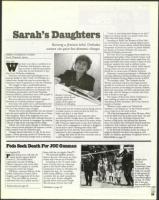
Brandeis University
sociologist Sylvia Barack
Fishman presents her
analysis of the impact of
feminism on Orthodoxy.
Torah scroll into the women's section during services
to enable women to touch and kiss the holy text
before and after it is read aloud.
Some have designed a new sanctuary with a
mechitza (divider) straight down the middle, rather
than putting women at the back of the room; others
offer women an opportunity to join their husbands
in front of the congregation to welcome a daughter's
arrival and to recite a blessing when their child
becomes bar or bat mitzvah. Some permit women to
participate in the congregation's ritual committee.
Changes like these are far from universal, even in
modern Orthodox congregations.
"I wish we were doing these things in our shul,"
sighed one Miami woman at a session where four
rabbis described these changes.
According to Rabbi Saul Berman of New York,
one of Orthodox feminism's leading rabbinic advis-
ers, most of the women seeking counsel from female
interpreters of Jewish law, known as yoatzot Halacha,
are haredi, or fervently Orthodox, the most anti-
feminist Orthodox community
Two New York City synagogues have created con-
gregational internships, where scholarly women work
as teachers of both men and women, speak from the
pulpit and fulfill other duties similar to those of male
seminary students who work as rabbinic interns.
Change has also been felt in Israel, where learned
young women are now serving as interpreters of
Jewish law in certain areas of halachic expertise.
Advances in women's participation in Orthodox life
were also reflected in the four booklets put out by the
Jewish Orthodox Feminist Alliance, known as JOFA.
The booklets, titled "The Orthodox Jewish
Woman and Ritual: Options and Opportunities,"
provide an introduction to Jewish law, new and tra-
ditional customs surrounding bat mitzvah, Shabbat,
death and mourning, and birth, and personal essays
that make clear the changes in women's roles from
even a decade or two ago.
The impact of feminism within Orthodoxy is
even making an impact on language, Blu
Greenberg, JOFA's president, said in her keynote
speech on Sunday.
Whereas women used to sit "behind the
mechitza," now females sit "in the women's section,"
just as males sit in the men's section.
`All of this has happened in a short 30 years, which
is but the blink of an eye as Jews count time," she said.
At the same time, Orthodox feminism has
become a flash point, the defining line between
those who believe that Orthodoxy should synthesize
modernity with tradition, and those who say that
tradition must be insulated from modernity.
In the fervently Orthodox world, the impact of
religious feminism has been only negative, said
Rabbi Avi Shafran, spokesman of Agudath Israel of
DAUGHTERS on page 20
Fels Seek Death For MC Gunman
Los Angeles/JTA
ederal prosecutors will seek the
death penalty against Buford
Furrow Jr., the avowed white
supremacist accused of killing a
Filipino American mail carrier after
he wounded five people at a Jewish
community center last August.
Jeff Rouss, executive director of the
Jewish Community Centers of Los
Angeles, said he approved of the deci-
sion. "This man killed an innocent
individual who was a public servant,"
F
Related editorial: page 29
Rouss told the Los Angeles Times:10'
"He terrorized children and hurt
them at day care. His was an act of ter-
rorism and it was an act of murder."
According to the 15-count indict-
ment, Furrow went on a shooting
spree at the North Valley Jewish
Community Center in suburban Los
Angeles last Aug. 10, wounding
three young children, a teen-aged
counselor and an adult receptionist.
An hour later, Furrow allegedly
gunned down mail carrier Joseph
Ileto because, Furrow later told
GUNMAN
on page 20
Children from
the North
Valley Jewish
Community Center
in Granada Hills,
Calif, are escorted
to safer ground by
Los Angeles Police
Department officers
on Aug. 10, 1999,
after a lone gun-
man wounded five
people at the center.
2/25
2000
19