

eoesi i i
s
Arts Entertal
:
or
14#
Mixed Media
CONEY ISLAND
New
Greek and American Cuisine
OPEN 7 DAYS A WEEK
154 S. Woodward, Birmingham
(248) 540-8780
Not To Be Forgotten
Halsted Village
(37580 W. 12 Mile Rd.)
Farmington Hills
(248) 553-2360
6527 Telegraph Rd.
Corner of Maple (15 Mile)
Bloomfield Township
(248) 646-8568
4763 Haggerty Rd. at Pontiac Trail
West Wind Village Shopping Center
West Bloomfield
(248) 669-2295
841 East Big Beaver, Troy
(248) 680-0094
SOUTHFIELD SOUVLAKI
CONEY ISLAND
Nine Mile & Greenfield
15647 West Nine Mile, Southfield
(248) 569-5229
FARMINGTON SOUVLAKI
CONEY ISLAND
Between 13 & 14 on
Orchard Lake Road
30985 Orchard Lake Rd.
Farmington Hills
(248) 626-9732
UPTOWN PARTHENON
4301 Orchard Lake Rd.
West Bloomfield
(248) 538.6000
HERCULES FAMILY RESTAURANT
33292 Westi2 Mile
Farmington Hills
(248) 489-9777
Serving whitefish, lamb shank,
pastitsio and moussaka
IIIIIIII MIN MI IIIIIIII Mill 1111111
I Receive
1 1110/ 1
,
1111/1 SIM
mg
n ":
ILI /1U
I
I
i
1/21
2000
82
Entire Bill
not to go with any other offer
with coupon
Expires 12/30/2000
me. Ems •in
eviews
I
I
Writer/director Tim Robbins' new
film, Cradle Will Rock (Rated R), opens
nationwide in theaters today. The movie
(which the film proclaims at its begin-
ning is "mostly true") portrays the art
and theater world of 1930s New York
City.
Cradle Will Rock is a tapestry of dif-
ferent stories. Nelson Rockefeller (John
Cusack) commissions Mexican artist
Diego Rivera (Ruben Blades) — whose
murals of autoworkers grace the Detroit
Institute of Arts — to paint the lobby
of Rockefeller Center. Italian propagan-
dist Margherita Sarfatti, a Jewish
woman who is a former mistress of
Mussolini's and a ghostwriter for Hearst
newspaper articles for the Italian dicta-
tor — raises funds for the fascists by
selling art masterpieces to Rockefeller
and his peers. A 22-year-old Orson
Welles (Angus Macfayden) — with the
help of his friend and producer John
Houseman (Cary Elwes) — directs his
Federal Theater group in an infamous
production of The Cradle Will Rock.
The man behind The Cradle Will
Rock was Jewish composer Marc
Blitzstein, who is portrayed in the film
by Hank Azaria. The Jewish actor
recently starred as Mitch Albom in the
TV production of Tuesdays With Morrie.
Blitzstein, notes Azaria, was
"arguably one of the most important -
American composers, although history
has relegated him to a lesser-known sta-
tus than his artistic equals. This, along
with a turbulent personal life, con-
tributed to his image as somewhat of a
sad figure.
"He had as much talent as his best
friends, Leonard Bernstein and Aaron
Copland," says Azaria, "but never
achieved the kind of fame they did."
According to Show Tunes by Steven
Suskin, published this year by Oxford
University Press, Blitzstein, born in
1905 to a prosperous banking family in
Philadelphia, could play piano by ear at
age 3. At 16, he performed as a soloist
with the Philadelphia Philharmonic,
and at 19 wrote his first theater score.
At 21, Blitzstein moved to Europe,
where he studied with Nadia Boulanger
(Aaron Copland's teacher) and Arnold
Schoenberg.
Returning to the United States in the
late 1920s, Blitzstein spent the early
years of the Depression developing his
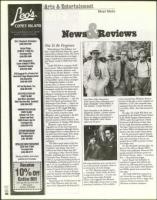
0Cary Elwes (John Houseman),
Hank Azaria (Marc Blitzstein) and
Angus Macfayden (Orson Welles) in
Tim Robbins' "Cradle Will Rock."
Susan Sarandon as the Italian Jew
Margherita Sarfatti, a former mistress
of Mussolini's who raises funds for
fascists by selling art masterpieces to
Nelson Rockefeller (John Cusack,
right) and his peers.
left-wing tendencies and a strong inter-
est in the potential of popular music as
an instrument of social message.
In 1935, Blitzstein played a sketch
— including "Nickel Under the Foot"
(a song of prostitution) — for the visit-
ing German playwright Berthold
Brecht, who suggested that Blitzstein
write a full-length theater piece in song,
showing all members of the establish-
ment as prostitutes. Blitzstein chose as
his hero of the play a union organizer in
Steeltown, U.S.A. (the composer drew
inspiration- from -the riots by autowork-
ers in Flint, Mich., that had occurred in
1936).
The play, The Cradle Will Rock, was
produced by the Federal Theater Project
of the Works Progress Administration
(WPA) under the supervision of John
Houseman (well known in later years
for his tough Harvard law professor in
The Paper Chase) and 22-year-old direc-
tor Orson Welles (the famed actor and
director who later made Citizen Kane).
But the government agency became
nervous after the first preview of Cradle,
and, with censorship in the air, sus-
pended all new WPA activities "to facil-
iate budget cuts."
On the scheduled opening night, the
doors of the sold-out Maxine Elliott
Theatre were padlocked. However, 800
people marched 20 blocks uptown to
the Venice Theatre, where — two hours
late — the. production began.
Actors' Equity had forbidden its
members to appear, but half the cast
showed up, delivering their lines from
their seats in the theater while Blitzstein
and Welles played and narrated from
the stage.
The Cradle Will Rock continued at
the Venice for two weeks. Welles and
Houseman left the WPA to begin their
Mercury Theatre Company, with
Blitzstein as resident composer.