

Arts & Intel
CANDID CONVERSATION from page 73
JN: Is Bugsy Siegel the only Jewish
criminal you're highlighting in your
book?
GC: If marrying a Jewish girl quali-
fies, there's Wyatt Earp. He's buried in
a Jewish cemetery in Los Angeles.
After his very checkered career, he
married a wealthy, Jewish woman
from San Francisco, lived out his life
kind of peacefully with her in
California and asked to be buried
with her.
JN: How did you come up with the
idea for the book?
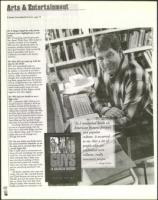
GC: As I researched books on
American historic festivals and popu-
lar culture, it occurred to me that a
lot of people who are celebrated were
villains, really unsavory people. I
thought that would make an interest-
ing book, going back into the historic
record, straightening it out a little bit
and giving people a travel guide to see
where these people hung out and
what remains of their legacy, mostly
negative, but still a legacy.
JN: Why did you decide to use a
light tone?
GC: I adopted a light writing tone
simply because I wanted it to be an
antidote toward all the decades, in
some cases centuries, of glorification
villains have enjoyed. People like Billy
the Kid, Jesse James and Blackbeard
the Pirate have acquired almost heroic
luster over the years, and the people
they killed and the horrible things
that they did are kind of glossed over.
I've always believed, as a columnist
or just as a human being; that the
best way to deal with things you hate
is to ridicule them, and I've tried to
adopt that sort of writing tone
through this book.
JN
1/21
2000
70
JN: Do you think your book covers
the most notorious criminals, or are
the ones you've covered taken from
a much larger list?
GC: I really tried to concentrate on
those who left something that people
could see. I'm sure there were many
other criminals that I didn't men-
tion, but there's nothing of theirs
that has been preserved, nothing
where you can take a trip, pay a visit
and see something associated with
them.
Of all the criminals. who came out
of the '20s and '30s, I picked Bonnie
and Clyde because you can go out to
Nevada and visit the casino and see
the car where they were shot dead.
Meyer Lansky, who certainly was a
baddy and deserves inclusion in the
Ms I researched books on
American historic ftstivals
and popular
culture, it occurred
to me that a lot o f
people who are
celebrated were
villains, really
unsavory people.''
sr
fs a
`7
~
IN AMMAN HISTORY tk
Georga
Cant e r