

TA A4.4ttml 4441 ge4÷/1444
of the
Jewish Home & Aging Services
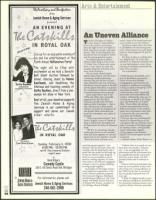
AN EVENING AT
An Uneven Alliance
IN ROYAL OAK
Jcin us fcr an enjcyable evening of
un and live entertainment at the
enth Annual Millionaires Party!
The night will be filled with
excitement as we hold a Borscht
Belt Silent Auction followed by
dinner, dancing, music by Rennie
Kaufmann, and headlining the
hilarious and touching comedy of
Kathy Buckley, direct from a one-
woman hit show in New York.
Best of all, your donation supports
the Jewish Home & Aging
Services in our commitment to
support and serve our Jewish
older adults.
4-chairs
Judil Brad Schram
Sunday, February 6, 2000
tariff: One Hundred Dollars
resort wear
at
Mark Ridley's
Comedy Castle
269 E. 4th Street, Royal Oak, Michigan
JEWISH HOME &
1/14
2000
84
AGING SERVICES Jewish Home & Aging Services
248-661-2999
Iwo honor the legacy of Martin
Luther King Jr., schoolchildren
all over the country are learning
about his fight to win civil rights for
black Americans through nonviolent
protest. They are learning about the
marches he led, the people he rallied
and the stirring speeches he gave.
As students prepare to observe
Martin Luther King Jr. Day on Jan.
17, Rabbi Marc Schneier also wants
them to learn about the close rela-
tionships King had with Jews in his
inner circle of advisers.
His new book, Shared Dreams:
Martin Luther King Jr and The Jewish
Community, details relationships
between King and the Jews and pro-
vides information that was, until now,
little known beyond experts in the field
and the players themselves. It examines
the complicated, sometimes ambivalent
connection between the two groups.
Some today believe that in the
1950s and 1960s, Jews universally
supported the idea that black
Americans should enjoy the same
rights as white Americans -- that it
was a halcyon era in black-Jewish
relations, and only the emergence of
anti-Semitic black nationalists poi-
soned the atmosphere, say experts in
the field.
"That's rosy-eyed nonsense," said
Arthur Magida, author of Prophet of
Rage: A Life of Louis- Farrakhan and
his Nation and the editor of Schneier's
book.
"We love to romanticize this par-
ticular past and say we all marched
hand and hand together, we were all
beaten arm in arm together," he said.
"Some of us were and some of us
and bring people together," says
Schneier, who has formed a close rela-
tionship with the King family and is
proud that the preface to his book was
written by Martin Luther King III. "I
think we can accomplish so much
more by working together. It's some-
what easier to be removed, segregated
and apart, but it's a greater challenge
to bring people together."
As president of the largest interna-
tional rabbinical organization in the
world, Schneier promotes programs
that transcend religious, theological
and ideological differences. He works
closely with Rabbi Dannel Schwartz
of Temple Shir Shalom, president of
the Michigan Board of Rabbis.
weren't. Most of us stayed home and
were cowards in our own fashion."
Questions remain about the realis-
tic possibilities of resurrecting some
sense of fate between Jews and blacks
based on what happened 30 and 40
years ago.
But there is-value in recalling what
was, Magida said. ''To revisit these
episodes is an important reminder that
we once had among us a man whose
yearning for freedom transcended the
color of his own skin."
Let us remember...
• Rabbi Maurice Eisendrath, presi-
dent of the Reform movement's
Union of American Hebrew
Congregations, was forced by his
members to withdraw an invitation
to King to speak at the group's 1959
convention in Miami.
• Most Southern Jews, concerned
about their own vulnerability and
comfort, preferred the status quo to
standing up on behalf of the Negro
cause and resisted the civil rights
effort. Those rabbis who did get
involved were primarily from the
Reform movement in the northern
states; later involvement came from
Conservative Jews and essentially
none from the Orthodox.
• The Jews who were professionally
involved in dismantling racial dis-
crimination, like one of King's closest
aides, University of Michigan gradu-
ate Stanley Levison, were generally
secular rather than religious.
• King argued to the Southern
Baptist Convention against prosely-
tizing Jews.
• A Jewish woman, Esther Brown, in
"I believe there is so much we can
learn from one another," Schneier
says. "I am so anguished over the
polarization and the divisiveness that
has engulfed the Jewish community
both here and in Israel, and that's
[another] battle that I continue to
fight."
-
Schneier believes Jewish-black rela-
tions are not as positive as they were
when King was a strong influence in
the 1960s, but he also is convinced
they are greatly improved since 10
years ago.
"I think the biggest hurdle to posi-
tive relations among Jews and blacks is
the antisemitic pronouncements com-
ing from African American personali-