

thought would be found offensive by
groups of museum visitors.
Another recent exhibit at the
Brooklyn Museum stirred a compara-
ble controversy, but attempts to can-
cel the similarly evocative exhibit
were thwarted.
Unlike Art, which questions the
SUZANNE CHESSLER
Special to the Jewish News
Pho to by Dan iel Lippitt
Photo by Joan Marcus
I
t may not be usual to enter a
theater focused on performance
art and leave discussing fine
art, but that's what often hap-
pens with Art, the next production
coming to the Fisher
Theatre.
The seriocomic play, ulti-
mately about friendship and
values, pivots around a
white-on-white painting .
and whether it is worth
$30,000, the price comfort-
ably paid by one of the
three characters and con-
demned as senseless by
another. The third character
in the play tries to mediate
between the two extremes,
only to cause new subjects
of contention.
Art, starring Judd Hirsch
with Cotter Smith and Jack
Willis, makes its Detroit
stopover Jan. 11-30. French
playwright Yasmina Reza
wrote the Tony Award-win-
ning play, produced in
Europe before premiering
on Broadway. Reza's mother
descended from Hungarian
Jews and her father from
Iranian Jews.
The play hits Michigan
just after much heated con-
troversy about what consti-
tutes art as shown in muse-
ums. It is likely to extend
discussions about a recent
exhibit curated by Jef
Bourgeau for the DIA that
sought to examine and cri-
tique various aspects of con-
temporary art in our soci-
ety. The Detroit Institute of
Arts' new director, Graham
Beal, cancelled the exhibit
based on a display he
and art history at Wayne State
University. "As a teacher, I spend a
lot of time talking about these kinds
of art subjects with colleagues and
students. That happens in a variety
of formats, and that's what education
is all about."
Abt considers the issue of artistic
definitions very different
from the issue of what
should be on exhibit at
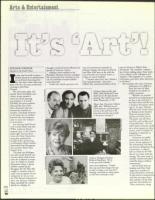
Clockwise from top left: Jack
public museums.
Willis, Judd Hirsch and Cotter
"Whether an artwork
Smith star in the Tony Award-
should be considered good
winning `Art," which runs at the
art has to do with how it
Fisher Theatre Jan. 11-30.
has been done and-the way
Wa ne State University Professor
it looks to the person view-
Jeffrey Abt: "Whether an art-
ing it," he says. "Shortly
work should be considered good
after the turn of the centu-
art has to do with how it has
ry, Russian artist Kazimir
been done and the way it looks
Malevich painted white
to the person viewing it."
squares on white canvas.
The paint was off-white
and left a rich surface and
a beautiful look. On the
other hand, someone could
do a white square on white
canvas, and it wouldn't be
engaging. It depends on
how it's done.
"Museums are public
institutions intended to
serve a broad segment of
the community, and they
can become flashpoints for
controversy. It doesn't
have as much to do with
the art as it does with the
setting. The same work in
ArtServe Michigan President
another context and place
Barbara Kratchman: "Art is
could be shown without
in the eyes of the beholder:"
controversy."
Artist Aviva Robinson: "I think
Art has been seen on
that any work that changes the way
London and New York
we look at things is art even if it's
stages by a number of
shocking, and white on white makes
metro Detroiters involved
us look more intensely at colon"
in the local art community,
and they are open about
their opinion of the play
and how they define art.
Their comments, along
use of conventional materials in
abstract images, the issues in Detroit
and New York have to do with the
use of human and animal waste, at
times on sacred symbols.
"I haven't seen [Art], but I think it
has a good premise," says artist
Jeffrey Abt, associate professor of art