

Arts Entertainment
On The Bookshelf
Beyond
P r op orti
SUZANNE CHESSLER
Special to the Jewish News
tephen Whitfield has spent a good part of
his life pondering the Jewish influence on
both the arts and thinking in the United
States and has spent the last four years
turning his thoughts and research into a book, In
Search of American Jewish Culture (Brandeis
University Press; $26).
Whitfield, a professor of American studies at
Brandeis University, covers the 20th century but
does not suggest his coverage is at all comprehen-
sive. His subject goes back farther than Irving
Berlin's 1919 song "A Pretty Girl Is Like a Melody"
and moves beyond Stephen Spielberg's end-of-the-
century film Schindler's List, all to give an idea of
how Jewish creativity evolved in this country.
"I hope readers will get some
sense of the extraordinary and
resourceful contributions which
Jews have made to American
culture far out of proportion to
their numbers and how differ-
ent American culture is thanks
to what Jews have created in
America and adapted to
America," says Whitfield.
"The book also tries to. suggest
problems that exist in trying to
define what those contributions
are and raises questions about the
future viability and health within
the community itself."
The author, who defines
himself as a committed Reform
Jew, questions whether artistic
assimilation can signal a loss of
Jewish identity.
Whitfield's text, directed toward academic and
nonacademic readers, confines his studies to musi-
cal theater, music and drama and mixes in consid-
erations of race, faith and the Holocaust. He elimi-
nated issues of fiction, poetry and Hollywood films
because of the volumes already exploring these dis-
ciplines and his space limitations. He ignored tele-
vision because of a personal distaste for it.
Author Stephen J. Whi eld
0
1.4
V
looks at the Jewish contribution
to American culture and ponders
its future a er a century of
assimilationist pressure
and mainstream success.
L
tt.1
•
1 it
.
.. ..
...
40,4wzrz‘v*,x4.4"
.
4Z. O . 162 1t$
0.0%.04,
Z 1V
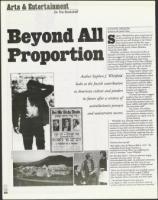
Clockwise from top left:
"Bob Dylan visits the Western Wall in 1971. "He
reclassified the job of pop musician as
audaciously as Lenny Bruce was redefining the
role of a comedian)." writes Whi tfi eld.
Bei Mir Bistu Shein": "From an otherwise largely
concealed minority culture, the song
circumnavigated the globe. An ephemeral community
of immigrants could tap and then revise its own
traditions and somehow manage to satisfy national
and even international cosmopolitan tastes."
"Never was the Jewish family more painfull exposed
than when the Group Theatre staged [Cli ord
Octets] Awake and Sing!' in 1935." From left are
John Garfield, Morris Carnovsky and Stella Adler.
"The Skirball Cultural Center opened in
Los Angeles in 1996, and was intended to evoke the
synthesis of Jewish. creativity and American citizenship."
12/31
1999
84