

Week
t
Birth
A-borni
4
First waves of young Jews
take their free trips to Israel.
AVI MACHLIS
Jewish Telegraphic Agency
Jerusalem
he first of some 6,015 young
people from 12 countries have
begun their free tours of Israel in
a program designed to boost
Jewish identity.
Rabbi Michael Melchior, Israel's minister
for Israeli society and world Jewish - commu-
nities, hailed the launch of Birthright Israel
as a "historic breakthrough" in Israel-dias-
pora relations.
Some 15,000 young Jews applied for the
first 6,000 spots on winter break tours.
The first group of about 170 college
students from Arizona and the B'nai B'rith
Youth Organization started its tour Dec.
19 and 420 more American students were
due to land on Thursday. Israeli Prime
Minister Ehud Barak will address visiting
students on Jan. 8.
The $210 million program, funded by
prominent Jewish philanthropists led by
Charles Bronfman and Michael Steinhardt,
aims to bring 50,000 young, unaffiliated
Jews to Israel over the next five years,
including 16,000 in 2000 alone. The pro-
gram aims to provide 15- to 26-year-olds
with a free, first-time trip to Israel.
Meanwhile, Birthright released a poll
of Israelis that showed nearly 82 percent
of Israelis support in principle giving all
Jewish youth outside Israel an opportuni-
ty to come to the Jewish state. However,
those polled were not asked if they would
support spending Israeli money on the
project.
Melchior fended off criticism from those
who say Israel should not spend taxpayer
money on Birthright at a time when unem-
ployment is on the rise. He said such claims
were "unacceptable" since Israel would have
to "close half the country" if it scrapped all
government spending not aimed at reducing
unemployment.
Melchior said that in the unemploy-
ment-stricken town of Kiryat Malachi, for
example, most public buildings are
backed by money from Jewish philan-
thropists overseas.
"If we want to have donors and people
who take care of Israel's strategic strength,
we must invest in the next generation,"
he said. Fl
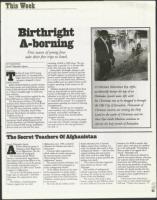
g an
lestinian boy, right,
umps the legs of an
wish man, left, with
— tree as he dragged it through
ti ItiLf
City o erusalem. Thousands of
n tourists are visiting the Holy
weeks of Christmas and the
ew Year while Muslims continue to
t hod Mandl of Ramadan.
The Secret Teachers Of Afghanistan
Jewish Telegraphic Agency
Jewish American group is
helping to fund illegal activ-
ity in Afghanistan: the edu-
cation of young girls.
The American Jewish World
Service, a nonsectarian organization
that supports grass-roots efforts in the
developing world, is one of the groups
that recently contributed money to
the education of 1,000 "secret" female
students in Afghanistan.
"For us as a Jewish group, we put a
high value on education," said Ruth
Messinger, the organization's presi-
dent.
The Taliban, a fundamentalist
Islamic regime that has ruled
A
Afghanistan since 1996, outlawed
education for females soon after it
took power.
A human rights organization,
which wishes to remain anonymous
for security reasons, started the
"Home Schools for Girls in
Afghanistan" project.
The project provides textbooks, and
employs teachers for young girls at
secret underground schools.
"If the Taliban found out the name
of the organization in charge of this
project, its director might get killed,"
said Katie Bell of the Global Fund for
Children, another group contributing
to the project.
Not only did the Taliban outlaw
female education, but it banned
Afghan women from working. As a
result, the females who teach in these
underground schools — who lost their
original teaching jobs and income
when their work was made illegal
place themselves at great personal risk,
perhaps even death.
"The women who have organized
these schools are heroes," said
Messinger.
The number of underground
schools is growing. Currently, there
are about 30, located in the cities of
Herat, Kabul and Jalalabad.
The women, who teach in their
homes, assign the girls different times
to enter and leave, so as not to draw
attention. For $300 a month, they
teach a basic curriculum for students
up to the sixth grade. "Everything is
done to make it not appear like a
school," Messinger said.
Before the women are selected to
teach by the project director, who pays
the women's salaries with funds col-
lected from the AJWS and others,
they discuss the possibility of teaching
with their husbands and extended
families. If a family decides that the.
women should teach, word is spread
throughout their neighborhood to
solicit pupils.
"I don't know how they keep it
secret with so many people knowing,"
Bell said. "They're very creative." 17