

Challenge Of Peace
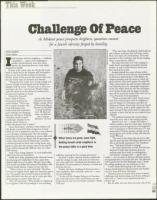
Pho to by AP/Nat i Harnik
As Mideast peace prospects brighten, questions mount
for a Jewish identity forged by hostility.
NEIL RUBIN
Senior Editor
I
srael at peace with her neighbors — suddenly
a possibility — poses a new challenge to
modern Jewish identity, ones that many
experts say American Jews are vastly under-
prepared to handle.
If peace truly comes, they say, the Jewish world
both in Israel and in the diaspora will be forced to
focus on its own divides instead of existential
threats. Some of that process has started, they note,
but the initial steps are tentative and limited.
"The good news is that we're strong enough and
mature enough in both Israel and the diaspora to
grapple with the issues. The bad news is we're just
starting to do that," says Samuel "Buddy" Sislin,
executive director of the Masorti Foundation for
Conservative Judaism in Israel.
Echoes Dr. Kenneth
Jewish settler Sarah
Stein, head of Emory
Gilad from the Golan
University's Institute for
Heights moshav (farm)
Israel Studies: "There may
o f Shaal picks flowers
be a couple of people who
she
grows in her fields.
head federations who
"I
raised my family
understand that Israel-dias-
here.
We built our
pora relations are changing,
home, we built our
but you still have a thinking
lives. I can't go
that Jews remain in peril
elsewhere,"
she said.
worldwide, whether in the
former Soviet Union or
below the poverty line in Israel."
Given the historic volatility of the Mideast and
the deeply entrenched Arab antagonism toward
Israel, no one is prepared to say that a new millenni-
um will assure a lasting peace. But the striking
about-face by Syria in agreeing to resume talks with
Israel after a four-year hiatus, and the growing con-
viction that Israel and the Palestinians can find a
common ground on their most vexing issues, sug-
gests to some that the nation's status in the next 50
years will be dramatically different than in its first
half century.
And if that change happens, it could profoundly
affect how Jews see themselves.
Rabbi Irwin Kula, president of the National Center
for Learning and Leadership (CLAL), argues that,
despite eight years of on-again, off-again peace talks,
Jews haven't yet shifted the narrative that defines 20th
century Jewish identity. It goes, he says, like this:
"'We're victims; we were vulnerable. Therefore,
we have to support Israel, fight anti-Semitism and so
on.' For people who control American Jewish life,
that tells them who they are and it's what gets their
juices going, no matter what they say."
Now, he continued, "What people are beginning
to recognize is that this paradigm is not providing
a 0
MENEM
: v.
ftg gtt
zre,
N
}2S
ft
11
R. M 12 E. Et MM.
When times are good, Jews fight.
Getting Israel's Arab neighbors to
the peace table is a good time.
sufficient meaning for the younger generation."
An Israel at peace, however tenuous, pushes the
need for change, he said. And such new direction
can come only from "hundreds and hundreds and
hundreds" of conversations in America, in Israel and
between the two.
Further, the linear thinking of American Jews —
have a problem, find a solution, move on — must
also be rethought.
"In the end, the changes facing us as American
Jews and Israeli Jews, and a world Jewry, are chal-
lenges that do not have immediate solutions," Rabbi
Kula says.
"They are large, theological, philosophical
and cultural solutions that will only evolve
from new types of conversations. The only
question is how inclusive and broad ranging
those conversations will be."
The talks will need to be wide ranging to
tackle Israel's seemingly intractable internal
divides, as well as those between Israel and
Jews around the world.
Analysts identify four main schisms within
Israel, of which the most obvious and immediate-
ly relevant to American Jews is the debate over
religious pluralism and the extent to which reli-
gious interests will control aspects of secular life.
Other issues include the split between Ashkenazi
and Sephardic Jews, the meaningful integration
of the one million Russians who have immigrat-
ed in the last decade and the degree of equality
that will be assured for Israeli Arabs, who now are
15 to 20 percent of the population.
"Those are huge tasks, which Israel cannot
deal with without peace with its neighbors,"
says Dr. Robert 0. Freedman, president of
Baltimore Hebrew University. American Jewish
leaders, he says, need to push support for the
peace process if they want Israel to make peace
at home, a front that has its own explosive pos-
sibilities.
The political scientist also worries about
American Jews' role in the coming months.
Massive U.S. aid — maybe $15 billion —
will be needed to pay for a final deal. Small but
vocal peace-process opponents, encouraged by
their counterparts in Israel and some U.S. fun-
damentalist Christian groups, already are lob-
bying against such funds, as they did with the
recent Wye aid.
"My worry is that those who are out to sabo-
tage the peace process will bring internecine war-
fare in the Jewish community," Dr. Freedman
says. "That kind of battle is coming."
Yet, there's good news as well. The dire pre-
dictions of some that American Jews are
pulling away from Israel are undergoing a
reevaluation. Younger Jews — age 45 and
under — do not relate to Israel as did their parents
and grandparents, but many still care. The phenom-
enal response for the free Birthright trips to Israel
for college students are one testimony to this.
"I don't think there's going to be some cata-
clysmic break between American Jews and Israelis,"
says Dr. Stein of Emory University.
"American Jews are much more aware of Israel's
challenges and shortcomings, and they're willing to
deal with it. They're more sophisticated than a
decade ago.
But, he adds, the view from the other side of the
12/31
1999
33