

Arts 16 Entertainment
Mon
8 a
The Darndest This
"
n om
A little book opens our eyes to the world of the spirit that children see.
many, When
the Lord
SANDEE BRAWARSKY
Special to the Jewish News
"The world is God's dollhouse
and we're His dolls. He presses
buttons and makes us talk and
walk." -- Elan4,
"I think he's a swarm of colors
that creates life on this planet."
Martin, 10
—
,God is a beautiful lady in a
l white dress. She sits in
coven with Her dress spread all
ound. It covers the earth and
rotects us." -- Tracy, 5
`God lives in the world and in
the Temple, which is His house.
:When die blue light is on over the
Ark where the Torahs are, that
means He's home."
— Richard, 4
"He takes care of me. He's basi-
i:ally like my parents, but He's one
person. I mean, my parents take
care of me, but God takes care of
them, and without God I wouldn't
Avishai, 10
have yarents.
r
Are
.
16.
•
"They're laws for Jewish peo-
ple. Its like our rules on what we
should and should not do, except
some people don't listen to them."
Arielle, 9
-Don't play with matches."
Zachal)4 4
"There's don't commit adultery.
That's what President Clinton
did," --- Ben, 12
"They're like a Jewish golden
rule. Like, thou shalt not take
God's name in covet." — Ricky, 9
"Aren't there 15?" — Allen, 9
72
says, "Yiddishkeit can't survive if left
to those who are callused, academic
and rational. Judaism needs minds like
those of children: fluid and fanciful.
Kids have eyes that can see in the
dark, that can see angels in the shad-
ows, souls inside of bodies, even
honey in the rock. Kids, looking at
religion, see clear through to the origi-
),
nal delight.
Seligman, who has interviewed
many different types of people over
the course of 30 years as a newspaper
and wire service reporter and writer
for the United Nations, says that she
felt "humbled" by the children as sub-
jects. She explains that the difference
sk an adult to tell you
about God or about angels
and he or she is likely to get
tongue-tied, quote a distin-
guished rabbi, or spin out a series of
cryptic sentences. Ask a child and wis-
dom seems to flow, unrehearsed.
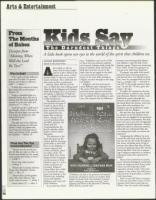
Mommy, When Will the Lord Be
Two: A Child's Eye View of Being Jewish
Today by Ruth Seligman and Jonathan
Mark (Kensington; $11) is a treasure
of wisdom, a collection of "holy say-
ings," as Rabbi Tsvi Blanchard writes
in the introduction.
The speakers are chil-
dren between the ages of
4 and 13, drawn from a
variety of backgrounds,
from across the country.
They speak from the
heart; their words are
direct, cutting to the
core of questions about
the Bible, miracles, the
Torah and Ten
Commandments, the
Jewish calendar, rabbis,
prayer, mitzvot, Israel
and more.
The selections in the
book also point to the
editors' gifts for listening
profoundly to what kids
have to say. Seligman, a
veteran reporter and
writer, and Mark, associ-
ate editor of the The
Jewish Week, New York's
largest Jewish newspaper,
are the parents of three
children, ages 8, 7 and 4,
whose comments are
RUTH SELIGMAN and JONATHAN MARK
included. Seligman,
Introduction by
whose father was a rabbi
Rabbi Tsvi: Blanchard
in Cleveland for many
years, has relatives in the
"[Children] can look at the spiritual and material
Detroit area, including
architecture of Judaism and yet can imagine Eden.
Louis and Madelon
Taught the literal truth, they articulate a response
Seligman and Louis and
that is nothing less than poetry and song," write
Faye Goldman.
Seligman and Mark in the foreward to 'Mommy,
In an interview, Mark
When Will the Lord Be Two?"
between interviewing public figures
and children is that the kids "aren't
playing a game. They're not measuring
their words. They're not going to let
you get away with fuzzy questions."
To prepare, she spoke with several
educators about focusing questions
and learned from one talented teacher
that "even the youngest kids are think-
ing in a complex way" — and that it
was OK "to lob tough questions their
way." So she did. "It was a great edu-
cation," she says.
To collect the comments, she met
with children in yeshivas, day schools
and afternoon Hebrew schools, made
additional contacts through the
Internet and by telephone. Once peo-
ple heard about the project, many par-
ents called with anecdotes, but
Seligman says she preferred to speak
directly with the children.
She says that they found that kids
in schools run by the Reform move-
ment were as engaged by the questions
as their yeshiva counterparts. But kids
who were not in any sort of organized
program of Jewish education, whether
full-time school or afternoon sessions,
often did not understand what she
was asking and could not answer the
questions.
Comparing the children she inter-
viewed for this book and the kids she
has met all over the world throughout
her career, including many living in
poverty, she reflects that they all share
a sense of optimism about life. She has
found that kids who have a smatter-
ing of religious experience or religious
education attach their optimism to
belief."
Many of the comments are jewels,
some read like theological sound bites.
Some are laugh-out-loud funny while
others are awe-inspiring in their
expression of deep truths. They lend
support to the notion that kids have a
natural sense of spirituality, a comfort
with these issues.
Here's 5-year old Tamar on prayer:
"I close my eyes when I pray to God,
because God is like a great big sun.
When I hear the music when people