

Arts Entertainment
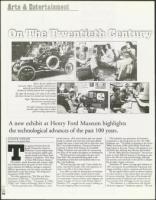
Above: By the middle-teens
and early 1920s, many people embraced cars,
especially rural families who were given
freedom of mobility beyond their imagination.
Top right: By listening to the radio in the 1930s,
Americans became less isolated and more focused.
Right: Television became the primary
form of mass communication
during the 1950s.
Far right: Computer and television
monitors play a large role in today's
youth receiving information.
A new exhibit at Henry Ford Museum highlights
the technological advances of the past 100 years.
SUZANNE CHESSLER
Special to the Jewish News
I
wo groups of seniors from the
Jewish Community Center in
Washtenaw County helped shape
the new permanent exhibit open-
ing this month at the Henry Ford
Museum in Dearborn: Your Place
in Time: 20th Century America."
The exhibit, which showcases this century's high-
tech milestones from the point of view of the con-
sumer, features five different settings to represent
different generations, and the seniors contributed
information to the first setting, "The Progressive
Generation (1900-1930)."
The other segments are "The War and Silent
Generation (1930-50s)," "The Baby Boomers
Generation (1960s-1970s)," "Generation X (1980s-
1990s)" and "Today's Technology (Kids of Today)."
"The first generation has a Nickelodeon, a turn-
1111E
12/24
1999
70
of-the-century, 1907 movie theater that was created
based on research and interviews with quite elderly
people who went to them and told us what they were
like," says Judith Endelman. Director of historical
resources at Henry Ford Museum & Greenfield
Village, Endelman was responsible for maintaining
the vision of the exhibit throughout its development.
"We did interviews with people who grew up in
New York. They remembered being taken to the
Nickelodeon as little kids and described what it was
like," says Endleman.
"We have big signs that read, 'Come inside; five
cents,' and there's actually a film and experience of
what it was like to be in those theaters."
In an effort to make the development of technolo-
gy a very accessible subject, exhibit planners made
sure there were many interactive exercises and immer-
sive experiences. Lawrence Fisher, senior designer and
project manager of Vincent Giulia Design, based in
Brooklyn, N.Y., mapped out the project, building on
his work designing Disney theme parks.
"The [exhibit's] next generation of immersive
environment is the living room on Oct. 30, 1938,"
Endelman says. "The family is listening to the Orson
Welles' broadcast of War of the Worlds, which had a
huge impact at the time. Visitors will experience it as
the family did, thinking that Martians had landed."
For the "Baby Boomers Generation," the environ-
ment is a little different because it's focusing on peo-
ple in the '60s who rejected technology, although
not entirely, and went back to the land for a simpler
life through a hippie commune.
"Generation X" shows a teenage girl's bedroom in
1987 and captures the proliferation of personal tech-
nology, including a phone, computer and boom box.
The last segment allows visitors to observe students,
on video monitors, as they discuss their views and use
of current technology There also will be decades-old
predictions made by celebrities and a chance for visi-
tors tO predict what will happen in the next century.
This exhibition is a collaboration with Popular
Mechanics magazine," Endelman explains. "We had