

Arts & Entertainment
Scul tunes From
W, V
" •
>A0.044V*1**\
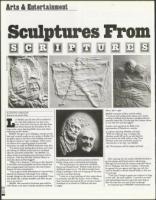
Above, left to right:
SUZANNE CHESSLER
Special to the Jewish News
Bleifeld's conception of Moses with the tablets:
"I've always loved reading about history, and I started
working on biblical stories because I wondered what the
patriarchs looked like. Did they look like Charlton Heston
or were they short and bow-legged?"
L
ee Bleifeld uses the look of live models for
his wall relief sculptures, but they never
pose. Most don't even know that their faces
and forms become the foundation for his
large works, many depicting Bible stories and others
expressing secular themes.
Bleifeld, who grew up in Michigan, recently moved
back and currently works out of a studio in Berkley. He
has gallery space at the front of his building and terms
the space in back an "open workshop," where visitors
can observe how capturing people he personally
encounters can make the biblical characters come alive.
"I've always loved reading about history, and I start-
ed working on biblical stories because I wondered
what the patriarchs looked like," says Bleifeld, 73,
whose artistry encompasses some painting as well as
sculpture. "Did they look like Charlton Heston or
were they short and bow-legged?
"When I do a character, I read up on that character
in the Bible and encyclopedias and [have found] they
were average people who became what they became
because the time necessitated it.
"I try to get as much information as I can and then
identify the character with people I see, making
enough changes so the person is not recognized. I have
one model who is always available, and that's the per-
son in my mirror."
Bleifeld, who returned to his home state with his
wife, Renee, to be close to family, decided to dedicate
2/24
1999
68
Another work ins_pired by the Bible is this
representation of Deborah as a warrior.
A sculpture depicting Abraham and Isaac.
"When the angel says stop, I imagine how
Abraham would lift up his son and hug him
just as hard as he could, which is why I have
Abraham with arms and hands outsized to
call attention to the hug," says Bleifeld.
Left: The artist poses with his sculpture of David
his professional time to creative projects and leaves
behind a long career in advertising and teaching.
"The first pictures I ever drew were of Mickey
Mouse and Donald Duck," Bleifeld recalls about his
childhood interest in art. "My father brought home
things I would get a kick out of copying. As the years
went by, I just kept drawing.
"I went on to copy paintings of other artists shown
in art books, and after the Army, I went to Wayne
State University and took all the art courses I could. I
transferred to art schools in California and then
taught."
After assessing the job market, Bleifeld decided to
go into design and found work in advertising,
although he continued his creative work after hours,
first in Michigan and then in Indiana. Ultimately,
he opened his own agency and kept up with that
until he decided to devote himself solely to fine arts
15 years ago.
"I did a lot of things in paper-cast sculpture to hang
on the wall," the artist explains. "I moved on to work
with polyurethane because it gives the same look as
fiber but takes less time and is hard to damage."
An important part of Bleifeld's work became syna-