

Arts Entertainment
Mixed Media
views
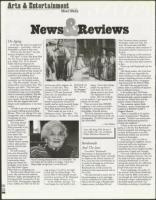
On Aging
At 93 years old, you're not pushy and
opinionated — you're feisty. And Leni
Sonnenfeld is as feisty as they come.
"Did you like the show?" she asks
during a telephone interview.
The "show" is Grow Old Along With
Me: The Poetry of Aging, which airs 8
p.m. Friday, Dec. 10, on Detroit
Public Television-Channel 56.
According to a PBS spokesperson,
the one-hour special offers a series of
positive role models to help "people of
every generation see old age as a rich,
productive and fulfilling time."
Sonnenfeld is not exactly doing
cartwheels over the finished produc-
tion. "The film evolved," she says. "It
started off as a much better idea. That
happy. I have these things
job because of his religion, he Rembrandt van
Rijn: "Jews in
happens very often. They lose their
people my age have; I
took it on full time. They
the Synagogue,"
way. Finally, it has become a collection
work them out. I'm not
immigrated to the United
of celebrities living very comfortably
taking pictures any more.
States in 1939 and discovered 1648, etching.
with no economic problems. The film
The equipment is too
there was "an immediate mar-
is what it is, and it will help PBS get
heavy. But I'm working
ket for their work."
some money. They have these fund
on my archives. I get requests for
They continued to photograph
drives. But the original had much
photos all the time."
Jewish communities around the
deeper social implications; it was more
There are more than 200,000
world, and her work currently hangs
serious.
negatives in her archives and she's
in museums in Washington, D.C.,
"It looks to me now as though it's
looking for a young intern with
New York, Berlin and elsewhere.
just people walking around picking
knowledge of Jewish history.
"Don't make me out to be a
flowers. This is not old age. It's a nice
"The most important constant in
Holocaust victim," she orders. "It's
enough film, and it will please people.
my life has always been my work, my
not relevant to the film. I'm a work-
And people are inter-
photography. It's still the same way,"
ested in celebrities."
says Sonnenfeld.
The show, hosted
— Curt Schleier
by the late Richard
Kiley (ironically in his
Grow Old Along With Me airs 8
last TV appearance)
p.m. Friday, Dec. 10, on Detroit
and Julie Harris, fea-
- Public Television-Channel 56.
tures James Earl
Jones, Hume Cronyn
and opera singer
Shirley Verrett, among
others, talking about
getting old and read-
ing poems.
It's stiff competi-
The exhibit "Rembrandt:
tion, but Sonnenfeld,
Masterpieces in Etching from the
out-feisties everyone,
Morgan Library, New York," currently
as she does her own
on display at the Detroit Institute of
Award-winning photojournalist Leni Sonnenfeld: "Bn
supermarket shop-
Arts, traces the artist's development as
very happy, but my health is not happy. I have these
ping and wheels the
an etcher by focusing on prints from
packages to her home things people my age have; I work them out."
the 1640s and 1650s, when
on New York's Upper
Rembrandt was in full control of a
West Side in a shopping cart.
ing woman. I'm still in my right
medium he first experimented with in
But then she's always been a sur-
mind and I'm doing things. I've
the 1620s.
vivor. She and her late husband,
never liked it when people are pre-
The artist devoted as much time to
Herbert, began photographing the
sented as survivors of the Holocaust.
his printmaking as to his paintings,
German Jewish community in the
It's not a badge of honor, is it?"
and the exhibition's 82 works offer a
late 1930s. Photography originally
At the moment, she says, "I'm
look at the full range of Rembrandt's
was a hobby, but when he lost his
very happy, but my health is not
subject matter, including Old and
Rembrandt
And The Jews
2
1
1999
94
New Testament scenes, portraits,
landscapes, nudes and more. For
many of his portraits and Bible
scenes, Rembrandt asked members of
Amsterdam's Jewish community to sit
for him.
Which brings up a still-unresolved
question that has been plaguing acad-
emics and historians for quite some
time — for more than three centuries
in fact.
What's up with Rembrandt and the
Jews?
The Dutch master, who lived from
1606 to 1669, was responsible for
many well-known works with Jewish
content, including portraits of rabbis,
Jewish wedding scenes, synagogues
and stories from the Hebrew Bible.
But why? Like any good Jewish
debate, there is a plethora of opinions
but no definitive answer.
In his widely cited 1962 book,
History of Art, H.W. Janson writes that
Rembrandt had a special sympathy for
the Jews as "biblical heirs and the
patient victims of persecution."
Pure nonsense, opines Sheila
Braufman, curator of paintings and
sculpture at Berkeley's Judah L.
Magnes Museum.
"How is it possible to be 'patient
victims' of persecution?" Braufman
wonders. "I think it was much more
likely that Rembrandt painted his
friends and neighbors."
If there is one area with little ambi-
guity, it is the fact that Rembrandt
lived in integrated turf. During a par-
ticularly fecund period in his life,
Rembrandt resided near the Jewish
quarter of Amsterdam.
From about 1632 to 1658, he
counted among his neighbors various
artists and well-to-do merchants.
Among the latter were affluent
Sephardic Jews whose families had fled
persecution in Spain and Portugal.
One such individual was Ephraim
Bonus, a physician and poet, who was
the subject of both a painting and an
etching by Rembrandt. It was also
during this period that the influential
Jewish scribe Rabbi Manasseh ben
Israel lived across the street.
Franz Landsberger, the author of
the seminal 1946 volume Rembrandt,
the Jews and the Bible, writes that it
was through the rabbi that Rembrandt
developed a deeper understanding of
the Jewish people and faith. The
friendship, according to Landsberger,