

he also won the Pulitzer Prize.
In September, Simon married
actress Elaine Joyce, with whom he
lives in California, close to his daugh-
ters Ellen, a 42-year-old screenwriter,
and Nancy, 36, a short-story writer,
both of whom have made him a
grandfather.
He recently spoke with the Jewish
News about his career.
JN: Of all your plays, do you have a
favorite?
NS: Not at all. I am working on my
33rd play and after a while things
start to get mixed up in your head.
Sometimes I have a play that I really,
really liked and then [I] see it and say,
`Nah, I could have done better,' and
the opposite it true, too.
I vaguely remember what it was
like writing each play, and the expe-
JN: Your plays have been performed
at the Fisher Theater in Detroit. Were
you there for any of the openings?
NS: I was in Detroit for Sweet Charity,
because that's where we tried it out.
We were there in the middle of the
winter and celebrated New Year's Eve,
but didn't get to tour the city.
JN: The New York Times recently
ran an article about the future of
JN: How does writing a
book compare to writing
a play?
NS: They are nothing
alike. When you write a
play you visualize an audi-
ence of 300-1,100 people,
and when you write a
book you are talking to
one person. It's me talking
to you. In a play you know
the beginning, middle and
end. But in my memoir, I
know the beginning and
middle of my life, but I
don't know the end.
JN: What was the most
difficult part about writ-
ing The Play Goes On?
NS: Making up my mind
what to put in and what
to leave out. When you
write this kind of a book,
you can't put in every-
thing. Some things are too
private, and it's those deci-
sions that are difficult. I
was not about to reveal
anything terrible about
anyone, except in rare
instances where I thought
someone was clearly
wrong.
JN: In Rewrites, you
wrote that there are two reasons for
writing memoirs: One is to pass on
as much as you're willing, and the
other is to discuss the truth about
yourself. Were these your goals in
writing The Play Goes On?
NS: [They were] for the first one,
and at the time I didn't realize there
was going to be a second. When I
was working on Rewrites, I thought
there would be just one book. But
when I got to page 400, and I talked
about my first wife, Joan, dying of
cancer, it wore me out and I didn't
want to go on.
Besides, it would [have been]
about a 700-page book and way too
long. Since a lot happened from
where I left off, I wanted to continue
to the present.
or if the producers won't take a chance
on doing them. But it doesn't mean
that the theater isn't healthy, because
they are making more money than
ever before.
JN: How are your plays doing?
NS: They are doing extremely well in
Europe and other countries because
my plays are done often in schools
and colleges and community theaters.
It's much easier for ama-
teur groups to do a play
than a musical.
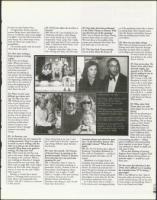
Clockwise from top right:
Neil Simon, ri g ht, with his second
wife, actress Alarsha Mason,
backstage on an opening night
of one bf his plays.
rience of putting it on, but I can't
say I really have a favorite. I guess as
I go along, different plays become
my favorite.
JN: Later this month, The Prisoner
of Second Avenue is opening at the
Jewish Ensemble Theater in Detroit.
Does that play have any particular
meaning for you?
NS: I remember when I wrote it,
but I don't remember anything in
particular. In fact, Prisoner is one of
those plays I had forgotten about
and when I saw it again, I really
liked it. I caught it this past summer
in London, because my ex-wife
Marsha Mason and Richard
Dreyfuss were doing it, and I loved
what they did with it.
JN: Your newest play, The
Dinner Party, about three
divorced couples, just
opened in L.A. Will the
play be making its way to
the New York stage?
NS: I wrote it with Off-
Broadway in mind. All I
want to do is write plays.
I want to write for the
sake of writing. I know
somewhere in the world
they will do it — maybe
in London, maybe in a
small theater in Detroit.
Who knows?
JN: What other Neil
Simon plays can audi-
ences expect to see in the
Neil Simon and Diane Lander,
whom he married and divorced- twice. future?
NS: We are planning to
He adopted her daughter Bow.
do some of my plays in
Sit11011 iilarr ied,for the, ifih time, to
revivals both on and off
actress Elaine Joyce, in September.
Broadway. We are doing
a
play at [New York's]
Neil Simon, surrounded by his
Roundabout
Theater
daughters, Nancy, left, - and Ellen,
called Hotel Suite. It's
right, and their :fiemilies, in East
comprised of four scenes
Hampton, N.Y, 1998.
from California Suite,
Plaza Suite and London
Suite, so it's a new form
American theater and asked the ques-
of presenting my plays — taking
tion, "Is the Broadway theater still a
pieces of different ones and putting
playwright's dream?" What do you
them together in one show. It goes
t hink?
into rehearsal in March or April and
NS: No. It's very hard to get a play on
will open in May.
Broadway. Nowadays [Broadway is]
We are also thinking of putting
like a ride in Disneyland — mostly to
Brighton Beach Memoirs together with
entertain people and make a lot of
Broadway Bound, showing them on
money.
alternate nights — maybe in a year
Broadway is no longer there to
from now
introduce new and great writers, like
we had for 100 years in the American
JN: You wrote for television in the
theater. It's almost all musicals now —
1950s. How difficult was it making
about 90 percent of plays are musicals,
the transition from TV to being a
and about 40 percent of them are
playwright?
revivals. They aren't luring really good
NS: It was difficult in that I had to
playwrights to write plays for the the-
leave the safety of writing with seven
ater because audiences won't come.
terrific writers and go out on my own.
So I don't know who is at fault —
I was trying to do something where a
if the writers aren't writing good plays
lot of my friends had failed.
12/1
199
79