

Spirituality
odox
On
Yes, it's possible to be an observant student
at the University of Michigan.
Sarah Leah
Gottfried of West
Bloomfield said simi-
lar factors drove her
decision to attend U-
M three years ago. "I
wanted to be in an
environment where I
knew that I would
have the opportunity
to continue being
Orthodox," she said.
To address these
needs of observant
students on campus,
U-M's Hillel provides
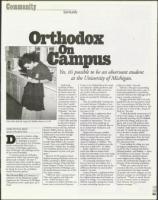
Dena Stein looks for recipes for Shabbat dinner at U-M
an alternative kosher
meal plan, as well as
Orthodox services each day. Michael
SHIRI REVITAL BILIK
Brooks, Hillel's director, said that
Special to the Jewish News
despite its small size, the Orthodox
community is very active through
uring the turbulent college
Hillel and other organizations.
years, students are constant-
"We have what may be the most
ly challenged to preserve
broadly based Hillel in the country,"
their identity. For Orthodox he said, "yet a very small Orthodox
Jewish students like Dena Stein, a
community." Despite this, he added,
University of Michigan sophomore
"the Orthodox presence here is very
from Pittsburgh, this challenge can be
vibrant because it is such a rich pro-
all the more formidable.
gram.
"I wanted a good-size Orthodox
Between 35-50 students attend
community where they weren't strug-
Shabbat morning Orthodox services at
gling to get a minyan," she said. "I
Hillel, according to Rabbi Avraham
wanted to know there would be oppor- Jacobovitz, director of the Oak Park-
tunities for Jewish education outside of based Machon L'Torah: The Jewish
university classes and that there would
Learning Network of Michigan and
be things for me to do on Shabbos
the Jewish Resource Center on U-M's
besides fraternity parties."
Ann Arbor campus.
"Hillel has quite a strong minyan.
Shiri Revital Bilik of Commerce is a
They
stick together and help each
sophomore in the Residential College
other," Rabbi Jacobovitz said.
program at the University of Michigan.
In addition to Hillel, Orthodox stu-
The political science major grew up in
dents
come to the Jewish Resource
Israel.
D
"
Center or to Chabad House for meals
and education. Rabbi Jacobovitz said
that while the JRC offers services to
any student with an interest in
Judaism, many of the center's pro-
grams are attended by Orthodox stu-
dents.
They are comfortable "coming into
our center because, Orthodox or not,
we have no strings attached to our pro-
grams," the rabbi said. "It's cozy, just a
nice place to be."
Stuart Jacobs, a sophomore from
Beachwood, Ohio, said the active
Orthodox community at U-M has
exceeded his expectations. "I'm sur-
prised at how many people go to
Orthodox services. I expected there to
be no kosher food whatsoever, and
there is," he said.
Despite the resources available,
Rabbi Jacobovitz said Orthodox stu-
dents on campus face some special
challenges, such as having to miss
classes on holidays or Shabbat. "But
the vast majority of problems are rela-
tively easy to deal with," he added.
Jacobs, who lives in a fraternity
house that offers no kosher food,
makes his own meals in his room using
kosher deli meat and chicken that his
mother sends from home.
"It's annoying sometimes that I
have to have my own dishes, but I
wouldn't say there's much day-to-day
difference between me and another
student," he said.
Lonnie Schwartz, a sophomore from
Silver Spring, Md., said she has found
her religious observance level harder to
preserve at college. "It is tremendously
difficult, especially coming from Israel,
to retain everything that you try to
hold on to there," she said.
Schwartz, who grew up attending
Jewish day school and spent a year in
Israel upon graduation, nevertheless
said she welcomes the challenges of liv-
ing in a secular community.
"In spite of the fact that I am truly
grateful for the way my parents raised
me, I was starting to feel that the reli-
gious Jewish world was all there is, and
in that way U of M is like a breath of
fresh air," she said.
"I think the Jewish community at U
of M is very unique. I can go to Hillel
on Saturday morning, stay for Kiddush,
go home and change, and go to the
game, and no one will question what
I'm doing in the Orthodox minyan or
whether I really deserve to be there,"
she said. "It would take such guts for
me to do that in another school."
Stein, who was raised Conservative,
said the independence from her back-
ground's influence has strengthened
her observance level.
"I was looking for college as a way
of religious independence, where I
could do what I wanted with kashrut
[keeping kosher], and Shabbat — items
of contention in my house," she said.
Gottfried also said she's become
more religious since college. Now a
senior, she attributes the change to the
diversity of the university population.
"When you come into an envi-
ronment like this, you either become
overwhelmed by the sheer number
of people who aren't religious or you
become stronger in your beliefs," she
explained. "There's so much diversi-
ty and everyone seems so strong in
their identity that you yourself
become stronger." II
oef
12/10
1999
63