

[Charlotte] sees the final version, she'll
be happy with it, too.
JN: Do you ever go back and listen
to the tapes of your conversations
with Morrie?
MA: All the time. I have tapes from
all our 16 or so Tuesdays. They're all
marked, and I know which ones have
which things on them. I listen to
them sometimes in their entirety and
sometimes in little pieces. I even start-
ed bringing down some of the tapes of
Morrie to WJR and playing them on
Tuesday afternoons so people can hear
his voice and be reminded about what
a special opportunity it is to have a
really good teacher in your life.
JN: Did writing that book change
your outlook or way of living, and
has the interest in the film affected
your outlook or way of living?
MA: I hope the experience changed me.
I don't think I take work quite as seri-
ously. I think I have a better perspective
on what really is important in life. I
think I'm a little less afraid of death. I
think I see more value in teachers, older
people and the mentors in our lives. I
think I'm a little kinder, and I think I'm
a little more involved in my community.
That shouldn't be interpreted as a
pat on the back for me as much as it is
a criticism of what I was like before
and how much I probably needed to
change. With all those changes, I still
feel I have a long, long, way to go
before I live up to a lot of the things
that Morrie taught me and wanted me
to be and tried to teach in that book.
The only way the big interest has
affected me is that there are so many
people who want to talk to me about
Morrie, his lessons, ALS, cancer and
death. They want to share some of
those things, and sometimes I don't
feel worthy of that kind of attention
because I'm not a rabbi or a priest. I'm
just a student of a great teacher. I
probably spend a lot more time now
talking about those things than I do
about sports, which is what they used
to want to talk to me about.
JN: Would you rather talk about
these values than sports?
MA: Oh, yeah. There's way too much
talk about sports right now as it is.
JN: Did you find any strength or
comfort in religion as you went
through this with Morrie and as you
coped with your brother's cancer?
MA: Faith has always been a backdrop
of my life. At different times of my
life, I have been more practicing than
others. All my schooling [grew out of]
a strict Jewish background, and it's
always been a big part of my life even
though I don't talk about it or proba-
bly don't present it on a public stage
very much.
Morrie's death and what I went
through with my brother [brought]
the temptation to question how there
can be a God or how you can believe
in religion when such good people are
hit with such bad things. But having
seen the spirit that both of those peo-
ple showed in the light of such terrible
circumstances, I almost have no choice
but to have a stronger belief in God,
because I have to ask where that spirit
came from.
How can people be so upbeat, care
about others so much and overcome
these terrible circumstances with
brightness of spirit if there isn't some
kind of divine force inside everybody?
•
•.•
<,<4
mivs
tv•kvA,;: dsk.
V117: *"w-
W,wM
JN: Do you belong to any religious
organizations or get involved with
any religious activities?
MA: I'm constantly involved with
Jewish activities, being asked to speak
for Jewish organizations, take part on
charity boards and raise money, which
I do. I am a big believer in what I
learned when I was younger about the
levels of tzedakah and the highest one
being you don't talk about what you
do for charity. You just do it. That's
why you don't see my name on a lot
of the things that I do.
JN: Do you belong to a synagogue?
MA: I belong to a synagogue where I
grew up, in South Jersey, just across
the river from Philadelphia. I go back
there for the High Holidays and other
services for one reason. The rabbi
there has been my rabbi since I was a
child. He was the first rabbi I ever
knew, and he still has a cherished
place in my heart like Morrie does.
He's one of the great teachers of my
life, and I always said as long as he's
there, then that's going to be my syna-
gogue even if I have to use an airplane
to get there. He's in his 80s now, but
he's still there and so am I.
JN: How do you feel now about a
comment in your book that
described Morrie as wasting no time
in front of TV sitcoms or movies of
the week as he becomes the subject
of a movie of the week?
MA: I think when I referred to
movies of the week, I meant the very
exploitative ones that involve sex
crimes or someone running off with
the baby-sitter or two lovers in a
'rfAtlyal
° P,
L DecO
_
:,
111&
‘. A
. M4et
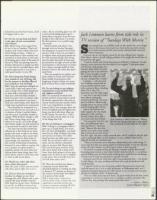
tion feel " m g sorry fc)r 1Vi ante plus
``T had t 0 try to keep t e emotion
UM,11- 10ri said Morrie truly had
it with .Albom, his other students ari
watch the film.
1 equate it with my love for acting,
with the more I do it. It is a noble protession, as
realized somewhere along the line that the key . is not t o
pie but to enlighten them,' Lemmon said.
"You can make them stop and think. All-go AN.rot
a painting to a novel or a poem, you can change or add to "so ernes
That's a very rare privilege that most people don't have." I 1
N
12/3
1999
81