

LESSONS LEARNED
from page 77
ZANNE CHESSLER
Special to the Jewish. News
hen writer-broadcaster Mitch Albom worked on his book
Tuesdays With Morrie, he did not envision that it would touch
so many people and be an international best seller. Certainly, a
made-for-TV movie didn't enter his mind.
Albom's intent was to introduce readers to the engaging personality and heartfelt
values of his former Brandeis University sociology professor, Morrie Schwartz, in a
way that would sell enough copies to pay Schwartz's huge medical expenses. The
former faculty member was fighting amyotrophic lateral sclerosis (known as ALS or
Lou Gehrig's disease), a condition that progressively steals voluntary movement.
The weekly, face-to-face conversations -- on family, regrets, love, death—
shared by professor and student took place long beyond Albom's graduation, adding
depth to some topics they had talked about years earlier. The two reconnected at
Schwartz's home outside Boston after Albom chanced upon a Ted Koppel Nightline
interview showing how the popular teacher was confronting his illness.
Oprah Winfrey was among the 3 million readers who was struck by the relation-
ship and ideas described in the book and decided the subject was right for a movie.
The result will be shown 9-11 p.m. Sunday, Dec. 5, on ABC.
Albom, 41, who reviewed the script at various stages, wanted the film to be an
additional vehicle for benefiting others and is enthtisiastic about the local preview
party to raise funds to combat ALS that was held Dec. 1 at the Star Southfield. The
event comes on the heels of his founding two charities in metro Detroit — The
Dream Fund, which allows disadvantaged children to become involved with the arts,
and A Time to Help, which brings volunteers together for once-a-month projects.
A Detroit Free Press award-winning sportswriter-columnist and WJR radio host,
Albom has written six other books, including collections of his columns and Bo, co
written with former University of Michigan football coach Bo Schembechler as an
autobiography. Also a songwriter, Albom composed "Cookie' for Two" for the
movie Christmas in Connecticut directed by Arnold Schwarzenegger.
Albom, who lives in Franklin with his wife, Janine, spoke about the film, the
book and his religious outlook with the Jewish News:
JN: What was your immediate reac-
tion when you saw the film version
of your book?
MA: My first reaction was how much
Jack Lemmon looked liked Morrie
and reminded me of Morrie. It was
almost a little scary. As the film began
to move along, I was a little uncom-
fortable at first with Hank Azaria as
me. It seemed a little strange to see
characters in the movie calling him
Mitch or calling him Mitch Albom.
As the movie went on, it got more
comfortable, and I realized that this
isn't supposed to be "me" the person or
"Morrie" the person. This is a dramati-
zation of what the story was about, and
in that, I think the movie does a very
good job of capturing the spirit of the
love between my old professor and me.
should not be pitied, pushed aside or
ignored as just another sick person.
Even though they may have a terminal
illness, there's still a lot that they have
to give, and there's a lot that we can
learn. Morrie proved that the disease is
an inconvenience, even a handicap, but
not anything that hindered his spirit.
I also hope viewers see that once
you have a great relationship with a
teacher, someone who really affected
you in your life, you never lose that
relationship. If you start it up again, if
you have lost touch, you can rekindle
a lot of what was special about it the
first time around. I just hope that peo-
ple have a chance to see that when
somebody special in your life dies, it's
as Morrie said, "Death ends a life but
not a relationship."
JN: What do you hope viewers will
get out of seeing the film?
MA: I hope it shows that people who
have ALS and other illnesses like that
JN: Did you have any input into the
production of the film?
MA: At first, they were interested in
having me write the script. It was a
A:::0:12rX -1:VM
difficult, painful thing for me to
JN: Have you talked to Morrie's fami-
write the book, and I didn't want to
ly since the making of the film and
go through it again to write the
learned their reaction?
script. When they chose the screen-
MA: I talk to them regularly and visit
writer, they had us meet a number
with them regularly since Morrie's
of times, and I got to know him
death. They're friends of mine. I don't
pretty well. When
know that Charlotte
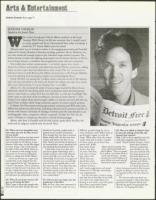
Above: Award-winning "Free
they chose Hank
(Morrie's widow) has
Press" sportswriter/columnist
Azaria, they had
seen the film yet. She
Mitch Albom: "How can people also was involved with
me meet with him,
be so upbeat, care about others so the script process and
and I got to know
much and overcome ...terrible
him pretty well.
had some final say on
circumstances
with brightness of the things having to do
When they pro-
spirit if there isn't some kind of with her and Morrie.
duced the script,
divine force inside everybody?"
they sent it to me a
They've been nervous,
number of times,
as I think all of us are,
and I made suggestions and raised
about being portrayed in film because
objections if I thought something
people are going to assume that the
was inappropriate.
real people are like the ones they saw
For the most part, I tried to recog-
on TV.
nize that this is their film of my book.
We want to make sure there are
So I tried to be careful about not
accurate portrayals. I think they did a
butting in too much. I sort of trusted
good job with Morrie's family and
their vision, particularly Oprah
showed the good, loving people that
Winfrey's and the director's.
they are. I'm hoping that when