

Chanuka
1
1:6
A665
HoliDaYs
C hr
Chanuka
( PT
P1
19 • • On
ri
Festiv
Ofiik
•
were in his favor: his army was much
larger than that of Judah Maccabee.
Yet once again Judah was victori-
ous in a huge battle at Beth-Zur.
This opened the doors for the Jew-
ish army to head into Jerusalem,
where Judah purified the Temple
and established an eight-day holi-
day known as Chanuka.
The story doesn't end here, though.
After the victory in Jerusalem,
Judah learned that Antiochus' forces
had attacked Jewish populations in
other areas of the kingdom, includ-
ing Gilead, Transjordan and the
Galilee. Working with his brothers
Simeon and Jonathan, Judah suc-
cessfully defended the Jewish com-
munities in these areas, as well as
advancing to Hebron.
Antiochus, meanwhile, had died
— leaving his 9-year-old son, Anti-
ochus Eupator, in charge. The new
king (who would be murdered two
years later by his cousin, Demetrius)
couldn't have been too optimistic
as he took charge: his military train-
ing had been at the hands of none
other than Lysias.
But things were about to change
— for the worse — for Judah and his
brothers.
Lysias began a new attack on
Judah, and this time he was success-
ful. In fact, he forced the Jewish-army
all the way back to Jerusalem. Judah
was holding up at Mount Zion where
• he had virtually no food or provisions.
Would this be the end of Judah
Maccabee? No.
Just as Judah must certainly have
been prepared for a terrible
defeat, yet another figure enters the
story. Lysias learned that another
Syrian leader, Philip, was eager to
assume power himself.
Apparently, Lysias realized he
couldn't battle two enemies at the
same time. He opted to make peace
with the Jews, and restored the reli-
gious freedoms Antiochus had
denied them.
This is, at least, what most scholars
believe happened.
There's another account of Judah
Maccabee's life. In this version, there
are few differences about exactly
what happened and when.
The key issue, however, is that the
story doesn't end with peace
between Lysias and Judah, but rather
there's another war. In this second
account, Judah leads a battle at a
place called Elasa (don't bother look-
ing for it on any map; to this day, no
one knows where it was). Here, his
army is defeated-and Judah is killed.
His body is then taken and buried in
the family tomb in Modi'in.
Though Judah Maccabee is, of
course, a Jewish hero, he has
inspired any number of gentile writ-
ers, as well. In fact, the first written
account of his life (outside the Books
of the Maccabees in the Apocrypha,
which is our only source for the story)
was Judas Maccabaeus, written by
William Houghton and first per-
formed in about 1600. The text has
since disappeared.
French and Italian authors present-
ed their versions of the story in the
17th century, then in 1872 Ameri-
can poet Henry Wadsworth Longfel-
low composed what is probably the
best-known contemporary account of
Judah Maccabee's adventures,
called Judas Maccabaeus.
Artists, too, have been inspirec by
the military prowess of Judah.
Rubens painted Judah Maccabee
praying for the dead, while 19th-cen-
tury painter Paul Gustave Dore creat-
ed an engraving that showed Judah
victorious over the Syrian army.
In the 18th century, Handel was
inspired to write an oratorio called
Judas Maccabaeus, which opened
in London in 1747. His inspiration
wasn't the story of Judah alone, but
rather a contemporary battle: The
Duke of Cumberland had just beaten
Jacobite rebels of Scotland at the Bat-
tle of Culloden. Apparently, Handel
saw a parallel between the Duke
and Judah. Whatever the reason for
the composition, Handel's Judah
Maccabaeus remains one of the
most popular pieces of music per-
formed in Israel. Li
Festiv
ts
is ht Facts For
fig ht Nights
Elizabeth Applebaum
1. Though some Jews consider "free-__
dom" the central theme of Chanuka,
Judah Maccabee and his army were
not fighting to be free. They were
fighting for the right of Jews to live
according to the Torah.
7. No doubt you've heard the story
about ancientJews (or, in some ver-
sions, it's their children) sitting around
playing dreidel. Why? They were
actually studying Torah, but because
this was forbidden, the Jews would
bring out dreidels whenever soldiers
z
2. Another misconception
about the holiday is that
gift-giving is an integral
part of the celebration.
There is absolutely no
halachic or historical rea-
son for giving presents at
Chanuka. Instead, Jews
have copied the idea from
another popular holiday
that happens to occur
around the same time:
Christmas.
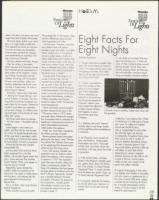
Chanuka means candles, latkes and many edi-
ble goodies.
3. In Hebrew, the word "menora"
actually refers to any lamp. Israelis
call the eight-branched candelabrum
a chanukia.
4. At Chanuka, many Israeli citi-
zens visit Modi'in, where Judah
Maccabee was born. They light
torches and carry them down the
mountains until they reach the Kotel
in Jerusalem.
5. In the Unitec States, and else-
where in the diaspora, dreidels read
nes, gadol, haya, sham, the first let-
ters in the phrase, "A Great Miracle
Happened There." In Israel, dreidels
have the letters nes, gadol, haya, po,
"A Great Miracle Happened Here."
6. To properly celebrate the holiday,
you should place your menora in a
window that can be seen from the
outside.
walked by. If you believe this, I'd like
to interest you in a little piece of prop-
erty I own. It's caller Los Angeles.
Now here's the REAL story.
One is not permitted to work while
the Chanuka lights are burning.
Consequently, throughout history Jews
have come up with a number of
ways to entertain themselves during
this time. A popular game in Ger-
many had players spinning a little top
with letters on each side which,
depending on where it stopped,
directed someone to take half, or all,
or give to the pot. German Jews
made up their own version of the
game and called it dreidel.
8. Instead of engaging in that ridicu-
lous debate over whether to top latkes
with sour cream or applesauce (or, in
the case of some Polish Jews, sugar),
consider the real meaning of Chanu-
ka. Is it Judah Maccabee's military
victory or God's miracle of oil that
lasted for eight days? 0
12/3
1999