

MICHAEL J. JORDAN
Jewish Telegraphic Agency
lel
Pristina, Yugoslavia
aving endured 10 years of
oppression and the largest
expulsion in Europe since
the Holocaust, the
Albanians of Kosovo often draw paral-
lels between themselves and Jews.
So it was little surprise to Greta
Kacinari that Jews would be among
those lending a hand in Kosovo, the
war-torn southern province of
Yugoslavia.
Despite the near absence of Jews in
Kosovo, the American Jewish Joint
Distribution Committee has rebuilt
many of its schools.
"I know a lot of Jews, and I know
they have helped each other in times
of need," said Kacinari, principal of
Elena Gjika Primary School. "But the
really amazing thing to me is there's
also something in their blood for them
to help people who are in a similar sit-
uation as Jews were in during their
history.
Kacinari's is one of 14 primary
schools in Kosovo's capital, Pristina.
All of them and in the countryside
have suffered years of neglect and van-
dalism, and later, war. Meanwhile, as
the Balkans have convulsed with one
crisis after another this decade, Jewish
groups have not only assisted the small
Jewish communities in the region, but
they have emerged as key supporters
of the overall relief effort.
Leading the way is the JDC. It
pitched in $1.25 million for the
Albanian refugee camps in Macedonia
and Albania earlier this year. Then,
when it expressed an interest in
Kosovo's primary schools late this
Helping Hearts
0
0
8
33
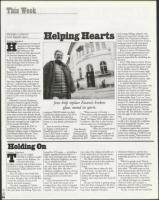
Jews help replace Kosovo's broken
glass, mend its spirit.
"When you say it 10 times —
summer, UNICEF asked it to help
`We're here to help the people because
rebuild the infrastructure of all 14 in
we care' — it loses its strength," says
Pristina. The JDC also selected a
Israeli Nir Baron, JDC's administrator
school in the southern city of Prizren,
in Kosovo. "But that is why I'm here,
home to a tiny Jewish community of
and to make sure everything gets to
40.
the right people."
Since its arrival in Kosovo
There are certainly plenty
in August, a small team of
Greta Kacinari,
of needy recipients.
Israelis has spent $1.1 mil-
principal of a
Kosovo, legally still part of
lion of JDC funds to replace
Pristina primary
Yugoslavia,
is wracked with
broken glass, doors and toi-
school rebuilt with
help from the JDC. violent crime, lawlessness
lets, among other projects.
and revenge killings, plagued with
daily power and water outages, and
saddled with 70 percent unemploy-
ment. A tour of the province reveals a
landscape scarred with mass graves
and land mines, and littered with
burned-out homes and businesses.
Kosovo is now a UN protectorate,
with its massive administration and
hundreds of relief agencies on the
ground responsible for rebuilding the
province.
Since 1989, Kosovo and its 90-per-
cent ethnic Albanian population lived
within an apartheid-like system ruled
by the Serbian minority. Albanians
were kicked out of universities, high
schools and most primary schools. In
response, the Albanian community
created a parallel school system, oper-
ated mostly out of private homes.
In schools like Kacinari's, the
Albanians were allowed to remain. But
anywhere from 750 to 900 school-
children were forced into half a wing.
As there were only nine classrooms,
teachers and students came to school
in three shifts, from 7 a.m. to 7P .m.
Meanwhile, the 350 Serb students had
access to 25 rooms, the gymnasium
and luxury items, such as microscopes.
When the Serb teachers and stu-
dents left school at 2 p.m., the heat
was shut off. The Albanians continued
into the night in the cold, Kacinari
says.
"I don't wish for anyone in the
world to live through the conditions
we lived through for 10 years," says
Kacinari in fluent English.
Repression against the province's
1.8 million Albanians grew progres-
sively worse, leading to NATO's inter-
vention this spring. Three months of
U.S.-led air strikes finally forced the
Boldin g On
Prizren, Yugoslavia
his city of roughly
150,000 is a historic trade
center in the Balkans. Its
centuries-old stone
bridges, mosques and wooden homes
framed by a range of densely forest-
ed mountains made it Kosovo's most
charming city.
Jews are said to have lived here
for centuries. There is no synagogue
in town, though a Star of David dec-
orates the minaret of one of the
town's old stone mosques.
The Serb campaign of "ethnic
cleansing" last spring forced most of
the city's Jews into hiding. Now, pro-
T
i.
12/3
1999
24
tected by UN troops — including a
highly regarded German force —
they have reemerged and, like their
ethnic Albanian neighbors, are seek-
ing to rebuild their lives.
Votim Demiri, the president of
the city's Jews, says the first need is
for jobs. Most Jews, like their
Albanian neighbors, eke out a living,
accepting food staples like flour and
cooking oil from humanitarian
groups.
Only one-quarter of the commu-
nity's 27 adults has found work,
ranging from shop clerk to hospital
worker. The average salary is $78 per
month — barely enough even in a
city where the collapse of public ser-
vices means that no one pays taxes,
or for gas, electricity and water.
The black market is thriving. But
Demiri says no one in his communi-
ty is drawn to the hustle of the
streets.
"We don't have a talent for this
kind of work," he says with a smile.
"It's impossible for me to go to
Turkey, fill up bags with cheap
clothes, then come back here and sell
them."
He says his family is getting along
fine: he's been reinstated as the direc-
tor of a local textile factory, a job he
lost when Yugoslav President
Slobodan Milosevic and his lieu-
tenants purged all "Albanians" from
leadership positions in 1989 and
1990.
What his people need, Demiri
says, are not handouts, but machines
to start up small businesses, like a
hair salon. We don't want to live
from humanitarian aid forever; peo-
ple in Kosovo know how to work
hard to make a living," he says.
Jewish identity here is not clear-
cut. Mixed marriages are common:
Demiri's father, for example, is
Albanian, and his wife is "something
between Albanian and Turkish."
Yet his 22-year-old son would like